The dead are
often very present in fairy tales: they have agency from beyond the grave. Some
return in bodily form, in gratitude for favours done, or out of concern
for the child they have left behind, or more simply to bid farewell to those
who loved them. Some come in dreams. And sometimes their presence is more
subtly expressed through the trees or flowers which spring from their graves.
The
tales in which the hero pays for a dead man’s burial [The Grateful Dead Man: AT E341.1] are at least as old as the
apocryphal Book of Tobit, dated 3rd or 2nd century BCE. Tobit,
living in Ninevah, piously buries the murdered body of a fellow Jew, but that
night he is blinded by sparrow droppings which fall into his eyes as he sleeps
in the courtyard. Tobit prays God to release him from misery or else give him merciful
death, while in distant Ecbatana, a young Jewish woman called Sarah is in even worse
trouble. She’s been married seven times to seven husbands, for on each wedding
night the demon Asmodeus arrives and kills the man before the union can be
consummated. Accused of their murders, Sarah too prays for either assistance or
death. Spotting an opportunity to kill two birds with one stone, God sends the angel
Raphael to help both her and Tobit.
Ignorant
of this, Tobit sends his son Tobias to fetch some money he deposited years previously
with a colleague in a far-off town, Rages (near present-day Tehran). Tobias has
never travelled, so Raphael disguises himself as a distant kinsman and offers
to guide him. I love the next bit: ‘The boy and the angel left the house
together, and the dog came out with him and accompanied them.’ (Please note the little dog in the bottom left-hand corner of this painting!)

We
are now well into fairy tale territory: a huge fish jumps from the river to
bite Tobias’s foot. The angel tells the boy to split the fish open and take its
gall, heart and liver: the heart and liver can be used to fumigate anyone
attacked by a demon, while the gall will cure blindness. Raphael guides Tobias
to Sarah’s house in Ecbatana and advises the boy to marry her. Having heard the
rumours Tobias hesitates, but the angel tells him to place the fishy heart and
liver on the incense burner in the bridal chamber: ‘When the demon smells it he
will make off and never be seen here any more.’ Success! Asmodeus flees to
Upper Egypt where Raphael overtakes and binds him, while the young couple pray
and sleep together in peace. Next, Tobias and Raphael go on to Rages, collect
Tobit’s silver and return to Ninevah, where you’ll be pleased to know, ‘The dog
went in with the angel and Tobias, following at their heels.’ (Faithful little
dog!) Using the fish gall, Tobias restores Tobit’s sight and tells his
rejoicing parents that their new daughter-in-law is on her way. Finally he
offers to reward his faithful companion with half of all that he has won, but Raphael
reveals himself: ‘I am Raphael, one of the seven
angels who stand in attendance on the Lord and enter his glorious presence.’
Aspects of this story differ from later fairy tales: it names real places (albeit with a shaky
grasp of the map), the person who buries the dead man is not the same person who
goes on the journey, and an angel accompanies Tobias, not the dead man’s ghost.
But the similarities are obvious, and most variants also include the rich young
woman whose previous suitors have all been killed, the supernatural agent
whose malignity brings about their deaths [The
Monster in the Bridal Chamber, AT 507B] – along with the boy’s marriage and
offer to split his wealth with his benefactor.
The best known fairy tale version is Hans Christian Andersen's The Travelling Companion. After paying the debts of a dead man, young Johannes is joined on the road by the travelling companion of the title, who helps him marry a princess whose suitors must answer three riddles, or die.

I was entranced as a child by Andersen’s description of the wicked princess who flies out of the castle on black wings to visit her lover – a troll king whose throne is supported on four skeleton horses with harnesses made of glittering red spiders. The travelling companion flies invisibly after her on white swan-wings, slashing her with a birch switch, the stinging blows of which she assumes to be hailstones. He learns the answers to the three riddles, kills the troll and disenchants the princess – who ‘was still a witch and didn’t love Johannes at all.’ Giving Johannes a bottle of liquid and three white swan feathers, the travelling companion tells him to pour the liquid into a tub of water by the marriage bed, cast the feathers on the water and duck the princess three times. She first turns into a black swan with fiery eyes, then into a white swan with a black ring around its neck, and last into a lovely princess who thanks him for breaking the spell. Johannes begs his companion to stay with them for ever, but he replies:
‘No, I must go. I have but paid my debt. Do you
remember the dead man whom you protected from wicked men in the church? You
gave all you had so he might rest in his grave. I am that dead man.’ And with
that he vanished.
A more laconic
version is Beauty of the World, told
to William Larminie by Patrick Minahan of Mainmore, County Donegal and
reproduced in ‘West Irish Folktales’ (1893).
There was a king then, and he had but one son. He
was out hunting. He was going past the churchyard. There were four men in the
churchyard and a corpse. There was debt on the corpse. The king’s son went in.
He asked what was the matter.
The king’s son
pays all the money in his purse (five pounds!) for the body to be buried, and
shortly after is joined by a red-haired man who, on condition that his wages
will be ‘half of all we gain, to the end of a year and a day’, sets out with
him to find the beautiful woman ‘with a head as black as a raven’s wing and her
skin as white as snow and her cheeks as red as the blood on the snow’ on whom
the king’s son has set his heart. Along the way, the red man wins three magical
objects from three giants: the ‘dark cloak’ of invisibility, ‘the slippery
shoes’, and ‘the sword of light’. And he warns the king’s son that his
wished-for bride is ferocious: ‘the woman you are approaching – there is not a
tree in the wood on which a man’s head is not hung, except one tree which is
waiting for your head.’
Each
night this woman, the eponymous Beauty of the World, presents the king’s son
with an object – a comb, a pair of scissors – and tells him that if he cannot
show it to her next morning, she will have his head. Each night, the young man
loses it.
He took hold of the comb. He put it down in his
pocket. When they were going to bed, the red man said, ‘See if you have the
comb.’ He put his fingers in his pocket. He had not the comb. His tears fell.
But clad in the
dark cloak and slippery shoes, and seizing the sword of light, the red man
follows the princess as she rows a cockleshell boat out to an island in the sea
where a giant lives. She gives the giant the comb, shares a drink of milk and
blood, and lies down to sleep with him. The red man steals the comb, so next
day the king’s son is able to show it to the woman, who in fury breaks half the
dishes on the table. He does the same for the scissors, and ‘there was not a
bit of delf on the table she did not break in her rage’. For the final test the
princess demands that the king’s son show her the last pair of lips she kissed.
The red man ‘whisks off’ the giant’s head with the sword of light, and the
king’s son produces it next day:
When she saw the giant was dead she gave one sweep,
and she left not a chair or a table, nor anything on the table she did not make
a smash of, so great was her anger.
I like her
energy, but the convention in these tales is that the spell or evil spirit
which causes the princess’s wickedness can only be driven out by thrashing her.
Even Hans Andersen retains a version of this; his travelling companion thrashes
the princess as they fly through the air, but he softens the ending when the
princess is plunged into water as a kind of baptism. In Beauty of the World the king’s son and
her father beat the princess until ‘a blaze of fire came out of her mouth’.
They strike again till ‘another lump of fire came out’, and then a third.
‘Now,’ said the red man, ‘strike her no more. Those
were the three devils that came out of her. Loose her now; she is as quiet as
any woman in the world.’ They loosed her and put her to bed. She was tired
after the beating.
No matter how
wicked the princess may have been, this does not make comfortable reading today, nor the moment a year after the wedding when the red man claims half of the
couple’s little son. It’s a test of the hero’s faithfulness to his word, for
as, like Abraham with Isaac, he draws his knife to cut the child in two, the
red man stops him.
‘Do you remember the day you were going past the
churchyard? … You had five pounds. You gave them to bury the corpse. It was I
in the coffin that day. […] Health be with you and blessing. You will set eyes
upon me no more.’
Even
bare bones may have agency in fairy tales. In The Singing Bone (KHM 28) a king promises his daughter’s hand in
marriage to whoever can slay a dangerous wild boar. Two brothers set out to
attempt it, and the ‘pure and good’ younger brother is given a black spear by a
little man he meets in the wood. He kills the boar, but his jealous brother
murders him, buries him under a bridge, claims the victory and marries the
princess. Years later (!) a shepherd finds a snow-white bone lying under the
bridge and fashions it into a mouthpiece for his horn. Then when he blows
through it, the horn sings,
Ah friend, thou blowest upon my bone!
Long have I lain beside the water;
My brother slew me for the boar,
And took for his wife the king’s young daughter.
The shepherd
takes the horn to the king, who orders the ground below the bridge to be dug
up, revealing the skeleton of the murdered boy. The wicked brother is sewn into
a sack and drowned, while the bones are laid to rest in a beautiful tomb.
Bones speak even more directly in Rashin Coatie, a Scots version of Cinderella. A queen dies, leaving her daughter nothing but 'a little red calfy', which however will give her anything she needs. Then the girl's father marries a new wife, an ill-natured woman with 'three ugly dochters':
They took awa’ her a’ her brae claes [all her fine clothes] that her mother
had gi’en her, and put a rashen coatie [coat
of rushes] on her and gart [made]
her sit in the kitchen neuk [nook],
and a’body ca’d [everyone called] her
Rashin Coatie.
The girl is is
treated as a servant and given left-overs to eat, but the little red calf
provides ‘good meat’ for her – until the stepmother finds out and has it
killed. Rashin Coatie sits down and cries, but then:
The dead calfy said to her: [The dead calf
said to her:
‘Tak me up, bane by bane, Take me up,
bone by bone,
And pit me aneth yon grey stane, And
put me underneath yon grey stone,’]
– and whatever you want, come and seek it frae me,
and I will give it you.
The dead mother’s
love extends beyond the death of her gift, the red calf – for even as buried bones it still provides advice and the
fine clothes necessary for Rashin Coatie to visit the kirk over Yuletide and
marry a visiting prince.
Most
of the Cinderella versions for
children are based on Charles Perrault’s Cendrillon,
where the fairy godmother is the heroine’s magical mother-surrogate. Godparents
were an insurance policy: they could be expected to help an orphaned godchild. But
there is no godmother in the Grimms’ version, Aschenputtel (KHM21).
Instead, the heroine plants a hazel tree on her mother’s grave:
It grew, and became a handsome tree. Three times a
day Cinderella went and sat beneath it and wept, and prayed, and a little white
bird always came to the tree, and if Cinderella wished for anything, the bird
threw down to her what she had wished for.
The white bird is
surely her mother’s spirit, or messenger, protecting and nourishing the young
woman just as the red calf does for Rashin Coatie. With this supernatural
protection, Cinderella is able to call all the birds of the air to help her
perform the tasks her stepmother has set (such as picking out lentils from the
ashes) and when she needs beautiful dresses for the ball –
She went to her mother’s grave beneath the hazel
tree and cried:
‘Shiver and quiver, little tree,
Silver and
gold throw down over me.’
Then the bird threw a gold and silver dress down to
her, and slippers embroidered with silk and silver.
The tree itself moves,
shakes and shivers as the dead mother responds to her child’s need. This is
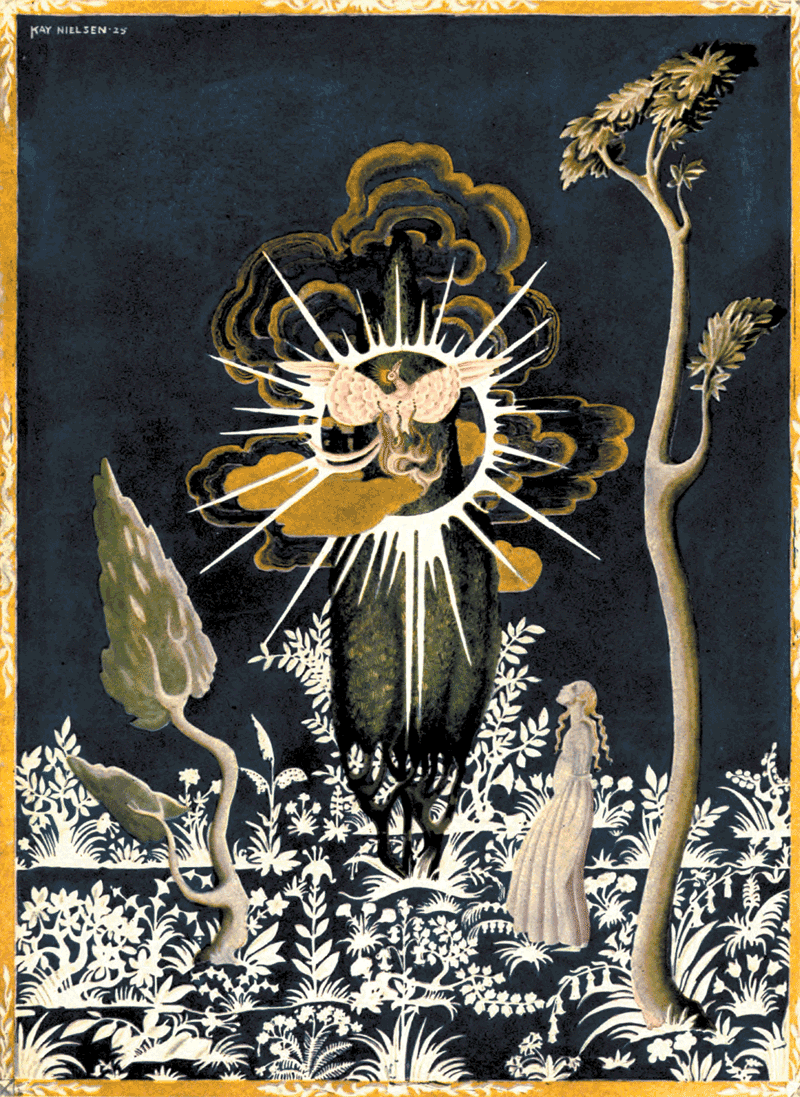
paralleled in The Juniper Tree (KHM 47)
in which a childless woman stands one winter day under a juniper tree in her
yard, peeling an apple. She cuts her finger, blood falls on the snow, and she
wishes for a child ‘as red as blood and as white as snow’. At once she knows it
will happen: the months of her pregnancy blend with the blossoming of the year
and the flourishing of the juniper, the berries of which she ‘greedily’ eats;
in the eighth month she tells her husband to bury her under the juniper if she
dies in childbirth. Her son is born white as snow and red as blood. She dies of
joy, is buried under the juniper, and the father marries a new wife, by whom he
has a daughter, Marlinchen. The stepmother is jealous of her stepson. She
murders him, tricks Marlinchen into believing she is responsible, cuts up the
child, stews him and gives the meat to her husband to eat. Little Marlinchen
sits under the table weeping, and when the meal is done she gathers her
brother’s bones (more bones!) in a napkin and lays them under the juniper tree.
Then the juniper tree began to stir itself, and the
branches parted asunder, and moved together again, just as if someone were
rejoicing and clapping their hands. At the same time, a mist seemed to arise
from the tree, and in the centre of the mist it burned like a fire, and a
beautiful bird flew out of the fire singing magnificently, and he flew high
into the air, and when he was gone, the juniper tree was just as it had been
before, and the napkin with the bones was no longer there.
As in the
Grimms’ Cinderella, here is a dead
mother buried beneath a tree that moves and stirs, with a spirit bird, the
child’s soul, flying up from its branches. Via the tree, the mother gives her
son second birth and new life, resurrects him in fact, for at the end the
once-dead child changes from bird-form to human shape and ‘he took his father
and Marlinchen by the hand, and all three were right glad, and they went into
the house to dinner, and ate.’ (So we know he’s truly alive: the dead don’t
eat.)
We still plant trees as memorials, for
they are living beings. And the notion of trees or other green, growing things offering
a kind of continued life for those who lie beneath is also found in ballads. Having
repented too late of her cruelty to the boy who died of love for her, the
eponymous Barbara Allen also dies.
Oh she was buried in the old
churchyard,
Sweet William was buried nigh her,
And out of his grave sprung a red,
red rose
Out of Barbara’s grew a green briar.
They grew and they grew up the old
church tower
Till they couldn’t grow any higher,
And there they tied a true lover’s
knot,
Red rose around green briar.
Whether
symbolically or in a more real sense, these lovers are united after death. Other dead lovers sometimes return to their
living sweethearts, to bid them farewell. The folk song The Grey Cock or The Lover’s Ghost begins with the extraordinary
verse:
I must be going, no longer staying,
The burning Thames I have to cross.
Oh I must be guided without a stumble
Into the arms of my dear lass.
Perhaps the
‘burning Thames’ is the supernatural barrier between death and life? Having
crossed it, the lover arrives soaking wet at his true love’s window and begs for
admittance; she lets him in and they kiss and embrace ‘till that long night was
at an end’ when she sees how deadly pale he is. And he admits, ‘Oh Mary dear,
the clay has changed me’: he must flee at cock-crow, and they will never meet again
until ‘the fish they fly, and the sea runs dry,/And the rocks they melt in the
heat of the sun.’
Not
all the returning dead are benevolent. The
Deacon of Myrká, an Icelandic tale collected by Jón Árnason (1819-1888),
tells how a deacon of the church of Myrká in Eyjafjördur had a sweetheart named
Gudrún, who lived the other side of the river Hörgá. The deacon always rode a
grey-maned horse called Faxi, and one year a few weeks before Christmas he
crossed the frozen river to invite Gudrún to a Christmas Eve dance at Myrká,
promising to call for her at a particular time to take her there. On the way
back to Myrká however, a sudden thaw caused the ice to break beneath him. He
fell into the river and though his horse struggled out, he was found drowned
with a deep gash at the back of his head made by the ice. Because of the
swollen river, no news of his death came to Gudrún. On the day of the dance she
was ready and waiting, and hearing a knock at the door went out into the night,
where the moon slipped between clouds. Faxi was standing by the door, and a man
at his side who without a word lifted her on to the horse and sprang up in
front of her. Off they rode, but –
When they reached the Hörgá, the ice-banks were
quite high, and as the horse went over the edge, the deacon’s hat was lifted at
the back, and Gudrún looked at his bare skull. At that very moment the clouds
cleared from the moon, and the deacon said,
‘The moon is gliding.
Death is riding.
Don’t you see a white spot
at the nape of my neck,
Garún, Garún?’
It was a
characteristic of Icelandic ghosts to repeat the last word of a clause, and no
ghost could pronounce the name of God – which formed the first part of Gudrún’s
name. Though alarmed, Gudrún kept silent, and when they came to the church at
Myrká they dismounted in front of the lychgate. The deacon said to Gudrún,
‘Wait here for me, Garún, Garún,
While I take my Faxi, Faxi,
Over to the pasture, pasture.’
Off he went.
Then Gudrún saw an open grave in the churchyard and became very frightened. She
ran to ring the lychgate bell; just as she clutched the rope the deacon grabbed
her from behind, tearing the coat from her shoulders, but as the bell began
sounding he hurled himself into the grave ‘and the earth rushed in over him as
if swept from both sides.’ It was a narrow escape, and Gudrún was never the
same afterwards.
Nevertheless,
many of the dead are motivated by love. Mothers often return from death in
person, if their children need them. The Danish ballad Svend Dyring tells how a mother lying in her grave hears her
children crying. With God’s permission, she bursts from her tomb to comfort
them – and to threaten the father and stepmother who have neglected them. (You can read the tale here.) There are also many tales of dead children who beg
their parents to cease grieving, as in the Grimms’ tale The Little Shroud (KHM 109) in which a child of seven returns.
As the mother would not stop crying, it came one
night in the little white shroud in which it had been laid in its coffin, and
with its wreath of flowers around its head, and stood on the bed at her feet
and said, ‘Oh mother, do stop crying, or I shall never fall asleep in my
coffin, for my shroud will not dry, because of all your tears which fall upon
it.’
Hearing this,
the mother controls her tears and next night the child reappears to tell her
that its shroud is almost dry, and it can sleep in peace.
Dead
sweethearts, too, complain of the tears shed over them. In the ballad Sweet William’s Ghost a young man killed
in the wars appears to his lover Lady Margaret, and asks for the gift he gave
her when they plighted their troth. She refuses unless he will first marry her ‘with
a ring’. He does, and she gives back the cross she’s worn, but he cannot stay:
‘The
wind may blow and the cocks they may crow,
And
it’s nearly breaking day,
And
it’s time that the living would depart from the dead,
My
love, I must away, away,
My
love, I must away.’
In the ballad of
The Unquiet Grave, the living partner
mourns for ‘twelvemonth and a day’, after which her dead lover requests her to
cease; he cannot sleep for her weeping, and ‘Your salty tears they
trickle down/And wet my winding sheet.’
It seems to me
that these particular tales and ballads offer to the bereaved not only an
understanding of the depths of grief, but the possibility of closure and the
permisson not to mourn forever. As even The
Wife of Usher’s Well found, you have to let them go. She cast a spell to
bring back her three sons drowned at sea, and though they return from the gates
of Paradise to visit her, they cannot stay beyond daybreak and the crowing of
the cocks, when the youngest bids a sorrowful but final farewell to life and
all its chances.
‘Fare ye weel, my mother dear,
Farewell to barn and byre;
And fare ye weel, the bonny lass
That kindles my mother’s fire.’
Picture credits:
The Wife of Usher's Well - HM Brock: ill., The Book of Old Ballads, ed. Beverley Nichols
Tobias and the Angel - Filippo Tarchiani
The Travelling Companion - Anne Anderson
Rashin Coatie - John D Batten
Cinderella and the Hazel Tree - Elenore Abbott
The Juniper Tree - Kay Nielsen
Sweet William's Ghost - Gwen Raverat
Love - Millais
The Wife of Usher's Well - HM Brock, as above.

 She leads him up, she leads him down,