Probably the best-known
enchanted sleeper after the Sleeping Beauty is Rip van Winkle. A lazybones
living in the Catskill Mountains, he prefers hunting to hard work. Out with his
dog one evening, he helps a strange little fellow to carry a keg up the
mountain. They arrive at ‘a hollow, like a small amphitheatre, surrounded by
perpendicular precipices, over the brinks of which impending trees shot their
branches, so that you only caught glimpses of the azure sky and the bright
evening cloud.’
Within this cave-like
structure a number of ‘odd-looking personages’ dressed in old-fashioned clothes
are playing at ninepins in complete silence except for the noise of the rolling
balls which raise thunderous echoes. Stopping their play, they stare at Rip
‘with such fixed, statue-like gaze, and such strange, uncouth, lack-lustre
countenances, that his heart turned within him and his knees knocked together.’
Rip nervously serves the little men drinks from the keg, after which they
return to their game; he tries the beverage himself, and falls asleep for
twenty years.

Rip is the invention of
Washington Irving who published the tale in 1819, but he based it heavily on a
German folktale ‘Peter Klaus’. Peter is a goatherd from Sittendorf who pastures
his herd on the Kyffhäuser, a prominent hill south-east of the Harz mountains.
Following a stray goat into a cave, Peter finds it eating oats mysteriously
showering from the roof. He hears horses neigh and stamp overhead, and a young
man beckons him up steps into a ‘deep dell, inclosed by steep craggy
precipices’ where ‘on a well-levelled, cool grass plot’, twelve knights
silently play skittles and sign for him to set up the fallen ones. Peter obeys:
then growing bolder, drinks wine from a nearby pitcher and falls asleep only to
wake stiff and old, with a beard a foot long. Descending the mountain to Sittendorf,
he finds his house a ruin and recognises no one until a young woman tells him
that Peter Klaus was her father – ‘It is now twenty years and more since we
searched for him a whole day and night on the Kyffhäuser. ... I was then seven
years old.’

Relevant to this tale is the
legend that the Holy Roman Emperor Frederick Barbarossa (1122-1190) sleeps in a
cave under the Kyffhäuser with six of his knights. He sits at the head of a
stone table and has been there so long that his great red beard has grown right
through the stone. This legend haunts the story of poor Peter Klaus and
explains his fate. Anyone local to the Kyffhäuser would know at once that the
cave, knights and horses belonged to Barbarossa. It’s generally a risky
business to enter the cave of a sleeping king and his army, especially if one
of the sleepers stirs and asks ‘Is it time?’ (The best plan is to answer, ‘No,
sleep on!’ and flee.) Hugh Miller, in his 1891 book Scenes and Legends of the North of Scotland, relates how a man
entered the Dropping Cave of Cromarty and fuelled by alcohol, blew a blast on a
bugle he found lying beside a vast sarcophagus, disturbing an unknown warrior:
The
cover heaved upwards, disclosing a corner of the chasm beneath; and a hand
covered with blood and of such fearful magnitude as to resemble only the
conceptions of Egyptian sculpture, was slowly stretched from the darkness
towards the handle of the mace. Willie’s resolution gave way, and flinging down
the horn he rushed toward the passage. A yell of blended grief and anger burst
from the tomb, as the immense cover again settled over it.
So far as I know, Washington
Irving had no similar legend of the Catskills to apply to Rip van Winkle, but
his odd little men are sufficiently fey to be disturbing. The fairies
traditionally dressed in old-fashioned clothes, and in Arthur Rackham’s
illustrations to Rip van Winkle the
little men look very like goblins.
Characters like Rip fall
asleep in consequence of having accidentally strayed into what might be termed
a supernatural danger zone. In fact, the ‘supernatural lapse of time’ – the
phrase coined by Edwin Sydney Hartland in The
Science of Fairytales (1890) – experienced by Rip and the sleeping Peter
Klaus is very similar to that of those who visit fairyland for what seems a few
days or hours, but find on their return that years or centuries have passed.
The 12th century
courtier Walter Map tells of King Herla of the Britons, who goes to the wedding
of a pygmy fairy king (half goat, half man) in underground halls of great
splendour. After the wedding, the pygmy king loads Herla and his retinue with
gifts including a small hound for Herla to carry on his saddle, warning that
neither he nor any of his men should dismount before the dog leaps down.
Emerging into the open, Herla asks an old shepherd for news of his queen, but
the shepherd can hardly understand him. ‘You are a Briton and I a Saxon... long
ago, there was a queen of that name ... who was the wife of King Herla; and he,
the story says, disappeared in company with a pygmy at this very cliff and was
never seen on earth again.’ Forgetting the fairy king’s warning, some of
Herla’s men jump from their horses and crumble instantly to dust: and Herla
still rides the hills with the rest of his company, for the little dog has not
yet leapt down.

The same prohibition was
placed on Oisin, son of the Irish hero Finn, who married Niamh of the Golden
Hair, daughter of the King of the Country of the Young and went away with her
to that country, riding over the sea. After spending three years there he longed
to see his father Finn again. Niamh gave him permission, and her horse, and warned
him on no account to dismount or put foot to the ground. Of course he forgot.
Some say it was hundreds of years he was in that country,
and some say it was thousands of years he was in it; but whatever time it was,
it seemed short to him. And whatever happened to him through the time he was
away, it is a withered old man he was found after coming back to Ireland, and
his white horse going away from him, and he lying on the ground.
Gods and Fighting Men, Book XI, Ch 1, tr. Lady Augusta Gregory
Oisin leaves the land of
everlasting youth and returns to mortal soil, where the weight of centuries falls
and crushes him. In a dialogue with St Patrick he describes himself as ‘an old
man, weak and spent, without sight, without shape, without comeliness, without
strength or understanding, without respect.’ Patrick tries to convert him, but
Oisin has the last word:
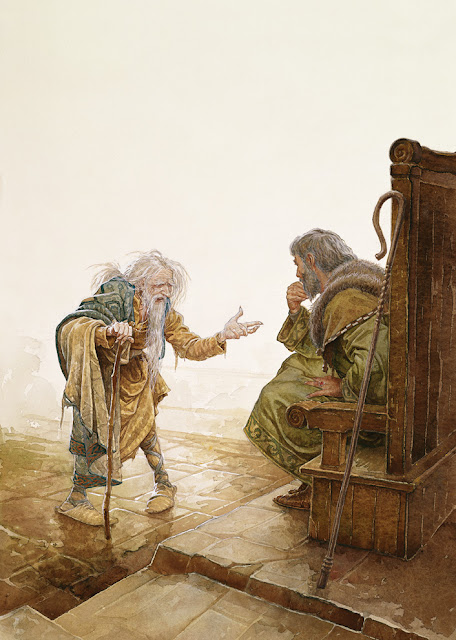 |
| 'Oisin and Patrick' by PL Lynch |
‘It is a good claim I have on your God, to be among his
clerks the way I am; without food, without clothing, without music, without
giving rewards to peers. Without the cry of the hounds, without guarding
coasts, without courting generous women; for all that I have suffered by the
want of food, I forgive the King of Heaven in my will.
‘My story is sorrowful. The sound of your
voice is not pleasant to me. I will cry my fill, but not for God, but because
Finn and the Fianna are not living.’
Gods
and Fighting Men, Book XI, Ch V, tr. Lady Augusta Gregory
Or are they? In most accounts
Oisin dies; his grave, like Arthur’s, is located in various places –
Antrim, Armagh, even Scotland – but for
Finn and the Fianna ‘there are some say he never died, but is alive in some
place yet.’
And one time a smith made his way into a cave he saw, that
had a door in it, and he made a key that opened it. And when he went in he saw
a very wide place, and very big men lying on the floor. And one that was bigger
than the rest was lying in the middle, and the Dord Fiann [Finn’s war-horn] beside him, and knew it was Finn and the Fianna
were in it.
And the
smith took hold of the Dord Fian, and ... blew a very strong blast on it ...
And at the sound, the big men lying on the ground shook from head to foot. He
gave another blast then, and they all turned on their elbows. And great dread
came on his when he saw that, and he threw down the Dord Fian and ran from the
cave and locked the door after him, and threw the key into the lake. And he
heard them crying after him, ‘You left us worse than you found us.’ And the
cave was not found again since that time.
But some
say the day will come when the Dord Fian will be sounded three times, and that
at the sound of it the Fianna will rise up as strong and well as ever they
were...
Gods
and Fighting Men, Book X, Chapter III, tr. Lady Gregory
(If you want to hear what the
Dord Fian might have sounded like, click
this link.)
Versions of this tale-type
known as ‘the king asleep in the mountain’ are found worldwide, and I can’t
resist sharing my recent discovery – recent to me, though known to many – of
perhaps the earliest European ‘sleeping king’ narrative. It’s recorded by the 1st/2nd
century CE Greek historian and philosopher Plutarch, who attributes it to
Demetrius the Grammarian ‘travelling home from Britain to Tarsus’. In one
dialogue ‘On the Silence of the Oracles’, Demetrius tells how on one of the
many islands lying around Britain, Cronus (Saturn) lies sleeping, guarded by
the hundred-handed monster Briareus: ‘and round about him are many demigods as
attendants and servants.’ Another
dialogue ‘On the Face Which Appears in the Orb of the Moon’ elaborates this
account:
A run of five days off from Britain as you sail westward,
three other islands equally distant from it and from one another lie out from
it in the general direction of the summer sunset. In one of these, according to
the tale told by the natives, Cronus is confined by Zeus, and the antique
Briareus, holding watch and ward over those islands and the sea that they call
the Cronian main, has been settled close
beside him.
[...]
For
Cronus himself sleeps confined in a deep cave of rock that shines like gold –
the sleep that Zeus has contrived like a bond for him – and birds flying in
over the summit of the rock bring ambrosia to him, and all the island is
suffused with fragrance scattered from the rock as from a fountain; and those
spirits mentioned before tend and serve Cronus, having been his comrades what
time he served as king over gods and men.
I wonder if Demetrius reached
the island on which ‘Cronus’ sleeps by circumnavigating Britain anti-clockwise,
and sailed down the west coast from the north?
[T]hose
who survive the voyage first put in at the outlying islands [...], and see the
sun pass out of sight for less than an hour over a period of thirty days, – and
this is night, though it has a darkness that is slight and twilight glimmering
from the west [...] and then winds carry them to their appointed goal.*
This description of the long
northern summer days and short nights convinces me that Demetrius really did sail in northern waters and picked up information and stories ‘according to
the tale told by the natives.’ It’s tantalising! What Celtic god or hero seemed
to Demetrius’ Greco-Roman mind, the equivalent of Cronus/Saturn, father of
Zeus?
Whoever that might be (incidentally, a friend has reminded me of CS Lewis's giant Father Time, who sleeps in a cave under Narnia until Time ends – Cronus is a personification of time, and you can bet Lewis knew his Plutarch) the
roll-call of sleeping heroes includes figures named and unnamed, legendary and
historical: Finn, Barbarossa, Charlemagne, Ogier the Dane, and of course there’s
Arthur.
Some men say in many parts of England that King Arthur is
not dead, but had by the will of Our Lord Jesu into another place; and men say
that he shall come again, and he shall win the holy cross. I will not say that
it shall be so, but rather I will say, here in this world he changed his life.
But many men say there is written upon his tomb this verse: HIC IACET ARTHURUS,
REX QUONDAM REXQUE FUTURUS.
Le Morte D’Arthur, Book XXI, chapter 7
Malory’s Arthur is taken away
in a barge to ‘the isle of Avilion, to heal me of my grievous wound’, but
England, Wales and the Borders are full of tales of the king and his knights
sleeping hidden under a hill. Jennifer Westwood and Jacqueline Simpson
summarize the stories in their comprehensive guide to England’s legends, The Lore of the Land.
In several places, including Sewingshields, Northumberland,
and Richmond Castle, Yorkshire, it is said that a man finds a secret doorway in
a hillside, leading to a cavern where Arthur and his knights sleep, surrounded
by weapons and treasures, which may include some significant objects, such as a
sword, a horn, or a bell. [...] The sleepers begin to stir, and the intruder
panics and flees. He... can never find the hidden entrance again; meanwhile,
Arthur and his knights return to their enchanted sleep, for the time for their
return has not yet come. Other stories, collected in the late 19th
century, say Arthur and his court dwell inside the hill-fort of Cadbury Castle,
Somerset; on the nights of full moon they emerge on horses shod with silver.
The Lore of the Land, p310
It’s easy to see how the ‘king
under the hill’ tales bleed into fairyland. The Cadbury legend makes Arthur and
his silver-shod steeds sound very like the Seelie Court or Faerie Rade. Other
than their regular full-moon wandering, the rest of the time do they sleep? The
Irish Earl Gerald of Mullaghmast, a master of the black arts, sleeps with his
warriors in a cave under the Rath of
Mullaghmast. Once every seven years he wakes and ‘rides around the Curragh of Kildare
on a horse whose silver shoes were half an inch thick’ when he fell asleep.
When they are worn ‘as thin as a cat’s ear, a miller’s son with six fingers on
each hand will blow his trumpet’ and the Earl and his men will wake and ride
out against the English.
Perhaps Tolkien remembered these
stories when he sent Aragorn into the Dwimmerberg, the Haunted Mountain, to
summon the King of the Dead and the shadow army which slept there. Once they
have fought on his side against the hordes of Mordor, Aragorn holds the dead king's ancient oath fulfilled, and the shadow army dissolves like mist.

Kings or heroes, all male,
lying asleep in caves or underground: like the tales I explored in my first post and unlike those of the second, these narratives focus on the lapse of
time and its effect, but there is a difference. King Mucukunda, the Seven
Sleepers, Honi the Circle-Drawer and their ilk were all put to sleep by some
divinity – and for a purpose. And their experiences were ultimately positive:
they received divine lessons or blessings and departed this life in peace. That
is not the case in these tales. Nothing St Patrick says can comfort Oisin,
whose lament expresses not only the personal, emotional cost of the lost years,
but fierce grief for a vanished way of life and the age of heroes.
What causes this difference? While
deities can be expected to look after you, it is dangerous to trespass into the
Otherworld of the Sidhe, where humanity does not belong, and even more
dangerous if you taste food or drink there. The fair folk don’t age like us.
Even Aragorn in The Lord of the Rings
will grow old long before his elven bride, Arwen.
The women in my second post do
not sleep in caves. They sleep in the open air on hilltops, or in the more
civilised environment of hall or castle. And they do not age. During her
century of sleep the Sleeping Beauty does not age at all, neither does the
valkyrie Sigrdrifa in the Poetic Edda,
or Brynhild in Volsunga Saga: they
wake from their enchantments as active, young and beautiful as when they fell
asleep. But whether by gradual natural process or sudden dynamic change, Peter
Klaus, Rip van Winkle and Oisin do age. They sleep for decades and wake already
old, or discover they’ve skipped a huge span of years and instantly wither –
some into dust.

A tale in The Celtic Magazine of November 1887 tells how a young bridegroom
leaving the church after his wedding was stopped by ‘a tall dark man’ who asked
him to come around the back of the building with him for a quick word, and asked
him to stand still till a small piece of candle he held in his hand should burn
out. The bridegroom complied; it burned for two minutes, then he ran after his
friends. They were out of sight, so he asked a man cutting turf if he had seen
the wedding party go by. The turf-cutter shook his head: ‘Not for a long time
past. What did you suppose the date of the wedding to be?’ The bridegroom gave
a date two hundred years in the past. And the turf-cutter told him, ‘My
grandfather had a tale his grandfather told him, of a bridegroom who
disappeared on the day of his wedding.’ ‘I am that bridegroom!’ the young man
cried, and fell as he spoke into a small heap of earth.
Maybe that’s the best way to
go? For those who survive for a while, the sense of loss is devastating. In Rip
and Peter Klaus’s case, meeting a grown daughter and grandchild offers partial
consolation, but there is no recovering lost youth.
As for the ones who grieve for
the lost years but do not die, one thing is clear: they are divorced from the
flow of time. They cannot grow or change. Some spend the endless years like
King Herla who ‘holds on his mad course with his band in eternal wanderings, without
step or stay’. This is not like sleep, which indeed doesn’t feature in Herla’s
tale, but it speaks of an inability to rejoin or ever to take part again in
natural life. Unable even to dismount from their steeds, Herla and his troop
are forever homeless, ‘blown in restless violence round about the pendant
world’, to quote Shakespeare. And the kings and their knights lie in their
caves in suspended animation, neither dead nor truly alive, waiting for the day
when they will be needed, will be relevant again. Alas, it is a day that may never
come, for – Aragorn excepted – in no story has any intruder ever desired to wake
them.

* Charles William King, whose
1908 translation this is, tells us that Demetrius was sent to the islands of
Britain by Trajan (who was emperor from 98 – 117 CE) and suggests that one of the
islands may be Anglesey – ‘the focus of Druidism’ – since only ‘holy men’ are
said to inhabit it. Could there still have been druids on Anglesey at the end
of the 1st century CE? I suppose it’s possible, even after the 60-61 CE
invasion by Suetonius Paulinus (busily burning the sacred groves just before
news of the Boudiccan rebellion reached him), and that of Agricola in 77 CE.
Druidism might well have hung on for quite a while, as the account goes on to
explain that the cave of Cronus is a centre for oracles and prophecies described as ‘the dreams of Cronus’.
Picture credits
Sleeping King Arthur: illustration by Eric Fraser for 'English Legends' by Henry Bett
'They stared at him': illustration to Rip van Winkle by Arthur Rackham
Barbarossa in the Kyffhauser: artist unknown
Oisin and Niamh by Richard Hook: see https://littleisobel.com/home/2011/10/12/richard-hook-great-folk-tales-of-old-ireland/
Oisin meets Patrick: illustration by P L Lynch for 'The Names Upon the Harp' with Marie Heaney
The Death of King Arthur: painting by John Garrick, 1862
To the Stone of Erech: by Inger Edelfeldt
Rip van Winkle: by Arthur Rackham


