October is a month for talking about ghosts, ghouls and the revenant dead... Here is a story I found in Le Foyer Breton (Emile Souvestre’s 1844 collection of Breton folk and fairy tales). After I’d translated it I realised it’s not Breton at all, but a prose version of a Danish ballad, ‘Svend Dyring’ – known in various 19th century English translations as ‘Childe Dyring’, ‘The Buried Mother’, ‘The Dead Mother’, ‘The Legend of the Stepmother’ and, in Sir Walter Scott’s The Lady of the Lake, as ‘The Ghaist’s Warning’. (‘Childe’, by the way, is an archaic term for a young nobleman who has not yet won his spurs.)

Dyring went off to an island and married a pretty young girl. He lived with her for seven years and became the father of six children, but then what happened? Death swept through the countryside and his fair, pure lily succumbed.
Off went Dyring to a different isle and chose himself a new wife. Once the wedding was over he brought her back to his home, but alas, her nature was hard and cruel. She walked in, saw the poor little children peeping at her through their tears and roughly rejected them.
She gave them neither ale nor bread, telling them, ‘You shall suffer hunger and thirst.’ She took away their soft blue blankets, saying, ‘You will lie on straw.’ She took away their bright candles, telling them, ‘You will sleep in the dark!’
In the evenings the little children wept, and from her resting place under the earth their mother heard them. Lapped in her cold shroud she heard and resolved to return to them. Coming before Our Lord she begged, ‘Let me go back, to see my little children!’ And she went on pleading and imploring until he gave her permission to revisit this world, on condition she was back in her grave before cock-crow.
Raising heavy, tired limbs she crossed the graveyard wall. Dogs filled the air with their howls as she passed through the village. Coming to her home, she found her eldest daughter sitting on the doorstep.
‘What are you doing there, my dear daughter?’ she asked, ‘and where are your brothers and sisters?’
‘Why do you call me dear daughter?’ asked the child. ‘You’re not my mother! My mother is young and pretty, my mother’s cheeks are white and red, but you – you are as pale as a corpse.’
‘How could I be young and pretty? I’ve come from the land of the dead, that’s why my face is pale. How could I be white and red when I’ve been dead so long?’
She came into her children’s chamber, where they were all crying. She bathed the first and braided the hair of the second. She comforted the third and the fourth, and took the fifth in her arms as if to breast-feed it. Then she said to her eldest girl,
‘Go and ask Dyring to come here.’ And when Dyring came into the room, she cried out in anger,
‘I left ale and bread here, and my children are hungry. I left warm blue blankets and my children sleep on straw. I left bright candles to light them and my children are in darkness. If ever I have need to come back again, bad luck will fall on you! Hark – now the red cock is crowing: all the dead must return to the ground. Hark! – the black cock is crowing and the gates of heaven are opening. And now, hark! – the white cock is crowing. I can stay no longer.’
Ever since that day, whenever Dyring and his wife hear dogs barking they give ale and bread to the children, and whenever they hear dogs howling they are terrified that the dead woman will appear to them once more.

The vigour of the original Danish ballad can be seen in some verses from an 1860 century translation by R C Alexander Prior.
She gave them neither bread nor beer,
‘Hunger and hate will be your cheer.’
She took away their bolsters blue:
‘Bare straw shall be the bed for you.’
She took away their fire and light:
‘In blind-house ye shall sleep all night.’
They cried one evening, till the sound
Their mother heard beneath the ground.
She heard it as in her grave she lay,
‘But go I must, their pain to stay.’
At God’s high throne she bent her knee,
‘Oh let me, Lord, my children see.’
And such her prayer and tale of woe,
That God in mercy let her go.
‘But there on earth no longer stay
When cock shall crow the break of day.’
Out from her chest she stretched her bones,
And rent her way through earth and stones.
As through the street she glided by
Loud all the hounds howled to the sky...
The bursting of the coffin and rending of earth as the dead mother forces her way out of the grave demonstrates both her terrifying power and the strength of her love. Sir Walter Scott includes in his version the apparently irrelevant but haunting refrains usual to Danish ballads, which I think are lovely:
Wi’ her banes sae star a bowt she gae, [With her bones so [?] a bound she gave,
And O gin I were young! Oh that I were young!
She’s riven baith wa’ and marble gray. She’s riven both wall and marble gray.
I’ the greenwood it lists me to ride. In the greenwood I love to ride.]
In ‘Tales of a Wayside Inn’ (1860) a series of narrative poems linked in the style of ‘The Canterbury Tales’, Henry Wadsworth Longfellow includes yet another translation of the ballad, ‘The Mother’s Ghost’, also with refrains:
Svend Dyring he rideth adown the glade,
I myself was young!
There he hath wooed him so winsome a maid;
Fair words gladden so many a heart.
A mother’s love for her children, lasting beyond the grave, clearly held great appeal for 19th century sentiment, and the story of the ballad was very widely disseminated. As early as 1814, Robert Jamieson, touching on Scott’s version in Illustrations of Northern Antiquities, goes on to mention an Scottish variant which must date from at least the 1770s.
On the translation from the Danish being read to a very antient [sic] gentleman in Dumfriesshire, he said the story of the mother coming back to her children was quite familiar to him in his youth, with all the circumstances of name and place. The father, like Child Dyring, had married a second wife, and his daughter by the first, a child of three or four years old, was once a-missing for three days. She was sought for everywhere with the utmost diligence, but was not found. At last she was observed, coming from the barn, which during her absence had been repeatedly searched. She looked remarkably clean and fresh; her clothes were in the neatest possible order; and her hair, in particular, had been anointed, combed, curled and plaited, with the greatest care. One being asked where she had been, she said she had been with her mammie, who had been so kind to her, and given her so many good things, and dressed her hair so prettily.
Illustrations of Northern Antiquities, pp 318-319
I’ll be talking more about the power of the dead in ballads and fairy tales, both for good and ill, in my next post.

Picture credit:
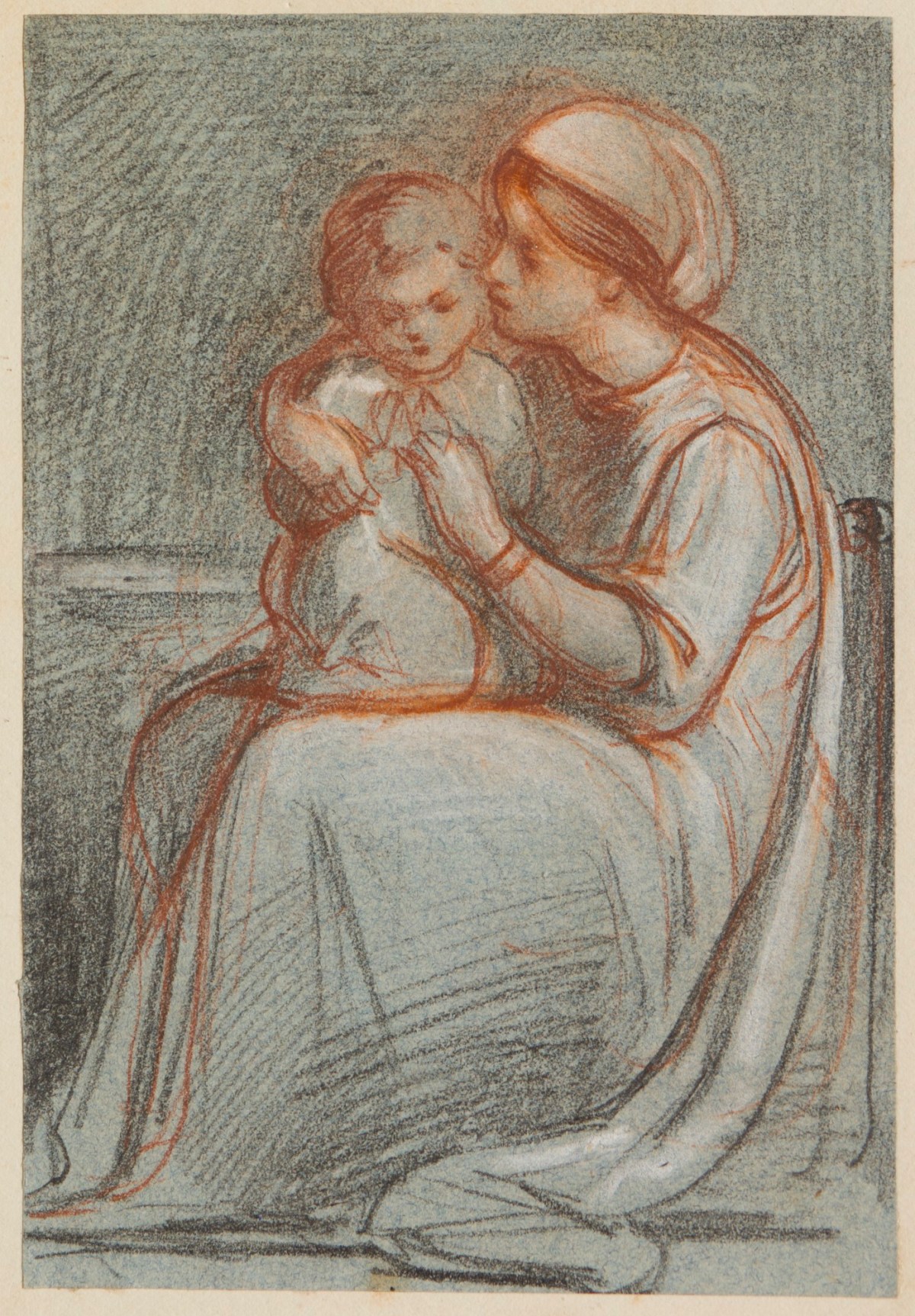
Woman and child - Richard Redgrave, RA, 1804-1888


