Showing posts with label Joan Aiken. Show all posts

Friday, 7 February 2014

Magical Classics: "A Necklace of Raindrops" by Joan Aiken


Jo Cotterill reflects on the enduring magic of Joan Aiken's marvellous fairytales.

I don’t know how old I was when I read A Necklace of Raindrops. I only know that it caused a tremendous longing in my soul for such a necklace. I was a girly child, fond of tutus and fairy wings, and a desperate desire for my own unicorn. The Necklace fitted perfectly into my romantic visions.

One dark and stormy night (yes, one of those beginnings!), Mr Jones, recently a father, finds the North Wind, personified as a tall man, stuck in his holly tree. On helping him get free, Mr Jones is rewarded by a necklace of three raindrops which the North Wind hands over as a present for his new baby daughter. ‘I will be the baby’s godfather’ he says imperiously. He promises to bring the girl a new raindrop every year on her birthday (the necklace starts life with three raindrops) and each raindrop will confer a new magic power. By the time she has the full set of ten raindrops (on her seventh birthday) she will be able to swim any river, go unharmed in the worst storm, and make it start and stop raining, among other things.

But as always there is a catch. The little girl, named Laura, is not allowed to take off the necklace, otherwise, the North Wind says vaguely, ‘it might bring bad luck’. What kind of a warning is that?

Anyway, Laura grows into a nice little girl who loves her necklace and dutifully wears it all the time – until she begins to attend school. Another girl, Meg, is jealous of Laura’s pretty necklace and so she tells the teacher that Laura is wearing jewellery. The teacher makes Laura remove the necklace, but Meg steals it from its safe place and takes it home. Laura is distraught – all the more so because it’s her birthday soon and her godfather is due to bring the tenth and final raindrop. Meg soon finds that crime doesn’t pay because the necklace doesn’t work for her, and her father takes it away. He sells it and soon it is on a ship, destined as a present for the princess of Arabia.

Laura cries desperately over the loss of her necklace, but in a Disney-like fashion, birds and animals pop up and offer to help her find it. Apparently, she has been kind to them in the past (though the story makes no mention of it up to now – an editor these days would demand earlier references!) and now they become her personal spies, sniffing out information.


Before long, Laura is on the trail of the necklace and has to take a ride on a friendly dolphin (since she can no longer swim) to Arabia where she begs the princess to return her necklace. In the ensuing argument, the North Wind arrives with the final raindrop. Annoyed that his god-daughter has taken off his present (after nearly seven years!) he lets the raindrop fall onto the grass where it is lost. The princess takes pity on Laura and hands over the necklace, whereupon one of Laura’s tears falls onto the necklace and becomes the final raindrop.

As a child, I was fascinated by the romance in Joan Aiken’s stories. Magic was referred to in such a practical way that it was taken for granted that buses could fly, unicorns could arrive on your lawn, and raindrops could hang from a necklace without falling off. It was the fantastical element that appealed, along with the stunning illustrations by Jan Pienkowski, my favourite ever illustrator.

It is interesting to me that as a writer, I shy away from fantasy now. It was such an enormous part of my childhood, and yet I don’t write fantasy at all. I hardly read it now either, and again I can’t explain why. Perhaps the practical, cynical side of me that says magic isn’t real has shouted down the inner romantic?

And yet…and yet…as I grow older, I find myself seeking out stories with magical elements. Not necklaces or unicorns, but real life experiences that defy rational explanation. And I am more and more attracted to fiction with a romantic edge: not necessarily a falling-in-love one, but a slightly rose-tinted one where people get the happy endings they deserve.

I do think that having children has had something to do with this. I have two young daughters, and for them, every day is magical in the smallest ways. My eldest licks frost from the tree. My youngest echoes the ‘beep’ from the microwave. I have begun to look at the world in fresh ways, noticing the beaded cobwebs in the garden and feeling so disappointed if there is no one to share them with.

And now I am sharing the necklace of raindrops with my eldest. At five and a half, this is the first story that she has eagerly wanted to read for herself. I read it to her, and then she wanted to read it to me. It took us four bedtimes to get through it, but she finished it in the end and the delight on her face was beyond words.

As if I needed any more proof of the power of this fairytale, she presented me with her Christmas list. Under ‘pink mobile phone, Rapunzel Barbie and chocolate coin maker’ she had written ‘necklace of raindrops’.


Here is the 'necklace of raindrops' that I made for my daughter this Christmas.  She was very excited to find it in her stocking on Christmas morning!


Jo Cotterill has been an actor, musician and teacher and now writes books at her home in Oxfordshire. She has published 21 books for young people and teenagers, including the critically acclaimed ‘Red Tears’ (as Joanna Kenrick) and her light romance series ‘Sweet Hearts’. Her new book, ‘Looking at the Stars’, a story of inspiration and imagination among refugees, has just been published by Bodley Head.

Friday, 14 June 2013

Magical Classics: 'The Wolves of Willoughby Chase' by Joan Aiken


Katy Moran explores Joan Aiken's disturbing yet entrancing classic


A grand house, a pack of hungry wolves and two brave and resourceful girls – this is the opening to one of the most magnificent children’s books ever written: a tapestry of skulduggery and deception, petty forgery and outrageous bravery, woven together with shining golden threads of thought-provoking fantasy. It’s also a tale of innocence and experience that William Blake would have been proud of.

Within seconds of the first meeting between Bonnie Green and her terrifying new governess, it is clear that Miss Slighcarp intends to rule Willoughby Chase with an iron rod. Bonnie’s days of ice-skating in the frozen park and bouncing on the window-seat cushions in a cosy, firelit nursery are unmistakeably numbered. It is no surprise, then, that Bonnie dreads the moment her parents will leave home to embark on their ocean voyage, but she must take comfort in the hope that a friendlier climate might improve her mama’s health, and in the knowledge that soon her cousin will soon arrive from London to keep her company. 

Miss Slighcarp


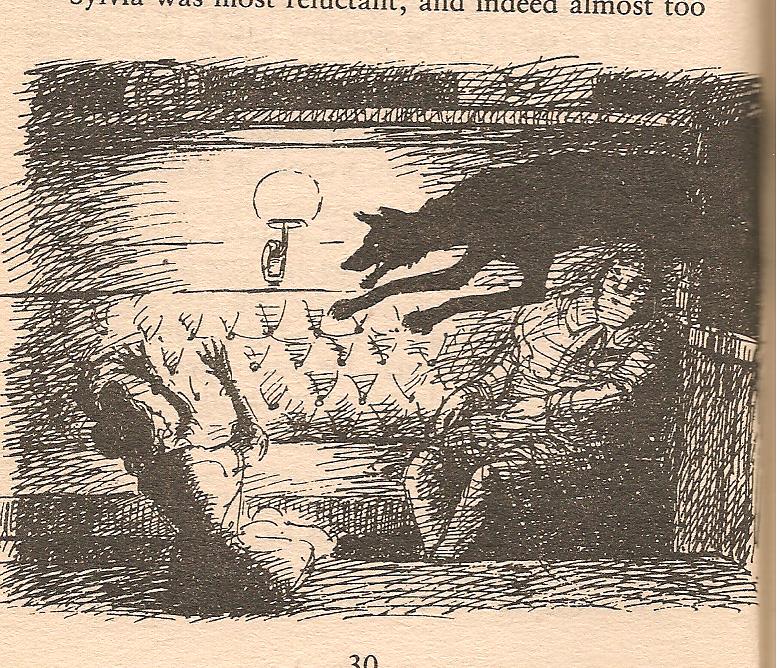
Ensconced in the chilly carriage of a train hurtling north, ever closer to Willoughby Chase, Sylvia Green has problems of her own as – horror of horrors ­– she is joined in the carriage by a fellow passenger, the alarmingly genial and kind Mr Grimshaw. His very presence means that genteel Sylvia cannot even nibble one of the hard, tiny bread rolls her dear Aunt Jane packed for the journey, and propriety certainly forbids accepting one of the oozing violet cream pastries Mr Grimshaw is so eager to press upon her. But outside the train carriage a fiercer danger stalks the snow and ice, for the wolves are baying with hunger and desperate enough to attack, and it quickly becomes clear that Mr Grimshaw is not quite what he seems. Joan Aiken is tremendously skilled at pinpointing the very real fears of children: Sylvia’s anguish at having to share her train carriage with a jovial and chatty stranger struck a deep chord with me when I was a child, and was a more frightening notion than Miss Slighcarp and the wolves combined. Mr Grimshaw’s dripping, sugary cakes were especially disturbing – so tempting, and yet every child knows never to accept food from strangers. Oddly, I didn’t find the wolves attacking the carriage scary at all.


The wolf attacks

The Wolves of Willoughby Chase is not only a classic, it represents a new beginning, and I think it may contain one of the first examples of steampunk in children’s literature. I first discovered the novel when I was about ten or eleven years old, but I had no idea that I was encountering the first flowering of a genre that was to rule children’s fiction in later years. I do remember being fascinated by a matter-of-fact foreword explaining that the action takes place in a Jacobean period of history that “never happened”, with a fictional King James III on the throne, and a newly opened Channel Tunnel the unintended conduit of hungry wolf-packs from mainland Europe. The real Channel Tunnel was still under construction when I first read the novel, and I still remember trying to picture what it would be like filled with horses and carriages. In fact, one of the first things I loved about The Wolves of Willoughy Chase is the way Joan Aiken renders the real world just a little bit strange and unusual. The grandeur and opulence of Bonnie’s home is already an exciting contrast to the genteel poverty of the life Sylvia has just left behind, as well as the more humdrum world of most children reading the book, but of course it doesn’t end there. There are wolves. This just doesn’t feel like fantasy of the same ilk as the wonderful novels by Tamora Pierce that I gobbled each week at the library, because of course it’s not. In truth, Aiken’s flights of fantasy are perhaps more strictly magic realism – they are always used to make a point, to escalate a moment of fear. The wolves of Willoughby Chase come to embody the danger gathering around Bonnie and Sylvia as Miss Slighcarp destroys their world piecemeal – it’s as if the wolves and the steampunk Channel Tunnel that allow them to exist in the novel actually represent the girls’ loss of innocence, and perhaps also a loss of innocence on a wider, social level as the action moves from the rural grandeur of Willoughby Chase to the harsh, dark world of industrial Blastburn.

Joan Aiken’s use of fantasy and steampunk is a lesson in kind for any author – she uses these elements with such obvious pleasure, but the wolves and the other touches of fantasy don’t exist purely for their own sake – they lend wings to the story as a whole, intensifying emotion and crystallising moments of tension with the kind of authorial magic that is utterly compelling, and which only emerges once or twice in a generation. I’m delighted to have made the discovery that The Wolves of Willoughby Chase was just the first in an entire series. I only wish I had known the rest of the books as a child – still trailing clouds of glory, as William Wordsworth might have said, more or less, anyway. It really is no exaggeration to say that I would give this book to any child. 

Katy Moran  is the author of several YA historical fantasies including Bloodline and Bloodline Rising , set in Britain and Constantinople in the Dark Ages, and Spirit Hunter, a tale of danger and forbidden love along the ancient and mysterious Silk Road.  Katy has also published Dangerous To Know, a modern love story for the festival-going generation. Her latest YA novel Hidden Among Us (Walker 2013) is a compelling faerie fantasy set in contemporary Britain, and I can highly recommend it.

Picture credits: cover and artwork from 'The Wolves of Willoughby Chase', copyright Pat Marriot 1962.


Friday, 30 November 2012

The Lady of Llyn y Fan Fach

by Lily Hyde


It's more than a year now I’ve been on the road. I’ve spent most of my adult life in other countries than the one I was born in. I’ve been reading and writing fairy tales for as long as I can remember.

Sometimes I blame fairytales for my longing to travel and encounter unknown people and places. Many fairytales involve journeys: across mountains of glass, forests of thorns, the seven miles of steel thistles of this blog’s title. And of course the tales themselves travel; versions of ‘Cupid and Psyche’ appearing in Scandinavia, Japan…

Even more stories involve a meeting between the ordinary and the unknown; indeed, isn’t that where their name comes from – fairy or faerie, that other realm that is so like our own but so utterly different. Some of my most-loved fairytales, the ones that have worked their way into my life and writing, are about encountering the new and strange, and falling hopelessly in love with it.

I don’t know where I first read or heard ‘The Lady of Llyn y Fan Fach’. It seems I’ve always known the story. But I came across it again on a neglected bookshelf in Kiev, in a book of folk tales from the British Isles bizarrely published – transcribed regional accents and all – in the Soviet Union.

I seized on this book like a piece of home. I was sharing my life with a man from a different country, a stranger in his strange land. Sometimes I felt like I was living in a fairytale. I felt like the lady of Llyn y Fan Fach.

In this Welsh tale, a shepherd by the lake in the Black Mountains sees a beautiful woman appear on the water, and falls in love. He woos her with his lunch, bread his mother baked, and finally wins her on the third try with bread that is neither over- nor under-cooked. The lady – fairy or goddess or just a stranger from a strange land, we are never told – agrees to live with the man until he strike her ‘Tri ergyd diachos’ – three causeless blows.

What happens next is a paradigm of a marriage.

The first time, they are late for a christening and the lady says she will fetch the horse to ride there if her husband brings her gloves. But when he comes back with the gloves she hasn’t brought the horse, and he strikes her.

The second time, the shepherd strikes her at a wedding after she starts weeping loudly “because these people are entering into trouble”.

The third time she begins to laugh uncontrollably at a funeral, because, she says, death puts people out of their pain. And he strikes her.

‘She then went out of the house saying, “The last blow has been struck, our marriage contract is broken and at an end. Farewell!”’

For me this story is about the encounter with the unknown, its fascination and its incommensurability. Maybe the lady knows the marriage will end in unhappiness – usually in fairytales when someone is told not to do something or else, you know they’re going to do it. But she marries the shepherd anyway. Maybe she is as charmed by his difference as he is enchanted by hers; the story doesn’t tell.

Yet the lady’s differences from her husband are not really between fairy and mortal. They’re the yawning gaps in understanding between two people.

The first time is a classic scene of family frayed tempers. The annoyed husband strikes her gently enough (it’s always emphasised that his blows are gentle) because she broke a promise and lied to him, however frivolously; suddenly she is not what she seems.

The second time, he must be baffled and embarrassed by her strange behaviour at the wedding – and maybe wondering what she is trying to say about their marriage.

The third time, at a funeral, he is surely shocked by the apparent heartlessness and bad manners of this person he can’t understand.

How can you ever causelessly strike the one you love? But the moment comes, the gap opening at your feet as you realise this person you love and think you know is a stranger; a liar, a laugher at funerals and a weeper at weddings, someone you simply do not know. You teeter on the brink of the pit; that’s when you lash out.
There is a lovely, wise, updated Joan Aiken version of the Welsh story, called ‘The People in the Castle’. The anti-social village doctor falls in love with the lady’s silence and mystery, and is disappointed when after moving in with him she turns out to be a sociable, movie-loving chatterbox. It’s as if he’s married a swan, only to find out she is just a girl in a feather dress.

That brings me to those stories in which people marry beings who are literally not what they seem: the white bear who is actually a prince; the frog who is Vassilisa the wise and clever under a spell – stories that retell ‘Cupid and Psyche’.

Very often it’s glimpsing this truth sooner than they should, through curiosity, impatience or embarrassment (everyone thinks I’m married to a frog/a bear/something I can’t even see – the humiliation!), that parts couples and sends the heroines or heroes off on their travels across glass mountains and forest of thorns to bring their beloved, in his or her true form, back home.

Those are the optimistic stories.

The pessimistic version is that harsh lesson in not knowing and curiosity, ‘Bluebeard’s Castle’, in which the wife discovers her husband is hiding the dead bodies of his previous wives. A more mixed (and gender-reversed) Russian version tells of Queen Marya Morieva and her husband Ivan, who however much he loves her can’t resist opening the forbidden cellar door. Out comes Koschei Deathless to chop Ivan into pieces (“Let him chop!” says Ivan recklessly, “for if I can’t live with you, Marya Morieva, I would rather not live at all.”)

“If you had only waited and not peeked,” reproach these secretive lovers who are not what they seem. “If you had only listened to me and not opened the door.” A trust has been broken, and hardship and separation ensues.

In many stories, the love, courage and ingenuity of the heroes or heroines ensures reunion, and a traditional Happy Ever After. Through these journeys to find their lovers (or more rarely siblings or parents), people discover themselves; no longer passive partners being married off or carried off, but actively seeking happiness.

Other stories suggest that the whole of another person is, in the end, impossible to grasp. And if we can’t accept the ultimate unknowability of the one we love, then we are destined to live forever apart. Like the Gaelic seal bride, who always finds her seal skin however the husband hides it, and goes back to her unknowable life in the sea. Like the Japanese Sea King’s daughter in the tale ‘The Sea King and The Tide Jewels’, who leaves forever when her husband discovers her true, truly other form is that of a dragon.

Joan Aiken takes pity on her Welsh doctor, and has the mysterious lady return to him one night. The Lady of Llyn y Fan Fach never comes back. She does show herself to her sons though and teaches them medicine, thus rooting the tale in historical reality since these sons established a line of famous Welsh physicians that continued till the 18th century.

I won’t tell you the end of my own story with a beloved from a different land. But it’s only in writing this reflection that I’ve realised one of my novels, a sequel to Riding Icarus, tells just this kind of fairytale journey.

The heroine, Masha, runs away from her mother, who is traumatised from an unwilling journey into the realities of trafficking, and sets off on her own journey across Siberia to Kamchatka and her absent father. There Masha meets a rat who is really a boy; she discovers her father is not what he seems – or what she wants him to be. In the end she realises the purpose of her journey wasn’t what she thought at all; really it is the true form of her mother she was trying to find and to rescue all the time. Her mother as a complicated, vulnerable person in her own right; someone Masha has to get to know just as in turn her mother has to get to know her, while both accepting there are things they will never truly understand about each other.

My editors thought the ending of this book wasn’t Happy Ever After enough for its intended young adult audience.

But where is the real fairytale, the happy magic, in a story like ‘The Lady of Llyn y Fan Fach?’

Maybe in this: we can never truly know, but despite and because and anyway, how much we can love…


LILY HYDE has travelled through Russia, the Ukraine and the Crimea, China and Tibet:, and we first met online when she sent me an irresistable email:

I have to tell you this – I’m in Tagong, which is a tiny town high in the grasslands on the edge of the Tibetan plateau, full of monasteries and prayer flags and yaks and swaggering cowboys holding hands, wearing Stetsons, and with silver and coral rings in their black plaits… and in the hostel where I’m staying I found a copy of ‘Troll Fell’! I thought you’d like to know how far your words have travelled (further away from the sea than the Vikings ever got?)

Lily’s first book, ‘Riding Icarus’, is the enchanting story of Masha, who lives with her grandmother in an abandoned trolley-bus (called Icarus), ‘on the very edge of Kiev, by the Dnieper River. With no overhead electric wires to fix onto, the two long springy rods attached to the roof waved in the air like antennae, forever searching for a new source of power on which to drive away.’

Masha’s father went away to Kamchatka four years ago, and then Igor, her mother’s ‘friend’, appears:

Igor, who told Masha to call him uncle even though he wasn’t, and who had found Mama a job abroad where she could earn lots of money. So Mama had gone to Turkey, leaving Masha with Granny.

The story, while rooted firmly in modern Kiev, develops into a tale of magical midsummer wishes and your heart’s desire, dancing Cossacks, mystical tigers, the power of love and friendship, and an exceedingly nasty and all-too-believable villain. Lily writes with a sure but delicate touch, and the serious theme of people-trafficking is clearly hinted at without ever becoming too heavy for younger readers. Lily's second novel for children is 'Dream Land'.

Lily blogs at This Trolleybus is Going East.


Picture credits:

Llyn y Fan Fach by SNappa2006, Wikimedia Commons
Lyyn y fan Fach in winter by Dara Jasumani, Wikimedia Commons

Sunday, 27 June 2010

Other Worlds (2 ) - Modern writers

Earthsea, Narnia, Middle Earth – the three classic fantasy worlds I talked about last week – are distinctive places. Most children – most people you meet – have a pretty clear picture of at least the last two, and even if they haven’t read the books, will certainly have heard of them. I venture to suggest, as a thought experiment, that if you were dropped at random into one of these worlds you would soon be able to guess which one it was.

There has been a lot of fantasy written since these worlds were created, but not much that competes with them in iconic status and recognisability. Try thinking of names of other worlds, and “Discworld” is the only one that springs readily to my mind. At the border where fantasy and science fiction blur, there may be others – but what in fact are modern writers doing with fantasy worlds? Is sub-creation, as Lewis called it, their primary concern?

Here follows a roundup of some of the ‘other worlds’ I myself have encountered in children’s and YA fiction. I’d be interested to hear of others.

First of all, there are the other worlds which are a slightly different version of our own. An obvious example is Joan Aiken’s wonderful alternative Georgian England – not Georgian at all, of course, because the Stuart kings are still in power, and instead of Bonnie Prince Charlie, we have ‘Bonnie Prince Georgie’ and a whole series of wonderfully bizarre Hanoverian plots to bump off the reigning monarch and put him on the throne. We know we are not going to get historical accuracy, so we play a happy game of follow-my-leader through the wildest places. Pink whales (“Night Birds on Nantucket”), a sinister overweight fairy queen in a South American Welsh colony (“The Stolen Lake”), a plot to roll St Paul’s Cathedral into the Thames in the midst of a royal coronation (“The Cuckoo Tree”), foiled by tent-pegging it down from the back of a galloping elephant… That one initial twist, parting her fantasy world from history, gave Aiken permission to let her imagination loose. And her imagination was powerful, joyous, puckish. Her books are always full of energy, but they can also be eerie, sad. It’s a long walk in the dark/on the blind side of the moon, a character sings in one of her short stories; and it’s a long day without water/when the river’s gone…

Diana Wynne Jones followed Aiken’s lead: many of her books are set in alternative universes that closely parallel our own except for one crucial difference: the existence of magic. Indeed, she goes so far as to suggest that the absence of magic in this world is something of an aberration. Each world diverges from the next in its ‘series’ because of a different outcome to some historical event – Napoleon winning the Battle of Waterloo, for example. Since every author is inspired by others, it wouldn’t be surprising if this had been suggested by Aiken’s books. And the ‘In-Between Place’ in ‘The Lives of Christopher Chant’ owes something in concept, though not in presentation, to Lewis’s ‘Wood Between the Worlds’ in “The Magician’s Nephew”: a neutral, mediumistic jumping-off ground between universes. Again, the main advantage of escaping the confines of our own world and its history is to allow Wynne Jones’ imagination free range, and perhaps also to enable us to consider our own world from an outsider’s point of view. (Handled interestingly in ‘Power of Three’ where the threatening Giants turn out to be, well, us.)

Fascinating, fun, and sometimes thought-provoking though these books are, they are not – and were never intended to be – creations of fantasy worlds in the classic sense. But they share a purpose with the next one I’m coming to: Terry Pratchett’s ‘Discworld’.

Discworld has grown enormously over the series. It began – in “The Colour of Magic” as a spoof, a comic take on sword-and-sorcery novels, with characters like the incompetent wizard Rincewind and the warrior Cohen the Barbarian. It was brilliant comedy, spot on the mark. But Pratchett was too good a writer to remain content with such an easy target. The books rapidly deepened and became more serious of purpose (though still extremely entertaining). Discworld fits the criteria for an instantly recognisable, self-contained imaginary world. It is carried through space by four elephants standing on the back of a giant turtle. It has a consistent geography, with its central mountain range at the Hub, the Ramtops, the city of Ankh-Morpork, the cabbage fields of Sto Lat; its directions (hubwards and rimwards rather than north and south ). There is nowhere quite like it... except that nearly everything in it is a deliberate borrowing from our own Earth, viewed through a slightly distorting fantasy lens that paradoxically allows us to see it rather more clearly. I don’t know of a more passionate advocate than Pratchett for racial and sexual equality. We might be reading about dwarves and trolls, but we’re not fooled. When Commander Vimes employs trolls, werewolves, dwarves, zombies and vampires in the City Watch, it’s not because they all live together in Ankh Morpork like one big happy family. Read ‘Feet of Clay’; read ‘Equal Rites’. Discworld, like the worlds of Aiken and Wynne Jones, sets Pratchett free to say exactly what he wants in a way quite different but not less seriously intended than so-called ‘realistic’ fiction.

But does fantasy have to have a ‘message’? Can’t it just be for entertainment? I wouldn’t like to pronounce on that, but I do think that it has to have a purpose: you have to know why you are writing fantasy and whether, as C.S.Lewis said about children’s fiction, it’s the ‘best medium’ for what you want to say. The charge of ‘escapism’ so often levelled against fantasy, implies that reading and writing fantasy is a frivolous occupation. Even if that were true, I see no reason why it should be disapproved. Plenty of human occupations are frivolous, yet no one objects: popular music, days on the beach, fashion, eating out, good food and wine. Yet many of us who love fantasy feel there is something more to it than this, that at its best it can provide something essential to the spirit. Escape, as either Lewis or Tolkien pointed out, is judged according to what it is you are escaping from. If reading fantasy impairs us for real life, that would be bad, but it’s by no means proven.

Many children and teenagers develop their own private fantasy worlds – perhaps because it’s healthy to stretch the imagination? I had one of my own. Once upon a time I was the imaginary leader of the red horses of the sunset clouds... my name: ‘Red-Gold’. My friend was the leader of the white summer clouds (‘Cloud’); our adversary, the black horses of the thunder. It was obvious enough (and of course I was horse mad), but it gave me a lot of pleasure and sent me off to sleep composing adventures. To give you a feel for the intensity of the thing, here’s a prose poem I wrote when I was twelve:

And out of the mist come horses galloping, born of the wind with wings like to it, dancing and running, plunging through the cool air, out of the golden, out of the glory, straight from the sun as it shines through the mist: dazzling, glorious, horses of the morning, horses of the sunrise, horses of the dawning, shining horses of the steel-blue sky. 

Can’t see it did me any harm at all. But here are three interesting books which study the effects of fantasy worlds built by young people, and ask what purposes they serve for good and for harm.

The first and earliest is ‘Peter’s Room’ by Antonia Forest, published in 1961, part of her series of novels/school stories about the Marlow family which began with ‘Autumn Term’(1948). Forest was a writer who transcended genre, and her well-characterised, insightful stories (now reprinted by Girls Gone By) are well worth attention. In this one, set during the Christmas holidays, the younger Marlows and their friend Patrick begin using an old stable loft (‘Peter’s room’) as their daily meeting-place. Inspired by the Brontë sisters’ Angria and Gondal, they pass the time by inventing an imaginary world with themselves as characters – role-playing, if you like. Gradually, their fantasy characters begin to exert influence on their real lives. It nearly ends in disaster...

Forest was writing with unusual foresight about the seductive power of role-playing (think of Second Life) – but also, the book is about the creative process – the way characters develop lives of their own and often take their authors and creators in unexpected directions. When Patrick’s ‘avatar’ – the heroic sounding ‘Rupert Almeda’ evolves into a traitor and coward, it throws Patrick himself into existential doubt. Is he really Rupert? Who is he? Forest is in no doubt that the process can be extremely dangerous. The reader doesn’t have to follow her all the way, though. It could be argued that role-playing is (usually) a safe way of exploring the possibilities of individuals and relationships. Just so long as it doesn’t take over…

A more playful but no less thoughtful exploration of the subject is Jan Mark’s “They Do Things Differently There” (1994) in which two bored and lonely teenage girls living in a very ordinary new town called Compton Rosehay, form a friendship by inventing an utterly bizarre alternative neighbourhood called ‘Stalemate’. Local landmarks become ‘Lord Tod’s Corpse Depository’ and ‘The Mermaid Factory:

“There is a mermaid factory?”
“You know that big iron barn place at the end of Old Compton Street, just opposite the bus stop at the end of the slip road.”
“Where it says O GLEE...?”
“That’s the place.”
“It’s got petrol pumps outside; I think it used to be a garage.”
“You may think so,” said Elaine, “but remember, here in Stalemate what you see is not necessarily what is there. Earth’s fabric hath worn thin. The real Stalemate is all about us, but we only get occasional glimpses of it. You’ll just have to take it on trust. It’s a mermaid factory.”

In this book, the fantasy world the girls create is the basis of the friendship between them. The book’s a celebration of the delights of invention and imagination, and of the joy of finding someone else with the same sense of humour. In the end, though, as the name suggests, you cannot stay in Stalemate. You have to move on.

The most recent book I know which looks at this subject is “The Traitor Game” (2008) by B.R.Collins. Michael and Francis share an imaginary world called Evgard, involved in bitter civil war, with a city called Arcaster. Michael invented it, and it’s been a refuge from the bullying he endured at his last school. Now Francis has been allowed in.

There was only one other person who knew where Arcaster was; who even knew it existed: Francis. It was as secret, more secret, than a love affair or a drug habit...
And sometimes… when they worked on something together, and ... when both of them were talking about Evgard, arguing, joking, pushing at each other for ideas, Michael felt like he could stretch out his hand and nearly, nearly feel the world of Evgard beyond the real one... He’d catch Francis’s eye when he looked up from his drawing, or hear him say, ‘No, but no, you couldn’t get from Than’s Lynn to Arcaster in two days, it’s winter, you’d have to go the long way round, via Gandet and Hyps,’ and suddenly he’d want to grin like an idiot. It was crazy, they were fifteen, for God’s sake, it wasn’t like they were kids, but here they were inventing a country.

So when Michael believes Francis has betrayed him, his emotions are catastrophic; and the betrayal occurs in Evgard too. This is a dark unflinching book which delves deep into jealousy, cruelty, anger and fear.

All three of these very different books are powerful explorations of friendship and selfhood, and the dark as well as the joyful side of the impulse to create.

And so we move on to wholly self-contained invented worlds. (I’m still excluding Elfland, which seems to me a different kettle of fish, and I’ll explain why some other time.) Some have been created for the sheer delight of experiencing something fantastical and other: but in the best fantasy that is never the be-all and end-all. They still have something to say. Katherine Roberts’ Echorium Sequence is a good example:  it reminds me of the Earthsea books.In the first volume, "Song Quest":

The day everything changed, Singer Graia took Rialle’s class down the Five Thousand Steps to the west beach. They followed her eagerly enough. A Mainlander ship had broken up on the reef in the recent storms, and the Final Years were being allowed out of the Echorium to search for pieces of the wreck.

Already the reader has picked up hints of reservations about the culture which treats a shipwreck as an excuse for a class outing. The task of the Singers on the Island of Echoes is to spread healing and harmony; they are the diplomats of their world, and are able to talk with the Half-Creatures, such as the Merlee who live in the sea and are trawled for by sailors who sell their eggs as delicacies. The boy, Kherron running away and picked up by fishermen, is told:

“You wait right over there with your bucket. When we draw them in, there’ll be lots of wailing and shrieking. Don’t you take no notice. Soon as we toss you one of the fish people, you get right in there with your knife. No need to wait for ‘em to die first. They ain’t got no feelings like we humans do. Got that?”

Kherron does – but soon:

Soon he was surrounded by flapping rainbow tails, coils of silver hair tangled in seaweed, gaping mouths and gills, reaching hands, wet pleading eyes – and those terrible, terrible songs.
“Help us,” they seemed to say.
He shook his head. “I can’t help you,” he whispered... [He] watched his hand fumble in a pool of green slime and closed on the dagger. He began to hum softly. Challa, shh, Challa makes you dream...
The creatures’ struggles grew less violent. One by one their arms and tails flopped to the deck, and their luminous eyes closed. Kherron opened their guts as swiftly as her could and scooped out handfuls of their unborn children. It helped if he didn’t look at their faces. That way he could pretend they were just fish.

This is strong stuff, and Roberts is clearly interested in the differences between a superficial adherence to peace and harmony – the soothing songs of the Singers, the diplomatic missions – and the blood and guts reality that it may not be possible even literally to keep your hands clean. Colourful adventures in imaginary places don’t have to be anodyne: even heroes and heroines may do some very bad things. But in YA fiction, the learning process is usually what counts, and hope is never forgotten.

John Dickinson’s fantasy trilogy – beginning with ‘The Cup of the World’ (2004) – is a more downbeat series. It’s set in a claustrophobic medieval-style kingdom, in a world pictured as held in a vast cup and circled by a snake or cosmic serpent. All of the characters are flawed: civil war is rife, and the main characters are themselves descendants of invaders from over the sea. Long ago, their ancestor Wulfram led his sons against the indigenous hill-people, whose goddess Beyah still weeps for the death of her son. It’s an intricate story which no brief summary can do justice: but the narrative is dark and fatalistic, with a gloom bordering at times on pessimism. This trilogy is a great corrective to the notion that fantasy is all about crude oppositions of good and bad, white and black. The main characters’ best intentions can lead to disaster, and often their intentions are selfish anyway. The descriptions of the world are lovingly detailed and rich, the writing is beautiful, and these are books I greatly admire. They are well worth reading – but not if you happen to be feeling low.

Last, and most recent, Patrick Ness’s trilogy “Chaos Walking” is set on another planet. I haven’t really had time to discuss science fiction, and the border between sci-fi and fantasy is blurred at best. Is this a fantasy trilogy? Why not? There is no reason other than convention why a fantasy world has to be (a) medieval and (b) in some other dimension. The books ask: is there ever an excuse for violence? And there isn’t a clear answer: Todd, the adolescent main character, has a good heart and wants to do the right thing. But, the books ask, how do you know what the right thing is? Can you trust your own judgement? Are people what they seem? Can even first love – the most intense of experiences – sometimes be a selfish excuse for doing harm to others? Like Katherine Roberts’ Kherron, like Antonia Forest’s Patrick, Todd learns that you can’t always keep your hands clean.

I enjoyed “Chaos Walking” immensely, but began to feel towards the end that I could have done with just a little less non-stop, breathless action, and a little more world-building. This is a trilogy which takes the moral choice to the level of a sixty-a-day habit. I loved the first book the best, maybe because there was more leisure to examine Todd and Viola’s (and Manchee’s) surroundings:

The main bunch of apple trees are a little ways into the swamp, down a few paths and over a fallen log that Manchee always needs help to get over…
The leap over the log is where the dark of the swamp really starts and the first thing you see are the old Spackle buildings, leaning out towards you from shadow, looking like melting blobs of tan-coloured ice cream except hut-sized. No one knows or can remember what they were ever s’posed to be…
… I start walking all slow-like up to the biggest of the melty ice-cream scoops. I stay outta the way of anything that might be looking out the little bendy triangle doorway… and look inside.

There are so many other books with fantasy worlds – Susan Cooper’s “Seaward”; Jan Mark’s “The Ennead” and “Riding Tycho”; Sally Prue’s “The Truthsayer” trilogy – but I have run out of space. These titles surely show that modern fantasy writers are still creating all sorts of other worlds for all sorts of different reasons.

So next week I want to go into that a little further. Why do we do it? And what are the pitfalls? When shouldn’t you be writing fantasy?

What’s it all for?

Monday, 11 January 2010

And the Snow Keeps Falling...

And clearly you've all had time to read all the books listed in my last post - and I've been reminded of even more wonderful snowy reads by some of your comments - so here's another list!

"Moominland Midwinter" by Tove Janssen.  I've just finished re-reading this for the nth time, and was yet again entranced.   Moomintroll inexplicably wakes up during his family's long winter hibernation, and he can't get back to sleep.  All alone in the dark, snow-covered house, he encounters the mysteries and terrors of winter, including the taciturn Dweller Under the Sink, the sadly ditzy Squirrel with the Marvellous Tail, and the frighteningly beautiful Lady of the Cold.  To say nothing of the brash Hemulen in the ski jumper.  And how wonderful are the pictures!


"The Hawk of May" by Ann Lawrence.  I've never met anyone else who seems to have read this book, so here's an opportunity to find out if any of you are fans?   It was published in 1980 by Macmillan, and the plot blends "Sir Gawain and the Green Knight" with the story from "The Wife of Bath's Tale":  it tells of Gawain's arduous winter journey, on pain of beheading, to find the answer to the question 'What do women want?'  The book is half Dark Ages realism, and half fantasy: a sort of mixture of T.H.White and Rosemary Sutcliff with a touch of Katherine Briggs.  It deserves to be better known. I wanted to find out more about Ann Lawrence - who also wrote another damn good book called "The Good Little Devil" - and then by coincidence discovered that my husband plays tennis with her widower...

A lot of people reminded me of "The Dark is Rising" by Susan Cooper - a majestic blend of Celtic mythology in a modern setting as young Will struggles against the forces of the Dark.  There is indeed a magnificent snowstorm in this book.  And "The Once And Future King" by T.H. White; and indeed why not Thomas Malory himself with "Le Morte D'Arthur"?  If you skip all the stuff about the Roman Wars (the 'battling averages' as White called them, with all that repetitive stuff about how Sir X 'rode a great wallop' at Sir Y and unhorsed him) the book is very readable.  I first came across the real thing in an extract published in a BBC Radio schools programme magazine when I was about 8 years old.  It was all about young Gareth coming to fight the Red Knight of the Red Launds, and I thought it was wonderful.


The "Ghost" trilogy by Susan Price should actually have made it to my earlier list.  "The Ghost Drum",  "Ghost Song" and "Ghost Dance" are some of the snowiest and most atmospheric books I have ever read, and perhaps the ones I would most like to have written myself... set in the far north of a Czarist Russia-that-never-was, full of shaman magic, wolves, crows, beauty and cruelty - and if the frozen steppes aren't chilling enough, just wait until you get to the Iron Wood...

And how could I have forgotten Joan Aiken?  "The Wolves of Willoughby Chase", and perhaps even better, "Dido and Pa", with the wolves running over frozen Hampstead Heath, and Hanoverian villainy afoot?


Snow seems to go well with fantasy: I see that all the books I've mentioned here are fantasies, and I rather like using the stuff myself: there's snow in all but one of my four books. and I think the snowiest one of all of them is "Troll Blood", where my hero Peer has to combat  the iciest-hearted of villains as well as the legendary 'jenu', the fearsome ice-giant in the snows of Vinland.

Perhaps fictional snow is better than the real thing?