Showing posts with label Viking ships. Show all posts

Friday, 23 September 2011

Mystical Voyages (1) Of Ships and Suns


In all kinds of mythologies there are stories about sailing across the sea to a mystical land.  Maybe peoples of all races and all times have this in their blood: anyone who’s ever stood at the seashore and seen the sun rising or setting over the ocean must have wondered, like my hero Peer Ulfsson in ‘West of the Moon’ what it would be like to find the lands beyond the sun:

He clambered across the cargo and up the curve of the ship into the stern, where he stood for a moment holding the tiller and gazing out westwards.  The sun was low, laying a bright track over the water: a road studded with glittering cobblestones.  It stung his heart and dazzled his eyes.

He felt a surge of longing.  Life was a tangle that tied him to the shore.  What would it be like to cut free, shake off the land, and go gliding away into the very heart of the sun?

That ships and suns go together can be seen from the Egyptian sun god Re with his two boats: the sun boat or Mandjet (Boat of Millions of Years) which carried him from east to west across the sky accompanied by various other deities and personifications, and the night boat, the Mesesket, on which the god travelled through the perilous underworld from west to east, to rise again in the morning.  

How old is Re?  Well, judging by the dates of temples dedicated to his worship, his cult rose to its zenith in the 5th Dynasty, beginning approximately 2500 BCE.  The dead were expected to spend eternity travelling with him across the sky. (Later his cult was superseded by the resurrection cult of Osiris.)  The photo above this paragraph shows the full-size Egyptian ship known as the Khufu ship, 143 feet long and built of Lebanon cedar, which was sealed into a pit at the foot of the Great Pyramid of Giza: the remains of many other solar boats have been found in different locations in Egypt.

Rock engravings in Scandinavia, dated to the Bronze Age any time between 1500 and 400 BCE show the same correspondence between ships and suns.  Here are some examples, reproduced in ‘The Chariot of the Sun and other Rites and Symbols of the Northern Bronze Age' by Peter Gelling and Hilda Ellis Davidson, showing ships embellished with sun discs and spirals. 

But people have been heading out to sea for literally hundreds of thousands of years.  Here’s a link to an article which seems to show that even before we were modern humans, hominids such as homo erectus ‘used rafts or other seagoing vessels to cross from Northern Africa to Europe’ – island-hopping as they went and leaving stone hand axes on Crete dating to at least 130,000 BCE.   How amazing – how utterly mind-blowing is that?  Modern humans crossed to Australia 60,000 years ago, and to North America earlier than 13,000 BCE. 

Whatever drove them to make these discoveries?  A nomadic hunter-gathering lifestyle is one thing: but setting off in a boat or on a raft on a one-way trip into an unknown ocean is quite another, especially with no population pressure pushing you on.  I can’t help but wonder if there was there a religious, a mystical element to these early voyages of discovery.  Maybe, standing on the sea shore, gazing at the sun rising or setting (depending which side of which continent they were), early peoples believed themselves to be embarking on journeys to follow the sun to the land of gods and the happy dead? 

And those left behind, watching them depart, must have felt a huge sense of awe, wonder and mystery about what befell the seafarers. As it says in ‘Beowulf’, when the dead king Scyld Scefing is set adrift in his ship-funeral:

Then they set up / the standard of gold
High over head: / let the sea bear him:
Gave him to the flood / with sad hearts
And mourning minds.  / Men cannot
Say for certain, / neither court-counsellors
Nor heroes under heaven, / who received that cargo. 

Who received that cargo?  By the time the Beowulf poem was written down, England was Christian.  But the poem leaves us in doubt as to the eventual supernatural landfall of a pagan king: it was an age which could still hold Christian and pagan beliefs in relatively comfortable simultaneity – an age which, maybe, knew it didn’t have all the answers.

And people down the centuries have been buried in ships, like the Anglo-Saxon Sutton Hoo ship, dating from the early 7th century AD, and the Oseberg ship, circa 800 AD,  which carried the bodies of two women, priestesses or queens, and the Gokstad ship, built of oak felled around 890 AD, sheltering the body of a man, perhaps a king.  The 10th century Muslim traveller Ibn Fadlan wrote an eyewitness account of a Viking ship-funeral in Russia: a chieftain interred in his ship along with many grave goods and sacrifices, including that of a slave girl who ‘saw’ into the land of the dead in a kind of drugged trance, after which she was strangled and stabbed and laid beside him to accompany him on his mystical voyage.  According to Ibn Fadlan’s account, she had voluntarily offered herself as the sacrifice, and we needn’t be too sceptical.  In all probability she utterly believed she would be accompanying her lord to the Otherworld.  He was her passport to immortality.  

So ships and suns and voyages into the west have been part of the human imagination for many thousands of years.  After Re the sun god, there came Odysseus, Jason, Maelduine, Brendan, Oisin and many a nameless adventurer with them.  There came the Christian hermits who sailed out to remote islets in the Atlantic, and the saints who founded monasteries on Holy Islands like Iona and Lindisfarne.  And for the next few weeks, I’m off to explore some of these tales of mystical voyages.

So let’s set sail for the western isles, the land of the gods, the land of the dead, the land of the ever-young.  Bid farewell to Middle-Earth.  This way to Aeaea, Avalon, Tir na n’Og, Valinor, Eldamar, the Hesperides and Hy Brasil.  Hush! Can you hear the seagulls crying?    


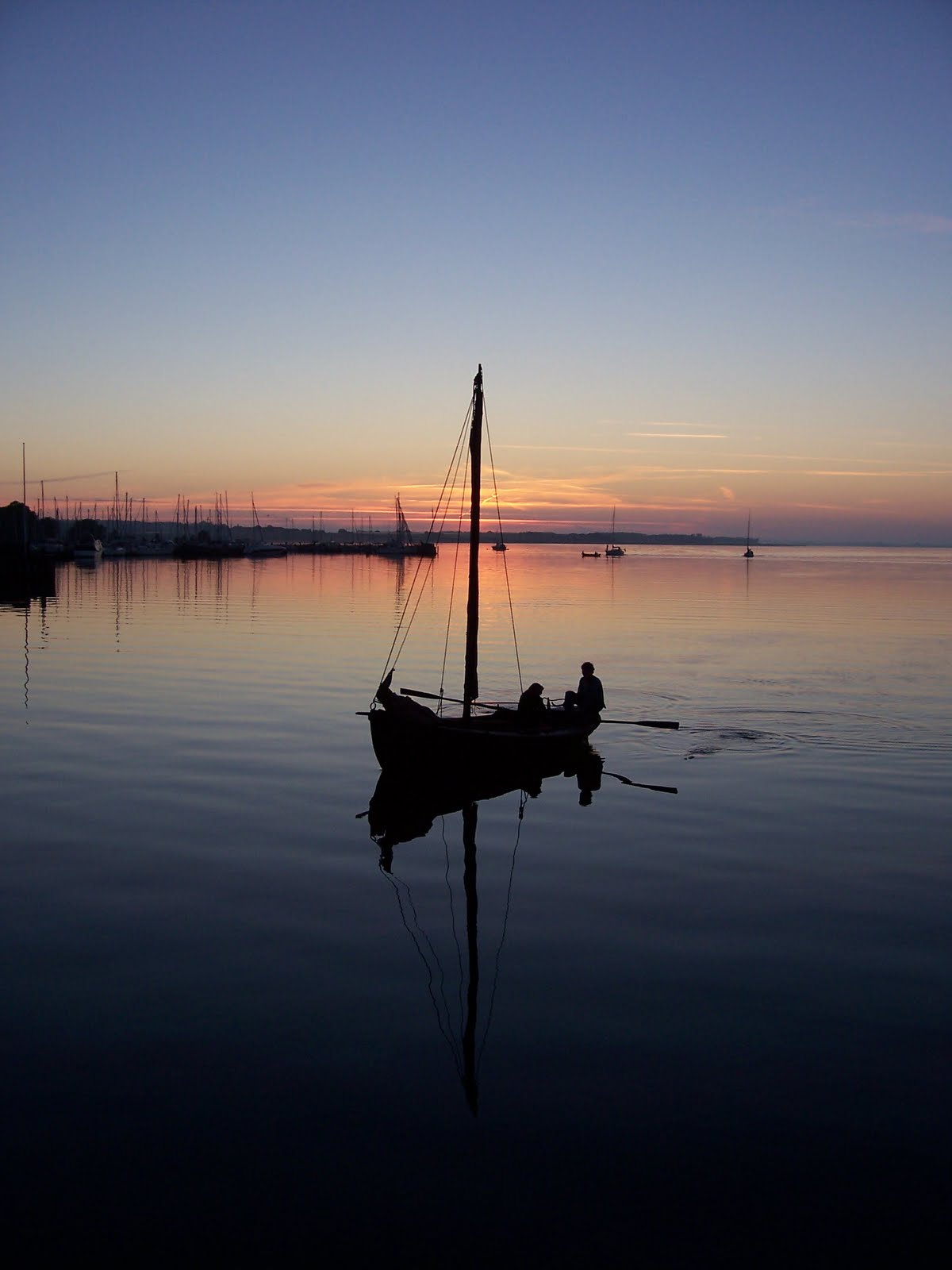
Picture credits: Sunset over Roskilde fjord, Katherine Langrish 2005
Ship and sun symbols: 'The Chariot of the Sun' by Peter Gelling & Hilda Ellis Davidson

Monday, 7 June 2010

Sailing with the Vikings


In about 1030 AD, the people of Roskilde Fjord in Denmark deliberately sank five old ships to block two of the three navigable channels leading into the fjord. This meant the only remaining entrance could easily be controlled, and any ship wishing to come down the fjord to Roskilde town would be spotted, challenged, and perhaps charged a toll for use of the harbour and the chance to trade.  Handy for the townsfolk then – and handy now: for those five scuttled ships have been rediscovered, raised and preserved, and are now a major tourist attraction as well as offering invaluable insights into Viking ship construction.  As an amazing bonus, while digging the foundations for the new Viking Ships Museum  they discovered not one, but nine more Viking ships buried in the silt.  One of them is the very longest longship ever found – over 36 metres!

Replicas of those first five ships, the ‘Skuldelev ships’, have now been built, and it was on some of these – five years ago this month – we were about to sail.

Arriving at Roskilde on a hot sunny June evening, we walked down through the town, past the great cathedral where no less than 28 of the Kings of Denmark lie buried, across the slanting cobbled square, and downhill under cool trees to the broad fjord.

The sun was low, but it wouldn’t set properly till eleven o’clock or later.  The western sky was full of colours, reflected in the fjord: stripes of tangerine, purple and blue.  And there they were, outlined against the sky: the tall masts and upcurved prows and sterns of four Viking ships, tethered to the jetty.  We walked past staring at them greedily: the two longships, Helge Ask and Sea Stallion of Glendalough; the fishing vessel, Kraka Fyr, the cargo ship, Roar Ege.  And then we saw a square sail, black against the sunset.  Another Viking vessel sailing towards Roskilde harbour, just as it would have done over a thousand years ago…and two swans swam across its path, like little Viking ships themselves, proud prows uplifted.

I was there because I was in the middle of writing the third and final book of a series of historical fantasies about the Viking era, and in this book, ‘Troll Blood’, my characters would sail across the Atlantic to the shores of ‘Vinland’ – the far-distant northeast coast of America – just as Leif the Lucky, son of Eirik the Red, did over a thousand years ago.  


And, no matter how much research you do in libraries, no matter how many books you read, there’s nothing to beat hands-on personal experience.  I’d found out that the Viking Ship Museum here at Roskilde ran a week-long sailing course in which I could learn a great deal about how to handle those great square-rigged sails, and all sorts of general things about how it really felt to be on the sea in a Viking age ship. 
Well, I learned a lot.  Here are some of my scribbled notes:

The sail towers over the boat – how big it is! – seems to cut off the sky and a large part of the horizon. 

The chuckle and truckle of water running along the sides and under the bottom boards.  Jellyfish pass by the end of my oar – ghostly circles in the dark water, frilled, pulsating.

It’s really hard work on the sheets when we change the tack, wrestling in these yards of struggling, flapping sail – the ropes are harsh and soft at the same time, dark horsehair, softish but prickly to the hand.  We yank and yank again, and the rope comes in through the hole in the gunwale, soaking wet, scattering spray like a dog shaking its coat. 

The boat heels, but nothing like so far as a modern yacht.  To change tack, the opposite lower leading corner of the sail changes and is fastened close to the bow to the ‘tack stick’.

Søren tells how his grandfather thought nothing of sailing thirty miles up and down the fjord to market, or of wheeling a barrow of live fish to Copenhagen and returning in a day

I learned how the mast could be taken down (unstepped) in a couple of minutes by flipping up the ‘shroud nails’; how a longship on a raid might cross the sea in three days rowing continuously: if one bench at a time rested, little speed was lost, so the resting period would ‘roll’ down the ship in a relay for the rowers to relax, drink, and answer calls of nature in turn.  And I learned that the round shields (so often depicted in overlapping rows along the ships’ sides) would only be hung out in an actual battle, ‘to cower behind’, said our skipper Søren, with a laugh.  ‘You can’t sail or row,’ he added, ‘with the shields in the way.’

Of course, most of the technical stuff never made it into the book; but I came away with confidence to write more truly, more realistically, about my characters’ voyage – even though they were headed out into the wild Atlantic, and I’d been sailing and rowing only in the fjord.  Who says research is dull?  We were there over midsummer.  On St John’s Eve, we camped in a hayfield with the boats on the shore below, ate barbecued fresh salmon, and watched the bonfires being lit along the fjord, and later the fireworks competing with a full, yellow moon.  

One of the things I liked best about being on our ship was the feeling of camaraderie amongst the crew, and the way, when things got lazy and the wind was blowing, those of us not needed to handle sails could lie back, relax, and tell stories, jokes and tall tales.  You realise how those Viking sailors must have done just the same thing.  

Thorstein, leaning back on the benches, says shyly, ‘So do you want to know about trolls?  We have lots of stories in Iceland about trolls.’

I say I’d love to hear, so he begins. ‘There was once a farmer’s wife, a lazy woman who would not weave the wool her husband provided.  One day a huge, ugly woman came to the farm, and offered to card, spin and weave it for her – but on condition that the farmer’s wife should guess her name, and if she didn’t guess right, she would have to go away with the troll (for this is what the ugly woman was) and serve her.

So the farmer’s wife agreed.  She thought it wouldn’t be hard to guess the troll woman’s name.  The troll woman sat down and carded and spun all the wool, and wove it into good cloth as fast as lightning.  The farmer’s wife was very happy – but not so happy when she tried to guess the troll’s name.  She tried this name and that, and they were all wrong.

‘Very well,’ said the great ugly troll woman, ‘I shall come back tomorrow, and if you can’t guess my name then, you shall come and serve me.’

The farmer’s wife was very frightened and began to cry and wail because she didn’t want to have to go with the troll.  And that evening the farmer came home…  ‘A funny thing happened to me today, wife.  I was passing a hill and saw a cave, all lighted up.  And inside, a huge troll woman was dancing and singing, “Tomorrow I shall have a new servant to do all the work for me.  She’ll never guess my name is Gilitrutt!”’

I tell Thorstein we have the same story in England, called ‘Tom Tit Tot’ (‘Rumpelstiltskin’ in Germany, and I think there’s a similar North of England story called Dame Habbitrot).  He adds with a smile, ‘But my mother’s father, who told me this story, used to say, ‘You know, probably the tall ugly troll woman was really the farmer himself – in disguise – to teach his wife a lesson…’