Thursday, 13 October 2022

Uncanny Whistlers


Whistling spirits aren’t the best-known of supernatural folkloric creatures, but they do occur, as I myself can tell you. The 'Seven Whistlers' was a death portent of seven crying birds - which Wordsworth describes in part of a sonnet about a poor old man who nevertheless ‘hath waking empire, wide as dreams’ since ‘rich are his walks with supernatural cheer’:

He the seven birds hath seen that never part,

Seen the seven whistlers on their nightly rounds

And counted them! And oftentimes will start,

For overhead are sweeping Gabriel’s hounds,

Doomed with their impious lord the flying hart

To sweep forever on aƫrial grounds.

'Supernatural cheer' seems an odd way to describe these dread omens, but perhaps the old man enjoyed telling Wordsworth the stories. The Whistler is among the 'fatal birds' Edward Spenser mentions in The Faerie Queene: 'the Whistler shrill, that whoso hears, doth dy.' (Book II, canto XII, verse 36)

I first came across the Seven Whistlers as a child reading one of Malcolm Saville’s well-known-at-the-time ‘Lone Pine’ adventure stories. Seven White Gates is set in Shropshire around and on the hill called Stiperstones. It’s a region full of folklore – Wild Edric and Lady Godda lead the Wild Hunt there, and the Devil sits on the rock formation on top of Stiperstones, known as the Devil’s Chair. Jenny, one of the characters in the story, tells the heroine Peter (yes) about the Seven Whistlers:

‘I remember Dad telling me once – and there are lots of others who’ll tell you too – that the Whistlers are seven mysterious birds sometimes heard whistling together at night. When you hear them in the night like that it’s bad, and the miners round her often wouldn’t go to work because an accident might happen to them ... it’s horrid. I hate them.’

There’s a rather wonderful 19th century poem about the Whistlers by Alice E. Gillington (1863-1934), who collected folklore and folk songs. The first verse: 

Whistling strangely, whistling sadly, whistling sweet and clear,

The Seven Whistlers have passed thy house, Pentruan of Porthmeor;

It was not in the morning, nor the noonday’s golden grace,

It was in the dead waste midnight, when the tide yelped loud in the Race;

The tide swings round in the Race, and they’re ‘plaining whisht and low.

And they come from the gray sea-marshes, where the gray sea-lavenders grow;

And the cotton grass sways to and fro;

And the gore-sprent sundews thrive

With oozy hands alive.

Canst hear the curlews’ whistle through thy dreamings dark and drear?

How they’re crying, crying, crying, Pentruan of Porthmeor?


Though the Seven Whistlers were often associated with curlews calling, that didn’t mean they were not still feared:

‘I heard ‘em one dark night last winter,’ said an old Folkestone fisherman. ‘They come over our heads all of a sudden, singing “ewe, ewe,” and the men in the boat wanted to go back. It came on to rain and blow soon afterwards and it was an awful night, sir; and sure enough before morning a boat was upset, and seven poor fellows drowned. I know what makes the noise, sir; it’s them long-billed curlews, but I never likes to hear them.’

            Folklore of the Northern Counties, William Henderson, Folk-Lore 1879, 137

So that’s the Seven Whistlers, but there are solitary whistlers too. JG Campbell’s Witchcraft and Second Sight in the Highlands and Islands records a tale from Tiree, ‘The Unearthly Whistle’. A young man was hurrying home late one moonlit night:

His way lay across a desolate moor called the Druim Buidhe (‘Yellow Ridge’), and when halfway he heard a loud whistle behind him but in a different direction from that in which he had come – at a distance, he thought, of above a mile. The whistle was so unearthly loud he thought every person in the island must have heard it. He hurried on, and when opposite an Carragh Biorach (‘the Sharp-Pointed Rock’) he heard the whistle again, as if at the place where he himself had been when he heard it first. The whistle was so clear and loud that it sent a shiver through his very marrow.

            With a beating heart he quickened his pace, and when at the gateway adjoining the village he belonged to, he heard the whistle at the Pointed Rock. He made off the road and managed to reach home before being overtaken. He rushed into the barn where he usually slept, and after one look towards the door at his pursuer, buried himself below a pile of corn.

            His father was in the house, and three times, with an interval between each call, heard a voice at the door saying. ‘Are you asleep? Will you not go to look at your son? He is in danger of his life and in risk of all he is worth.’

            Each call became more importunate, and at last the old man rose and went to the barn. After a search he found his son below a pile of sheaves, and nearly dead. The only account the young man could give was that when he stood at the door he could see the sky between the legs of his pursuer, who came to the door and said it was fortunate for him he had reached shelter, and that he (the pursuer) was such a one who had been killed in the ‘Field of Birds’ in the Moss, a part of Tiree near at hand.

                        The Gaelic Otherworld, JG Campbell, ed Ronald Black, Birlinn 2005, 282

Another tale of a strange whistler was collected in Gaelic in 1891 by Lady Evelyn Stewart Murray from John Robertson of Atholl (born c. 1829), carter and labourer. But ‘The Whistler of Glen Tilt’ was not malevolent:

There was a whistling spirit in Glen Tilt. It could be heard whistling up and down the glen but nobody ever saw it. A farmer called Paul lived in the glen. He had a flock of sheep and when he was out among the sheep Whistler would call to him, ‘Paul! Leave the sheep,’ and Whistler himself would keep the sheep safe. A thief went to steal Paul’s grey sheep and he tied the animal’s legs with garters and carried her off on his back. Whistler shouted, ‘Leave the grey sheep, Paul,’ and Whistler struck the man and he left the sheep. When the folk got up in the morning they found the sheep, tied up just as the thief had left it.

Tales from Highland Perthshire, Stewart Murray: tr. & ed. Robertson & Dilworth, Scottish Gaelic Text Soc. 2008, 139

A second tale of the same whistling spirit was told to Lady Evelyn by 83 year-old widow Mrs Ann Stewart (born 1808) on Saturday May 16th, 1891:

In Glen Tilt there was a spirit called the Whistler. The shepherds would hear him chivvying along the sheep and they wouldn’t see him, but they could hear the whistle even though they couldn’t see him. One wet night the River Tilt was in spate, and the shepherds said to each other, ‘We won’t see the Whistler tonight’ and the Whistler said, ‘I created the spirit laws. I went round by the bridge and here I am.’

Tales from Highland Perthshire, Stewart Murray: tr. & ed. Robertson & Dilworth, Scottish Gaelic Text Soc. 2008, 287

And so to my own whistler story. Far too long ago I lived in an old house in the remote Dales village of Malham, in Malhamdale at the top of Airedale. Nights were dark, winters were wild, and I'd lie at nights listening to the owls and the noise of the beck rushing over stones on its way down to the source of the Aire. Once in a while there was another sound, which I described in a diary entry of December 7th 1977. (I was twenty-one.) 

A black wind blowing around the house and I don’t like getting up in the mornings because of the cold. Last night there was the whistling again, long fluctuating whistles like a farmer to his dog. The time was ten past midnight and it was fainter than before, and only lasted about ten minutes. I have heard it often, louder and longer; it can’t possibly be the wind and is like no owl I ever heard.

It wasn't a curlew either, I was used to hearing their long melancholy cries. They are rare now. And later that month, Sunday December 18th:

Whistling again: it’s a clear still night, midnight. Very clear, shrill and fluctuating; it’s not wind. Either man, bird or ghost!

Maybe it was one of the farmers, though they wouldn’t usually be moving sheep at midnight, or be whistling for so long, so close to the farms. I don't have a good explanation, but I wrote a small poem at the time.


Whistling after dark,

whether man, bird, ghost,

often seems to come

when the stream runs most;


while the beck’s rough and loud

it carries most plain,

the long sheep-dog whistle

again and again,


like somebody walking

unable to sleep,

whistling the lost collie,

the canny dog that knew the sheep.


Picture credits:

Turner: Breakers on a Flat Beach (1835-40), National Gallery, Wikimeda

Turner: Fishing Boats Bringing a Disabled Ship into Port, Tate Gallery

Katharine Holmes: Malham: Trees and Barn, ink and wash: in possession of author.


Thursday, 6 October 2022

The Two Sisters and the Curse


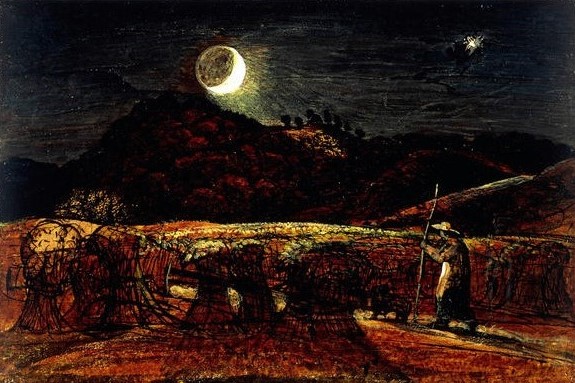
This sinister story is recorded by John Gregorson Campbell in ‘Clan Traditions and Popular Tales of the Western Highlands and Islands’ (1895). In his notes, Campbell explains that the term ‘dun’, applied to a human being, could be an expression of contempt. He adds that the harvest custom was for the last handful of corn to be cut and taken home by the reaper – usually the youngest – and kept as ‘the harvest maiden’ until the following year; and that old women might go about from house to house begging from the harvesters, and whoever was last to finish reaping would have to maintain one of them for a year. (I wonder if ‘last to finish reaping’ implied ‘more furrows to reap’ and therefore more corn to share?  Lastly, I think ‘my sickle will not cut garlic’ must be taken to mean that the sickle is not sharp.


Two sisters were living in the same township on the south side of Mull. One of them who was known as Lovely Mairearad had a fairy sweetheart, who came where she was, unknown to anyone, until one day she confided the secret to her sister, who was called Ailsa, and told her how she dearly loved her fairy sweetheart. ‘And now, sister,’ she said, ‘you will not tell anyone.’ ‘No,’ her sister answered, ‘I will not tell anyone; that story will as soon pass from my lips as it will from my knee!’ But she did not keep her promise; she told the secret of the fairy sweetheart to others, and when he came again, he found that he was observed, and he went away and never returned, nor was seen or heard of ever after by anyone in the place.

            When the lovely sister came to know this, she left her home and became a wanderer among the hills and hollows, and never afterwards came inside of a house door to sit or stand, while she lived. The cattle herders often tried to to get near her and persuade her to return home, but they never succeeded further than to hear her crooning a melancholy song which told how her sister had been false to her, and that the wrong done would be avenged on her or her descendants – if a fairy has power. On hearing that Ailsa was married, she repeated, ‘Dun Ailsa is married and has a son Torquil, and the evil will be avenged on her or on him.’ And she sang like this:

My mother’s place is deserted, empty and cold,

My father who loved me is asleep in the tomb,

Friendless and solitary I wander the fields

Since there is none in the world of my kindred

But a sister without pity.

She asked, and I told her, out of the fullness of my joy,

There was none nearer of kin to know my secret:

But I felt, and this brought the tears like rain to my eyes

That a story comes sooner from the lip than the knee.

 Then she was heard to utter these wishes:

May nothing on which you have set your expectations ever grow,

Nor dew ever fall on your ground.

May no smoke rise from your dwelling

In the depth of the hardest winter.

May the worm be your store,

And the moth under the lid of your chests.

If a fey being has power,

                        Revenge will be taken, though it be on your descendents. 

Ailsa married and had one son. Her afflicted sister heard of it and added to her song –

Dun Ailsa has married,

And she has a son Torquil.

Brown-haired Torquil who can climb the headland

And bring the seal off the waves,

The sickle in your hand is sharp,

In two swathes you will reap a sheaf.

Whatever other gifts the brown-haired only child of her sister was favoured with, he was a notable reaper, but this gift proved fatal to him. When he grew up to manhood he could reap as much as seven men, and none among them could compete with him. Then he was told that a strange woman was seen coming into the harvest fields in autumn after the reapers had left, and that she would reap a whole field before daylight next morning, or any part of the field that the reapers could not finish that day, and in whatever field she began, she left the work of seven reapers finished after her. She was known as the Maiden of the Cairn (Gruagach a’ chĆŗirn), from being seen to come out of a cairn over opposite.

            One evening then, brown-haired Torquil, who desired to see her at work, being later than usual returning home looked back and saw her beginning to reap in his own field. He turned back, and finding his sickle where he had put it away, took it and went after her. Resolving to overtake her, he began to reap the next furrow and said,  ‘You are a good reaper, but I will overtake you;’ but the harder he worked, the more he saw that instead of getting nearer to her, she was drawing further away from him. Then he called out,

            ‘Maiden of the cairn, wait for me, wait for me.’

            She said, answering him, ‘Handsome brown-haired youth, overtake me, overtake me,’

            He was confident that he would overtake her, and went on after her till the moon was darkened by a cloud; then he called to her,

            ‘The moon is cloud-smothered, delay, delay.’

            ‘I have no other light but her, overtake me, overtake me,’ she said.

            He did not, nor could he overtake her, and on seeing again how far she was in advance of him, he said, ‘I am weary with yesterday’s reaping, wait for me, wait for me.’ She answered, ‘I ascended the round hill of steep summits, overtake me, overtake me,’ but he could not. Then he said, ‘My sickle would be better for being sharpened, wait for me, wait for me.’ She answered, ‘My sickle will not cut garlic, overtake me, overtake me.’ At this she reached the head of the furrow, finished reaping and stood still where she was, waiting for him.

            When he reached the head of his own furrow, he caught the last handful of corn to keep it, as was the custom, it being the ‘Harvest Maiden’, and stood with it in one hand and the sickle in the other. Looking her steadily in the face, he said,

            ‘You have kept the old woman far from me, and it’s not my displeasure you deserve.’

            She said, ‘It is an ill thing on Monday to reap the harvest maiden.’

On her saying this, he fell dead in the field and never more drew breath. The Maiden of the Cairn was never afterwards seen, or heard of; and that was how the sister’s wishes ended.


Picture credit:

A Cornfield by Moonlight with the Evening Star (c.1830) - sketch by Samuel Palmer, British Museum

Tuesday, 13 September 2022

Defending VILLETTE


Way back in June 2016 I took part in an event for the BrontĆ« Society at Haworth Parsonage called ‘The Great Charlotte BrontĆ« Debate’. Up for friendly yet heated discussion was the question, ‘Whether  BrontĆ«’s greatest book was Jane Eyre or Villette?’ Jane Eyre was ably defended by Joanne Harris and Claire Harman, while Lucy Hughes-Hallett and myself took the part of Villette and its heroine Lucy Snowe. Tracy Chevalier presided and saw fair play, while the wonderful Maxine Peake read extracts from both novels. The audience, members of the BrontĆ« Society, were asked to vote for their preferred title before the debate, then vote again afterwards to see if we had changed any minds. This was my contribution, and I began by reading a couple of paragraphs from about a third of the way through Villette, when a violent thunderstorm breaks over the town one night. While her colleagues and pupils in the seminary wake in panic and pray, Lucy reacts differently. ‘Roughly roused and obliged to live,’ she dresses, gets out of the window and sits on the outer ledge with her feet on the sloping roof below.

It was wet, it was wild, it was pitch dark. [...] I could not go in: too resistless was the delight of staying with the wild hour, black and full of thunder, pealing out such an ode as language never delivered to man – too terribly glorious, the spectacle of clouds, split and pierced by white and blinding bolts.

            I did long, achingly, then and for four and twenty hours afterwards, for something to fetch me out of my present existence, and lead me upwards and onwards. This longing, and all of a similar kind, it was necessary to knock on the head, which I did, figuratively, after the manner of Jael to Sisera, driving a nail through their temples. Unlike Sisera, they did not die: they were but transiently stunned, and at intervals would turn on the nail with a rebellious wrench; then did the temples bleed, and the brain thrill to its core.

                        Villette, Chapter 12

This is an absolutely fabulous passage. Dramatic though it is, the thunderstorm Lucy climbs from her window to experience is less terrible than her mental anguish and that extraordinary simile of ‘turning on the nail with a rebellious wrench’. For the really striking thing is that Lucy’s communion with the storm, her delight in the wildness of nature, is not cathartic. It awakens more pain. And the only way she can deal with the pain is to try and kill something in herself: that awakening, that emotional response. There is no room in her cramped life for it: it cannot take her anywhere. It must be kept down. It will not quite die, but while it’s under control she can exist, and existence, not life, is all she can hope for.

            ‘I, Lucy Snowe, was calm.’ That’s the first thing this heroine tells us about herself, but of course she isn’t calm at all. ‘I had feelings’, she says... She just never allows herself to express them. Why? Because no one cares. She is just as passionate as Jane Eyre, but where Jane from her very childhood lets it out, Lucy shoves it all down out of sight – even out of our sight, for unlike Jane, Lucy makes no bid for our sympathy. If anything her opinion of us is low. She is abrasive and witty. She mocks, keeps secrets from us, makes wry, bitter comments about the gap between her experience and our illusions, satirises our complacence and naĆÆvety.

On quitting Bretton [...] I betook myself home, having been absent six months. It will be conjectured that I was of course glad to return to the bosom of my kindred. Well! the amiable conjecture does no harm and may therefore be left uncontradicted. Far from saying nay, indeed, I will permit the reader to picture me, for the next eight years as a bark slumbering through halcyon weather, in a harbour still as glass [...] A great many women and girls are supposed to pass their lives something in that fashion; why not I with the rest?

                       Villette, Chapter 4

            Villette is a book about constant mental suffering. No one has ever written better about the agony of powerlessness. Lucy is poor and plain. Jane Eyre is poor and plain too, or so we’re told – but we don’t really believe it any more than we believe Rochester is not handsome. We believe it about Lucy, though: she’s too painfully conscious of it. This lack of beauty, her social status and her sex require her to remain silent when she wants to speak, restrain herself when she wishes to act: there is no one even among her few friends in whom she can confide, for that would be to presume upon their affection – which is only affection, not love. She longs for love but she’s clear-sighted and knows the difference. To her friends the Brettons she’s ‘quiet Lucy Snowe’, not so much calm as nearly invisible. She can be drily funny about it, though never without pain. Handsome Dr John Bretton is smitten with shallow Ginevra Fanshawe and imagining Lucy to be hurt by her neglect, he feels the need to assure Lucy that ‘at heart, Ginevra values you’.

‘You are very kind,’ I said briefly. A disclaimer of the sentiments attributed to me burned on my lips, but I extinguished the flame. I submitted to be looked upon as the cast-off and now pining confidante of the distinguished Miss Fanshawe: but, reader, it was a hard submission.

Soon afterwards Lucy does lose patience and breaks out, ‘There is no delusion like your own. [...] On this exceptional point you are but a slave. I declare, where Miss Fanshawe is concerned, you merit no respect, nor have you mine.’ All this does is to cause coolness in their unequal but real friendship and she soon asks his forgiveness, which he warmly grants. But it’s a socially impossible relationship. When you can’t say what you want to say, you can’t be known. Out of kindness, Dr John promises to write to her: when she receives his first letter she draws out the happiness – saves up it for later. Will it be long or short? Cool or kind? She lives from letter to letter, but what’s vital emotional nourishment to her is little to him, and when the letters stop for weeks and she doesn’t know why and can’t ask – she’s  like a starving animal in a cage desperate to be fed…

            Villette is an extraordinary book. The heroine is in love with two different men at the same time and not a hint of censure. Charlotte BrontĆ« looks us straight in the eye and dares us to blink. ‘This is how it is,’ she seems to say. ‘Accept it.’ Lucy buries Dr John’s letters in a casket in the garden, but is haunted by an image of golden hair growing irresistably out though the cracks of a coffin... Like the image of Sisera ‘turning on the nail with a rebellious wrench’, her feeling for Dr John cannot be killed. It’s folded up tight like a magical tent from the Arabian Nights which, released, could open into a vast pavilion... and at the same time, she’s growing into a different kind of love with her fellow teacher M. Paul Emanuel, the crotchety, fiery little man who sees her, who perceives the fire, the strength and the soul that no one else sees. Perhaps not even herself.

            Villette is a pressure-cooker of a book, boiling with desperate, contained, suppressed passion. Every time some of the steam escapes, every time there’s a moment’s relief, it all gets battened down again. Close to the end, Lucy believes she’s lost Paul Emanuel, that he’s sailed for the Indies without a word of farewell. Wandering desolate among lively crowds at a midnight fete in the park, she suddenly glimpses him, and listen to this –

I clasped my hands very hard, and I drew my breath very deep; I held in the cry, I devoured the ejaculation, I forbade the start, I spoke and I stirred no more than a stone; but I knew what I looked on; through the dimness left in my eyes by many nights’ weeping, I knew him.

No sniggering please, at a word that did not then carry the only meaning it seems to have now. Not for  another seventeen pages does the pressure cooker finally explode. At last, after she’s waited and waited and waited for him, Paul Emanuel comes to speak to Lucy but  Madame Beck tries to prevent him from doing so, and the pressure can’t be contained any longer. Lucy cries aloud,

            ‘My heart will break!’ 

Four short, almost banal words: in a burst of anguish Lucy Snowe lets go her iron grip on herself and is recognised, acknowledged. ‘Trust me’, says Paul Emanuel, and his words ‘lifted a load, opened an outlet. With many a deep sob, with thrilling, with icy shiver, with strong trembling, and yet with relief –  Lucy weeps.

The overflowing fountain of Lucy’s deeply repressed emotion, and the fiery banishment of Madame Beck by Paul Emanuel, which follows, form the climax of the novel. There is no ‘Reader, I married him’. There’s a brief, very brief interlude of happiness, followed by the famously ambiguous ending, which of course isn’t ambiguous at all unless you want it to be. As if speaking to children, Lucy Snowe says to us, ‘I know you can’t cope with the truth, so here’s the lie. Believe it if you wish. Human kind cannot bear very much reality.’ And she withdraws from us: ‘Farewell.’ 

Post-script: Which side won the Great Debate? Well, the votes cast before it began strongly favoured Jane Eyre as Charlotte BrontĆ«’s greatest novel, but the votes cast at the end showed a distinct swing towards Villette. Although Jane Eyre still came out top, Lucy Hughes-Hallett and I can claim that we changed some minds, that evening. The Bronte Society's own post on the occasion can be read here: https://bronteparsonage.blogspot.com/2016/06/the-great-charlotte-bronte-debate.html)


Lucy Hughes-Hallett, Katherine Langrish, Maxine Peake, Tracy Chevalier, Joanne Harris and Claire Harman

Picture credits

Lucy Snowe at the door of the Pensionnat de Demoiselles - by Edmund Morison Wimperis

Photo of the Great Charlotte Bronte Debate team - Brontƫ Society