Showing posts with label Wild Edric. Show all posts

Wednesday, 8 March 2017

Women who lead the Wild Hunt


As an appropriate post for International Women's Day, fortuitously following on from my last post - are there any female leaders of the Wild Hunt? The answer is yes, which shouldn’t surprise anyone who’s ever heard of a Valkyrie.  Njal’s Saga tells of a man in Caithness named Dorrud, who on Good Friday sees ‘twelve people riding together to a women’s room’ who disappear inside. Looking in, he sees these twelve women working a loom. They are using severed heads for the weights, and intestines for the thread. As they wind the finished cloth on to the loom beam, the women chant a poem known as ‘The Song of the Spear’ which includes these lines:

Valkyries decide
who dies or lives.
[…]
Let us ride swiftly
on our saddle-less horses
hence from here
with swords in hand.

Njal’s Saga, tr. Robert Cook (Penguin Classics)

The women then pull down the cloth and tear it to pieces; each keeping a torn piece in her hand, they climb on their horses and ride away, six to the south and six to the north.

In Gods and Myths of Northern Europe, Hilde Ellis Davidson cites an Old English charm known as Wið færstice (‘Against sudden pain’ – probably cramp or stitch), which visualises the pain as ‘caused by the spears of certain supernatural women’:

Loud were they, lo, loud, riding over the hill.
They were of one mind, riding over the land,
Shield thyself now, to escape from this ill.
Out, little spear, if herein thou be.
Under shield of light linden I took up my stand
When the mighty women made ready their power
And sent out their screaming spears…

Davidson thinks this may once have been a battle-spell, though the charm addresses supernatural causes of pain – elf-shot, witch-shot, gods’-shot – rather than human. (Cramps do seem to come out of nowhere…)  In another Old English charm a swarm of bees is addressed as sigewif, ‘victory-women’. This implies that Anglo-Saxons correctly assumed worker bees to be female, which was neither obvious nor scientifically proved until the late 18th century. At any rate, the image conjured up is a flying host of warrior women, armed of course with stings. 

Gold plaques embossed with bee goddesses, 7th C Rhodes. British Museum

In England, at least one Wild Hunt still possesses a female leader. In Shropshire, the Lady Godda rides the hills forever with her partner Wild Edric at the head of their troop.  First found in the late 12th century account of Walter Map, the tale tells  how the lord of the manor of Ledbury North, Edric Salvage (a real person named in Domesday Book) snatches an unnamed fairy woman he has found dancing with her sisters in a cottage in the woods. She marries him on condition he must never reproach her with her fairy origin: when he breaks this prohibition she vanishes and Edric dies. However, as Katharine Briggs remarks in ‘A Dictionary of Fairies’, ‘Tradition restored him to his wife, and they rode together over the Welsh borders for many centuries after his death.’  To see them was unlucky. Charlotte Burne in ‘Shropshire Folklore’ (1883) knew a servant girl who as a child had seen them with her own eyes: by this time, the fairy lady had acquired a name:

It was in 1853 or 1854 or, just before the Crimean War broke out.  She was with her father, a miner, at Minsterley, and she heard the blast of a horn. Her father bade her cover her face, all but her eyes, and on no account speak, lest she should go mad. Then they all came by; Wild Edric himself on a white horse at the head of the band, and the Lady Godda his wife, riding at full speed over the hills. 

Hold that thought please, and read this account from Jacob Grimm. 

There was once a rich lady of rank named frau Gauden; so passionately she loved the chase, that she let fall the sinful word, ‘could she but always hunt, she cared not to win heaven’. Four-and-twenty daughters had dame Gauden, who all nursed the same desire. One day, as mother and daughters in wild delight hunted over woods and fields and once more that wicked word escaped their lips, that ‘hunting was better than heaven,’ lo, suddenly before their mother’s eyes the daughters’ dresses turn into tufts of fur, their arms into legs, and four-and-twenty bitches bark around their mother’s hunting car, four doing duty as horses, the rest encircling the carriage; and away goes the wild train into the the clouds, there betwixt heaven and earth to hunt unceasingly as they had wished, from day to day, from year to year. 

They have long wearied of the wild pursuit, and lament their impious wish, but they must bear the fruits of their guilt till the hour of redemption comes. Come it will, but who knows when? During the twölven* (for at other times we sons of men cannot perceive her) frau Gauden directs her hunt towards human habitations; best of all she loves on the night of Christmas eve or New Year’s eve to drive through the village streets, and wherever she finds a street door open, she sends a dog in. Next morning a little dog wags his tail at the inmates, he does them no other harm but that he disturbs their night’s rest by his whining. He is not to be pacified or driven away. Kill him, and he turns into a stone by day, which, if thrown away, comes back to the house by main force and is a dog again at night. So he whimpers and whines the whole year round, brings sickness and death upon man and beast, and danger of fire to the house; not till the twölven comes round again does peace return to the house. 

* twölven: the twelve nights of Yule or Christmas
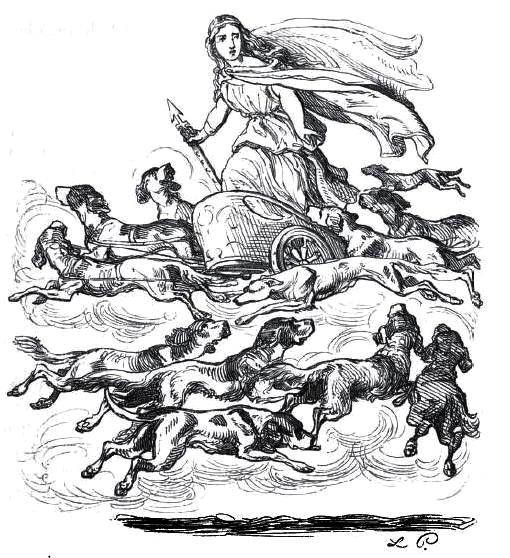

Frau Gauden and the Lady Godda are both supernatural wild huntresses and the names are surely too similar to be coincidence. But who was Frau Gauden? Grimm continues with another story. 

Better luck befalls those who do dame Gauden a service. It happens at times that in the darkness of night she misses her way and comes to a crossroad. Crossroads are to the good lady a stone of stumbling: every time she strays into such, some part of her carriage breaks, which she cannot herself rectify. In this dilemma she was once when she came, dressed as a stately dame, to the bedside of a labourer at Böck, awaked him and implored him to help her in her need. The man was prevailed on, followed her to the crossroads, and found one of her carriage wheels was off. He put the matter to rights, and by way of thanks for his trouble she bade him gather up in his pockets sundry deposits left by her canine attendants during their stay at the crossroads, whether as the effect of great dread or of good digestion. The man was indignant at the proposal … incredulous, yet curious, he took some with him. And lo, at daybreak, to his no small amazement, his earnings glittered like gold, and in fact it was gold.  He was sorry now that he had not brought it all away.

Notable here (apart from the enjoyable comic element) is that though like the Valkyries, Godda rides a horse, Frau Gauden travels in a wagon, which seems a cumbersome thing to go hunting in. 


But here is a goddess or priestess riding on a wagon. It’s made of bronze and was found in a cremation grave of the 7th century BC, near Strettweg in Austria. The female figure in the middle who supports an offering bowl towers above a crowd of smaller figurines, male and female, some on horses. Facing outwards at both the front and back is a stag flanked by figures of indeterminate sex who are holding its antlers. There is of course no knowing for sure what all this may have meant, or of connecting it in any direct way to the Wild Hunt or to the wagons of Frau Gauden or Frau Holle. But deities in wagons are certainly known from prehistory. The Norse gods called the Vanir presided over fertility and the domestic arts: the two most powerful were brother and sister Freyr and Freyja – titles which mean simply ‘Lord’ and ‘Lady’, and from which the word ‘Frau’ is derived.  


If a sly story told in the 14th century Icelandic Flateyjarbòk (the ‘Flat Island Book’) has any truth in it, an image of Freyr used to be taken about the Swedish countryside in a wagon accompanied by a priestess: the wagon gets stuck in a snowstorm and all the attendants desert it except the priestess and a young man called Gunnar. The two keep each other warm in the time-honoured way: a few months later when the priestess is discovered to be with child, the worshippers are delighted at the fertility of their ‘god’. It’s quite possible that Freyr’s sister Freyja also travelled in a wagon. A beautifully carved ceremonial wagon was placed in the Oseberg ship, itself the burial-place of two high-status women who may have been priestesses. Carefully dismantled wagons have been found in Danish bogs, presumably cult offerings.


The Roman historian Tacitus (AD 56-120) tells of a Danish goddess, Nerthus, who represented ‘Mother Earth’ and  whose occasional dwelling was a sacred wagon in a grove of trees on an island:

One priest, and only one, may touch it. It is he who becomes aware when the goddess is present in her holy seat; he harnesses a yoke of heifers to the car, and follows in attendance with reverent mien. Then are the days of festival, and all places which she honours with her presence keep holiday. Men lay aside their arms and go not to war; all iron is locked away … until the priest restores her to her temple, when she has had enough of her converse with mortals. Then the car and the robes and (if we choose to believe them) the goddess herself are washed in a mystic pool. Slaves are the ministers of this office, and are forthwith drowned in the pool. Dark terror springs from this, and a sacred mystery surrounds those rites which no man is permitted to look upon. 

Tacitus, Germania, 40, tr. RB Townshend, 1894

Wagons are associated with another supernatural woman, Frau Holda. Grimm suggests she is originally a sky deity associated with the weather – and therefore able to move through the air. She appears in the Grimms fairytales as the kindly but powerful Mother Holle (KHM 24) whose country the heroine arrives at by jumping down a well. 

At last she came to a little house, out of which an old woman peeped; but she had such large teeth that the girl was frightened, and was about to run away. But the old woman called out to her,  ‘What are you afraid of, dear child? Stay with me; if you will do all the work in the house properly, you shall be the better for it. Only you must take care to make my bed well, and to shake it thoroughly till the feathers fly – for then there is snow on the earth. I am Mother Holle.’


'The Old Woman is plucking her geese' was the phrase my mother used when I was small... In a story very similar to the one about Frau Gauden, Mother Holle needs the linchpin of her wagon mended, and rewards the helpful peasant with the woodshavings left from his work: these too turn to solid gold. 

But Holda had her dark side. ‘At other times,’Jacob Grimm continues, ‘Holda, like Wotan, can also ride on the winds, clothed in terror, and she, like the god, belongs to the ‘wütende heer’ [furious army]. From this arose the fancy, that witches ride in Holle’s company … in Upper Hesse and the Westerwald, Holle-riding, to ride with Holle, is equivalent to the witches’ ride.’ The souls of unbaptised infants were held to join Holle’s wild company.  

The unnamed author of a 9th century document called the Canon Episcopi denounces the the wicked folly of those who believe in witches and their power. ‘Have you shared in a superstition to which some wicked women have given themselves?’ he demands. ‘Fooled by demonic phantasms, they believe themselves in the hours of the night to ride with Diana the pagan goddess, with Herodias and with innumerable other women, mounted on the backs of animals and travelling great distances in the silence of the night.’ 


Diana or Artemis is an obvious Wild Huntress. Nor is it surprising that a cleric should place Herodias in the witches' wild hunt, though it’s worth noting his main point is that witches don’t exist, not that they do. (It took a long time for the church to pass from this relatively healthy scepticism to the crazed witchhunts of later centuries). Herodias is the name given in the Middle Ages to the girl who danced before Herod and asked him for the head of John the Baptist. Though known today as Salome, that name is not in the Gospels; some Greek versions read ‘Herod’s daughter Herodias’, while in  the Latin she is named only ‘the girl’ or ‘the daughter of Herodias’ - who was her mother. Jacob Grimm suggests that Herodias ‘was dragged into the circle of night-women … because she played and danced, and since her death goes booming through the air as the “wind’s bride”.’  Medieval poets really went to town on Salome/Herodias’ fate; Grimm quotes from a medieval Latin poem which tells how  

From midnight to first cock-crow she sits on oaks and hazel-trees, the rest of her time she floats through the empty air. She was inflamed by love for John which he did not return: when his head is brought in on a charger she would fain have covered it with tears and kisses, but it draws back and begins to blow at her; she is whirled into empty space and there she hangs forever.


Frau Gauden and Frau Holle both have connections with crossroads. One of the many titles of the Greek goddess Hecate was ‘She of the crossroads’, and she was represented as three bodied, able to face in all directions.  Dogs were sacred to her, and she presided over thresholds and crossing-places, including the threshold between life and death. The dog is of course the guard-dog of the threshold into the underworld. According to Everyman’s Classical Dictionary Hecate was probably ‘a pre-Hellenic chthonian deity’ and Hesiod represents her as able, like the Norse Vanir, to gift mankind with wealth and all the blessings of daily life.  With her troop of ghosts and hell-hounds she visited crossroads where offerings of meat, eggs and fish were left for her. And in the 3rd century BC Argonautica, Medea tells Jason to sacrifice a ewe to Hecate, pour honey over the offering and leave without looking back – even if he hears the sound of footsteps or the baying of hounds. (Argonautica Book III lines 1020-1040)

Finally, what about the Breton legend of the Ankou who drives about the countryside in a cart, picking up souls? ‘At night,’ says Sabine Baring-Gould, ‘ a wain is heard coming along the road with a creaking axle. It halts at the door, and that is the summons.’ The Ankou is a male figure, but as Baring Gould points out:

The wagon of the Ankou is like the death-coach that one hears of in Devon and Wales. It is all black, with black horses drawing it, driven by a headless coachman. A black hound runs before it, and within sits a lady – in the neighbourhood of Okehampton and Tavistock she is supposed to be a certain Lady Howard, but she is assuredly a personification of Death, for the coach stops to pick up the spirits of the dying.

This seems to bring us back to the valkyries again – the choosers of the slain. 

It’s hardly possible or even desirable to come up with a single explanation for stories of the Wild Hunt, but it does seem to me that its female leaders are even more complex in origin than the males. The leaders of most British Wild Hunts have assumed the names and characters of local heroes such as Edric Salvage, Hereward, King Arthur, Sir Francis Drake, a tendency which makes them somehow easier to grasp, more comprehensible.  But the only remaining British Wild Huntress, Lady Godda, has a name similar to the German Frau Gauden, stories of whom include items – wagons, dogs, crossroads – reminiscent of ancient goddesses such as Nerthus and Hecate who held sway over domestic affairs such as fertility and farming, which literally implies over life and death.  And since the Wild Hunt has always been associated with death, its appearance in tales from Germany and Scandinavia also suggest the weaving in of a separate strand of bloody battle-spirits. Hilda Davidson thinks the valkyries may originally have been believed to devour the dead of the battlefield, rather than merely, as later, to escort them to Valhalla. 

Herodias, whirling in the windy blast from the lips of John the Baptist’s severed head – Frau Gauden with her carriage and her dogs and their golden poo – Lady Godda riding on her white horse in her green gown like many a later Queen of Elfland – the phantasmal spear-women galloping over the hill while drops of blood shake from their horses’ manes – the lady in the black death-coach – these are wonderfully various stories which deserve to be better known. 


Picture credits 

Hilde, one of the valkyries, by Ludwig Pietsch, 1894

Frigga or Frau Gode hunting, by Ludwig Pietsch, 1894

Gold plaques embossed with winged bee goddesses, perhaps the Thriai, found at Camiros Rhodes, dated to 7th century BCE (British Museum)

Strettweg cult wagon, photo by Thilo Parg, Wikimedia Commons  

Nerthus in her wagon, by Emile Doepler (1855-1922)

Goldmarie shaking Mother Holle's bedding, by Herman Vogel (1854-1921)

The Wild Hunt, by Peter Nicolai Arbo, 1831-1892

Salome dancing before Herod, by Gustave Moreau, Wikimedia Commons

Valkyries leading the slain to Valhalla, by Ludwig Pietsch, 1894

Friday, 16 November 2012

Wild Edric - and the art of writing


by Pauline Fisk


My whole life has been spent trying to bring together ‘real life’ and the world of fantasy, in particular by finding new and interesting ways of expressing a sense of the magical in my writing. Ever since I was five years old, hunting down fairies in the back alley behind my parents’ house, a sense of more to life than meets the eye has been part of who I am.  When I was a child, life was one big fairy tale.  That was how I felt.  But how to get into that fairy tale?  How to make that fairy tale my life, and make it real and be a part of it? 

It was through stories that I found the way.  I couldn’t write when I was five years old, but I could make up stories and that was what I did, standing at the garden fence, telling them out loud to the big children in the house next door, lined up on their side of the fence asking, ‘What happened next?’   But those stories, made up off the top of my head, were ephemeral.  They were fly-by-nights, whereas words on paper had a strange new durability which I discovered when I learnt to write.   Describing Winnie the Pooh hunting honey made me part of the story.  Adventuring with the Famous Five turned them into a Famous Six.  I made those things my own, and I made them real - and simply by writing about them. 

This is something I’ve been doing ever since.  When, at the end of ‘Mad Dog Moonlight’, I wrote about a river flowing through the stars, I put myself onto that river and sailed away.  When Abren in ‘Sabrina Fludde’ turned to water and flowed down a mountain, I flowed too.  And when hoof-prints beat upon the hill behind my house, I knew that Wild Edric, himself - that glorious superhero of Shropshire legend - was passing in the night.  By writing him into ‘Midnight Blue’, I wasn’t just making him up.  The act of writing brought him to life.

Tolkien defines fairy tales as stories about the adventures of humankind in Faerie, and here amongst the hills, valleys, woods and towns of my home county, Shropshire, Faerie’s all around me.  It’s where I live.  It’s a fabled place.  And I’m twice blessed, because it also exists inside my head.          

The power of imagination is the land called Faerie.  ‘We may put a deadly green upon a man’s face and produce horror.  We may make the rare and terrible blue moon to shine, or we may cause woods to spring with silver leaves and rams to wear fleeces of gold.  In such ‘fantasy’ as it is called, new form is made; Faerie begins, Man becomes a sub-creator.’

Tolkien again, who wrote fairy tales for adults to read as a natural branch of literature rather than playing at ‘being children’, or pretending to enjoy them for the sake of the kids.   ‘When we can take green from grass, blue from leaves and red from blood, we have already an enchanter’s power,’ he wrote.   And what else compares to having that power?  

As a child I was captivated by Hans Christian Anderson’s Fairy Tales.  As a  teenager I discovered Alan Garner’s ‘Weirdstone of Brisingamen’.  Starting out in life as a writer myself, I fell head-first into Tolkien, and took some extracting.  Finally I found my own voice and my own way into Faerie.   This was a long process, which is what the word ‘finally’ is all about.  For many years I thought that if I sounded like the writers I admired, Emily Bronte, Dylan Thomas, JRR Tolkien, Graham Greene – whoever the favourite of the moment might be – then I’d be a ‘proper’ writer but, if I sounded like myself, nobody would ever read me.    A book of terrible short stories was published at the age of twenty-three [long since out of print, thank God], its lofty style definitely not mine.   It wasn’t until years later, embarking upon ‘Midnight Blue’ that I developed the confidence as a writer to be myself. 

I’m indebted to that decision.  ‘Midnight Blue’ would never have been written without it.  But it also would never have been written without Charlotte Burne, the first woman president of the Folklore Society, whose ‘Shropshire Folk-Lore: A Sheaf of Gleanings’ introduced me to Wild Edric, whose mysterious presence haunts ‘Midnight Blue’. 

 According to legend, whenever England is in danger, Wild Edric and his knights rise up from their sleep of centuries beneath a rugged range of Shropshire hills called the Stiperstones, and ride out in warning of impending doom. Charlotte Burne recorded conversations with people who claimed he’d been heard and seen before both the Battle of Waterloo and the First World War.  

The history behind the story, as recorded in the Anglo-Saxon Chronicles, tells of a local lord who, having refused to submit to the Norman Conquest by raising a rebellion which was decisively defeated, betrayed his people by joining  forces with the Conqueror.  For this dastardly about-face, ‘Wild Edric’, as he became known, was doomed to sleep beneath the Stiperstones with his knights, only ever finding the release of death when England returned to her rightful people.  He sleeps still, and some legends have added the comfort of a fairy wife, the Lady Godda, though others have him meeting and losing her before his days of betrayal and doom. 

Wild Edric’s is a great story and, both as legend and history, he’s alive and well in Shropshire.  After writing him into ‘Midnight Blue’, I attended a history society meeting where local Stiperstones people claimed to have heard him riding by, and one person even claimed direct descent.  And he’s alive and well in my life too. I've talked about him at a weekend I’m running on myths and legends and how to use them in creative writing.  I've even led a walk up to the Devil’s Chair, where he and his knights are supposed to burst out of the ground. 

It’s years now since I wrote ‘Midnight Blue’, but Wild Edric has stayed with me ever since.  My books have included other characters I first came across in Charlotte Burne. including the highwayman Humphrey Kynaston, and the goddess of the River Severn, brought to life in ‘Sabrina Fludde’.  But nowhere have I found a sadder doom than Edric’s, lying beneath cold rocks, unable to die - unable even to be at peace.

The romance of Edric is Arthurian.  He too is meant to sleep until his country is set free.  And the legend of Alderley, which Alan Garner drew on in his book, ‘The Weirdstone of Brisingamen’, calls forth sleeping knights as well.  They’re a universal emblem – and yet they’re a personal emblem too, especially if you’re a writer.

Every writer’s like a sleeping knight beneath a hill, brought to life when he or she has a story to tell, rising in the dark to gallop forth with a laugh, or tears or a chill breeze to broadcast to the waiting world.  When I’m writing, I feel alive. When I’m not, I feel asleep.  It’s as powerful as that.   Maybe the idea of writers as the white-knight guardians of a watching world sounds a bit fanciful to you. But I’d say not.  I’d say what we do matters more than anyone could ever say, and that the idea of an Edric who performs the role of guardian is only there because people want it, just as they want writing, and stories and people like me. 

So I can’t help but identify with Wild Edric.  He and I are two sides of the same coin.  He’s an age-old legend, trying to break free, and I’m a fresh-faced pilgrim at the gate of Faerie, trying to get in.


PAULINE FISK'S first book, ‘Midnight Blue’ won the Smarties Book Prize in 1990. It's the story of a girl called Bonnie who has just found a home with her very young mother, in an inner city block of flats.  Just as it looks as if they can be happy together and build their relationship, her controlling and malevolent grandmother moves in: and Bonnie runs away, finding refuge in a mid-city oasis, a walled garden where a mysterious man called Michael is building a hot air balloon with the help of a strange shadowy boy.  Michael’s aim is to fly to the land beyond the sky:

Beyond the sky.  Not ‘in outer space’ or ‘in another galaxy’, but beyond the sky… as though it were possible to peel away the edge of the blue and pass straight through.
Sabrina Fludde’(2001), opens with a body floating down the River Severn, the body of a lost, almost drowned girl whose memory is lost too, who plucks the strange name Abren out of the air for herself...  In fact, the book is full of lost characters with strange names. In the end, Abren has to return to her own source (and that of the river) on the mountain Plynlimon, where a cold and sinister family claim her as their own.  Alone and in terrible danger, she makes her escape down to the sea.  And 'Mad Dog Moonlight' (2009) is another tale of a child seeking his true self and a place to belong.  Pauline's latest book is 'Into the Trees', in which a boy comes to Belize looking for his father and falls in with a group of gap year volunteers.  Living in the trees will change them all. 

Pauline's books are beautifully written, interweaving strands of the real world with airy fibres so fine, they are barely even fantasy – more like mysticism, or elemental forces.  She writes about vast emotional themes of love, anger, insecurity, and the need to belong to people and a place.  They leave a lasting imprint on the mind.


Picture credits
The Wild Hunt Illustration by Friedrich Wilhelm Heine,Wikimedia Commons
Herne the Hunter  Illustration by George Cruikshank, scan by Steven J Plunkett, Wikimedia Commons


Friday, 8 July 2011

Fairytale Reflections (26) Pauline Fisk

Pauline Fisk is a fantasy writer of rare talent.  Her books take you where few writers even think to go, interweaving strands of the real world with airy fibres so fine and strong, they are barely even fantasy – more like mysticism, or elemental forces.  She writes about vast emotional themes of love, anger, insecurity, and the need to belong to people and a place.  They leave a lasting imprint on the mind.

Her first book, ‘Midnight Blue’, which won the Smarties Book Prize in 1990, is a story about a young girl called Bonnie who has just found a home with her very young mother, in an inner city block of flats.  Just as it looks as if they can be happy together and build their relationship, her controlling, rigid and malevolent grandmother moves in: and Bonnie runs away, finding refuge in a mid-city oasis, a walled garden in which a mysterious man called Michael is building a hot air balloon with the help of a strange shadowy boy.  Michael’s aim is to fly to the land beyond the sky:

Beyond the sky.  Not ‘in outer space’ or ‘in another galaxy’, but beyond the sky… as though it were possible to peel away the edge of the blue and pass straight through.

Bonnie and the shadow-boy seize the balloon and fly without him.

As they rose, the sun rose with them, as if they were racing for the top of the sky.  Its warmth welcomed them, turned the dark skin of the fiery balloon as Michael had named it, midnight blue.  They flew straight up … the sweet, clear music of the lonely pipe, the only sound left in the whole world, drew them on until they prepared to hit the very roof-top of the sky itself. Then the smooth sky puckered into cloth-of-blue and drew aside for them, like curtains parting.

How on earth to follow that?  Well, Bonnie wakes up, apparently after the balloon has crash-landed, in the bedroom of a farmhouse in a place called Highholly Hill, in the welcoming midst of a warm-hearted, but surprisingly incurious  family whose daughter, Arabella, is almost Bonnie’s doppelganger: herself as she might have been in a different, secure life.  Far from relaxing into this idyllic world, Bonnie struggles with jealousy of Arabella, and hatred. And then her grandmother reappears, a sinister, knowing figure with the power to suck away the essence of a person and leave a simulacrum behind.  There’s a lot going on in this book.

(If you want to see Highholly Hill, look at the photo at the head of this blog.  Pauline and I share a love for the magnificent and brooding hill called Stiperstones, in her home county of Shropshire on the Welsh border.  In my book ‘Dark Angels’, I call it ‘Devil’s Edge’.)

Pauline has written many more books since then, and many of them are set in or around Shropshire and the borders of Wales.  ‘Sabrina Fludde’, Bloomsbury 2001, opens with a body floating down the River Severn, the body of a lost, almost drowned girl whose memory is lost too, who plucks the strange name Abren out of the air for herself...  In fact, the book is full of lost characters with strange names – a homeless boy called Phaze II; a speechless and motionless old woman called Sabrina Fludde. In the end, Abren has to return to her own source (and that of the river) on the mountain Plynlimon, where a cold and sinister family who claim her as their own.  Alone and in terrible danger, she must make her escape down to the sea.

Abren listened to the stream murmuring as it flowed into the darkness.  She fancied that she heard something.  A snatch of a new sound carried on the water.  Just a whisper, but growing all the time – and Abren knew what it was!

“You’re fine,” the stream sang sweetly.  “Really.  Fine.  You’re brave and strong and where you should be.  There’s nothing to be frightened of.  Trust me.

Like 'Midnight Blue', the book is interwoven with legends and folklore.  It’s a gripping and eerie mystery with strongly realised modern settings, which looks at the way old hatreds tend to morph into new rivalries.  When a gang of boys calling themselves the Border Commandoes push Abren off the iron bridge into the river, Phaze II is a shamed and unwilling witness:

Even when he saw the body, Phaze II knew he wouldn’t do a thing.  There it was right under him, waves breaking over it.  And he knew he couldn’t help.  Not with the river in full flood.  Not in the dark, with the water as cold as ice, and waves with jagged edges like hungry white teeth. 
            “I can’t!” he shouted, peeling out of his coat.
            “I won’t!” he shouted, pulling off his boots.
            “NEVER IN A MILLION YEARS!” he shouted – and he jumped.            

Do read these books, they are beautiful, and finely written, and completely unlike anyone else’s.  (Probably only Pauline could write about a girl who is, in some mystical sense, also a river).  And now I’m going to let her tell you all about one of the most enduring legends of Shropshire…


WILD EDRIC (and me) 


My whole life has been spent trying to bring together ‘real life’ and the world of fantasy, in particular by finding new and interesting ways of expressing a sense of the magical in my writing. Ever since I was five years old, hunting down fairies in the back alley behind my parents’ house, a sense of more to life than meets the eye has been part of who I am.  When I was a child, life was one big fairy tale.  That was how I felt.  But how to get into that fairy tale?  How to make that fairy tale my life, and make it real and be a part of it? 

It was through stories that I found the way.  I couldn’t write when I was five years old, but I could make up stories and that was what I did, standing at the garden fence, telling them out loud to the big children in the house next door, lined up on their side of the fence asking, ‘What happened next?’   But those stories, made up off the top of my head, were ephemeral.  They were fly-by-nights, whereas words on paper had a strange new durability which I discovered when I learnt to write.   Describing Winnie the Pooh hunting honey made me part of the story.  Adventuring with the Famous Five turned them into a Famous Six.  I made those things my own, and I made them real - and simply by writing about them. 

This is something I’ve been doing ever since.  When, at the end of ‘Mad Dog Moonlight’, I wrote about a river flowing through the stars, I put myself onto that river and sailed away.  When Abren in ‘Sabrina Fludde’ turned to water and flowed down a mountain, I flowed too.  And when hoof-prints beat upon the hill behind my house, I knew that Wild Edric, himself - that glorious superhero of Shropshire legend - was passing in the night.  By writing him into ‘Midnight Blue’, I wasn’t just making him up.  The act of writing brought him to life.

Tolkien defines fairy tales as stories about the adventures of humankind in Faerie, and here amongst the hills, valleys, woods and towns of my home county, Shropshire, Faerie’s all around me.  It’s where I live.  It’s a fabled place.  And I’m twice blessed, because it also exists inside my head.          

The power of imagination is the land called Faerie.  ‘We may put a deadly green upon a man’s face and produce horror.  We may make the rare and terrible blue moon to shine, or we may cause woods to spring with silver leaves and rams to wear fleeces of gold.  In such ‘fantasy’ as it is called, new form is made; Faerie begins, Man becomes a sub-creator.’

Tolkien again, who wrote fairy tales for adults to read as a natural branch of literature rather than playing at ‘being children’, or pretending to enjoy them for the sake of the kids.   ‘When we can take green from grass, blue from leaves and red from blood, we have already an enchanter’s power,’ he wrote.   And what else compares to having that power?  

As a child I was captivated by Hans Christian Anderson’s Fairy Tales.  As a  teenager I discovered Alan Garner’s ‘Weirdstone of Brisingamen’.  Starting out in life as a writer myself, I fell head-first into Tolkien, and took some extracting.  Finally I found my own voice and my own way into Faerie.   This was a long process, which is what the word ‘finally’ is all about.  For many years I thought that if I sounded like the writers I admired, Emily Bronte, Dylan Thomas, JRR Tolkien, Graham Greene – whoever the favourite of the moment might be – then I’d be a ‘proper’ writer but, if I sounded like myself, nobody would ever read me.    A book of terrible short stories was published at the age of twenty-three [long since out of print, thank God], its lofty style definitely not mine.   It wasn’t until years later, embarking upon ‘Midnight Blue’ that I developed the confidence as a writer to be myself. 

I’m indebted to that decision.  ‘Midnight Blue’ would never have been written without it.  But it also would never have been written without Charlotte Burne, the first woman president of the Folklore Society, whose ‘Shropshire Folk-Lore: A Sheaf of Gleanings’ introduced me to Wild Edric, whose mysterious presence haunts ‘Midnight Blue’. 

 According to legend, whenever England is in danger, Wild Edric and his knights rise up from their sleep of centuries beneath a rugged range of Shropshire hills called the Stiperstones, and ride out in warning of impending doom. Charlotte Burne recorded conversations with people who claimed he’d been heard and seen before both the Battle of Waterloo and the First World War.  

The history behind the story, as recorded in the Anglo-Saxon Chronicles, tells of a local lord who, having refused to submit to the Norman Conquest by raising a rebellion which was decisively defeated, betrayed his people by joining  forces with the Conqueror.  For this dastardly about-face, ‘Wild Edric’, as he became known, was doomed to sleep beneath the Stiperstones with his knights, only ever finding the release of death when England returned to her rightful people.  He sleeps still, and some legends have added the comfort of a fairy wife, the Lady Godda, though others have him meeting and losing her before his days of betrayal and doom. 

Wild Edric’s is a great story and, both as legend and history, he’s alive and well in Shropshire.  After writing him into ‘Midnight Blue’, I attended a history society meeting where local Stiperstones people claimed to have heard him riding by, and one person even claimed direct descent.  And he’s alive and well in my life too.  Later this year I’ll be talking about him at a weekend I’m running on myths and legends and how to use them in creative writing.  I’ll even lead a walk up to the Devil’s Chair, where he and his knights are meant to burst out of the ground. 

It’s years now since I wrote ‘Midnight Blue’, but Wild Edric has stayed with me ever since.  My books have included other characters I first came across in Charlotte Burne. including the highwayman, Humphrey Kynaston and the goddess of the River Severn, brought to life in ‘Sabrina Fludde’.  But nowhere have I found a sadder doom than Edric’s, lying beneath cold rocks, unable to die - unable even to be at peace.

The romance of Edric is Arthurian.  He too is meant to sleep until his country is set free.  And the legend of Alderley, which Alan Garners drew on in his book, ‘The Weirdstone of Brisingamen’, calls forth sleeping knights as well.  They’re a universal emblem – and yet they’re a personal emblem too, especially if you’re a writer.

Every writer’s like a sleeping knight beneath a hill, brought to life when he or she has a story to tell, rising in the dark to gallop forth with a laugh, or tears or a chill breeze to broadcast to the waiting world.  When I’m writing, I feel alive. When I’m not, I feel asleep.  It’s as powerful as that.   Maybe the idea of writers as the white-knight guardians of a watching world sounds a bit fanciful to you. But I’d say not.  I’d say what we do matters more than anyone could ever say, and that the idea of an Edric who performs the role of guardian is only there because people want it, just as they want writing, and stories and people like me. 

So I can’t help but identify with Wild Edric.  He and I are two sides of the same coin.  He’s an age-old legend, trying to break free, and I’m a fresh-faced pilgrim at the gate of Faerie, trying to get in.  


Wild Edric and me:  copyright Pauline Fisk 2011
Picture credits: Pauline Fisk
The Wild Hunt by Friedrich Wilhelm Heine 1882