Thursday, 13 July 2023

The Unhappy Love Affair Of Giant Bolster


This is a tale told in Robert Hunt’s ‘Popular Romances of the West of England, or The Drolls, Superstitions and Traditions of Old Cornwall’. First published in 1865 it went into three editions and was illustrated by George Cruikshank, of whom more below. The third edition begins with a selection of tales about some of the many Cornish giants. This particular one was called Bolster. Like most giants he was a disreputable character, but unlike most giants he fell madly in love with the local St Agnes. He was in fact a sort of giant stalker, but I’m not sure which of the pair I disapprove of most – him, or her.


Bolster must have been a giant of enormous size, since it is stated that he could stand with one foot on St Agnes’ Beacon and the other on Carn Brea; these hills being distant, as the bird flies, six miles. In proof of this, there still exists in the valley running upwards from Chapel Porth, a stone in which may be seen the impression of the giant’s fingers. On one occasion, while enjoying his usual stride from the Beacon to Carn Brea, Bolster felt thirsty and stooped to drink out of the well at Chapel Porth, resting while he did so on the above-mentioned stone.

We hear but little of the wives of our giants, but Bolster had a wife, who was made to labour hard by her tyrannical husband. On the top of St Agnes’ Beacon there yet exist the evidences of the useless labours to which this unfortunate giantess was doomed, in grouped masses of small stones gathered from an estate at the bottom of this hill [which] whenever Bolster was angry with his wife, he compelled her to [...] carry in her apron to the top...

Be this as it may, the giant Bolster fell deeply in love with St Agnes, who is reputed to have been singularly beautiful and a pattern of virtue. The giant allowed the lady no repose. He followed her incessantly, proclaiming his love and filling the air with the tempests of his sighs and groans. St Agnes lectured Bolster in vain on the impropriety of his conduct, he being already a married man. This availed not [and] the persecuted lady, finding there was no release for her while this monster existed, resolved to be rid of him at any cost, and eventually succeeded by the following stratagem.

Agnes appeared at last to be persuaded of the intensity of the giant’s love, but she told him she required one small proof more. There exists at Chapel Porth a hole in the cliff at the end of the valley. If Bolster would fill this hole with his blood, the lady would no longer look coldly on him.

The huge bestrider-of-hills thought it was an easy thing which was asked of him: he could fill many such holes and be none the weaker for loss of blood. Stretching his great arm across the hole, he plunged a knife into a vein, and a torrent of gore rushed forth. Roaring and seething, the blood fell to the bottom, and the giant expected to see the hole filled in a matter of moments. Yet it required much more blood than Bolster had supposed: still, in a short time it must be filled, so he bled on. Hour after hour the blood flowed from the vein, and the hole was not filled. Eventually the giant fainted from exhaustion. The strength of life within his mighty frame enabled him to rally, but he had no power to lift himself from the ground and was unable to staunch the wound he had made. So it was, that after many throes, the giant Bolster died!

In proposing this task, the cunning saint was well aware that the hole opened at the bottom into the sea, and as rapidly as the blood flowed into the hole it was washed away. Thus, the lady got rid of her lover, Mrs Bolster was released, and the district freed from its tyrant. The hole at Chapel Porth still retains the evidence of this tradition, in the red stain which marks the track down which flowed the giant’s blood.

A footnote to this story takes us to an amusing letter written by the artist George Cruikshank to the book’s publisher Mr Hotten. Cross swords with an artist at your peril:


                                                                        263 Hampstead Rd, N.W., April 18th, 1865

Dear Mr. Hotten, – I have received your note, in which you express a doubt as to whether some portion of the public will understand my representation of the giant “Bolster”.

            To all such persons, I would beg them to reflect, that if a giant could stride six miles across a country, he must be twelve miles in height, according to the proportions of the human figure. In order to get a sight of the head of such a giant, the spectator must be distant a mile or two from the figure. This would, by adding half the “stride” and above eleven miles perpendicular, place the spectator about fifteen miles distant from the giant’s head, which head, in proportion to other parts of the body, would be about three-quarters of a mile measuring from the chin to the crown of the head. Now, let anyone calculate, according to the laws of perspective, what size such a head would be at such a distance. To give a little insight into the matter of perspective, let anyone imagine they are looking down a street, fifteen miles long, of large houses, and then calculate what size the last house would be at the farther end of the street; and it must therefore be recollected that every part of such a huge body must lessen in the same way – body and limbs – smaller by degrees, if not beautifully less.

            I selected this subject from my friend Robert Hunt’s work as one of the numerous proofs, which are shown in both the volumes, of the horrible dark ignorance of the Early Ages – a large amount of which ignorance and darkness, I am sorry to find, still remains.

            I hope that these few lines will explain satisfactorily why Giant “Bolster” has been thus displayed by, – Yours truly, George Cruikshank.

PS. – The first time that I put a very large figure in perspective was about forty years back, in illustrating that part of “Paradise Lost” where Milton describes Satan as

                        “Prone on the flood, extended long and large,

                          Lay floating many a rood.”

This I never published, but possibly I may do so one of these days.


Thursday, 22 June 2023

Descriptive Formulae in Scottish and Irish Wonder Tales


I've been reading a lot of Irish and Scots fairy tales or wonder tales lately and have been struck, as often before, by the sheer beauty of expression in many of them. I cannot read the original Gaelic of course, but various Victorian translators seem to have done a marvellous job of indicating the poetry. For example, here are some extracts from ‘The Young King of Easaidh Ruadh’ in J.F. Campbell’s orally collected ‘Popular Tales of the West Highlands’. It was narrated in Gaelic circa 1820 on Islay by ‘an old man of the name of Angus McQueen to James Wilson, a blind fiddler on Islay' – who recited it to Hector MacLean, the schoolmaster on Islay, who wrote it down in Gaelic and sent it to Campbell in 1859. The tale tells how the young king decides to play a game (gambling) against the local Gruagach (‘the hairy one’), the stake being ‘the cropped rough-skinned maid that is behind the door’. He wins, and marries the maid, the Gruagach’s own daughter who in fact is very beautiful. Next day he visits the Gruagach again and his wife advises him to play for ‘the dun shaggy filly with the stick saddle’. Again he wins, and the dun filly is his. Of course the third time he plays, the Gruagach wins and sets out the penalty.

‘The stake of my play is,’ said he, ‘that I lay it as crosses and as spells on thee, and as the defect of the year, that the cropped rough-skinned creature, more uncouth and unworthy than thyself, should take thy head, and thy neck and thy life’s look off, if thou dost not get for me the Glaive of Light of the king of the oak windows.’

This is unfortunate. His own wife must kill him if he cannot bring back the Glaive (sword) of Light! No wonder, then –

The king went home, heavily, poorly, gloomily. The young queen came meeting him and she said, ‘Mohrooai! my pity! there is nothing with thee tonight.’ Her face and her splendour gave some pleasure to the king when he looked on her brow, but when he sat on a chair to draw her towards him, his heart was so heavy that the chair broke under him.

I love ‘heavily, poorly, gloomily’ – and the chair breaking under him because of the heaviness of his heart. Only in a fairy tale could you get away with that. But the queen tells him to cheer up. After all, he has ‘the best wife in Erin and the second-best horse in Erin’ and if he follows her advice and the filly’s advice, all will turn out well!

She set in order the dun shaggy filly, on which was the stick saddle, and though he saw it as wood, it was full of sparklings of gold and silver. He got on it; the queen kissed him and she wished him the victory of the battlefields. ‘Take thou the advice of thine own she-comrade the filly, and she will tell thee what thou shouldst do.’ He set out on his journey, and it was not dreary to be on the dun steed.

            She would catch the swift March wind that would be before her, and the swift March wind would not catch her. They came at the mouth of dusk and lateness, to the court and castle of the king of the oak windows.

‘The mouth of dusk’... all that last paragraph is pure poetry, yet made up of formulae that with variations turn up again and again in these fairy tales. (You’ll find ‘the wind of March’ in an Irish tale, below.) These repeated formulae or set pieces are an important part of oral storytelling, going back at least as far as Homer. ‘Dawn with her rosy fingers’, ‘thoughtful Telemachos’, ‘gray-eyed Athena’ – as Richmond Lattimore comments in the introduction to his verse translation of the Odyssey:

In both epics, women are deep-girdled, iron is gray, ships are hollow, words are winged and go through the barrier of the teeth, the sea is wine-coloured, barren and salt, bronze is sharp and pitiless. [...] The poet repeats brief formulae and even sizeable sequences. Adaptation may be necessary. Amphimonos goes down, Odyssey xxii: ‘He fell, thunderously, and took the earth full on his forehead.’ We cannot quite have the standard Iliad line: ‘He fell, thunderously, and his armour clattered upon him’: Amphimonos has no armour.

Memorable for their cadences and evocative power, such ready-made phrases take the strain of description, painting familiar but vivid pictures for those listening. (And to to return for a moment to ‘The Young King of Easaidh Ruadh’: the swift filly tells the young king how to steal the sword of light. She helps him escape and advises him how to slash off the head of the king of the oak windows – catching the head neatly in her mouth as they gallop side by side. On the young king’s return his wife tells him that since the king of the oak windows was the Gruagach’s brother, he had better kill him too, or be killed himself. This he successfully does, but that’s not the end of the story; next thing his wife is stolen by a giant and the king sets out to find her with the help of ‘the slim dog of the greenwood’...)

            In another very long tale, ‘The Battle of the Birds’, told by ‘John Mackenzie, fisherman, near Inverarie’ the king’s son of Tethertown arrives late to view the annual battle of the birds. The raven has won, but is being attacked by a snake which the king’s son swiftly dispatches with a blow of his sword. To reward him, the raven takes him up on his back and flies ‘over seven Bens and seven Glens and seven Mountain Moors’ to the house of the raven’s sister where he receives ‘meat of each meat, drink of each drink, warm water to his feet and a soft bed for his limbs’. A similar journey is repeated on the next day; on the third, the king’s son is given the gift of a bundle to carry to the place he would wish to dwell. (Inside the bundle is a castle: much more follows.) However, the ‘seven bens and seven glens and seven mountain moors’ over which the raven flies is a stock phrase echoed by the Irish tale ‘The King Who Had Twelve Sons’ (in ‘West Irish Folk-Tales and Romances’ collected and translated by William Larminie, 1893). In this tale a boy rides a pony over ‘seven miles on hill on fire and seven miles of steel thistles and seven miles of sea’, while a shorter variant of those steel thistles appears in ‘The Wal at the Warld’s End’, a story from Fife printed in Robert Chambers’ ‘Popular Rhymes of Scotland’. A lassie’s stepmother sends her to fill a bottle of water from the well at the world’s end: she gets there on the back of a pony who gallops over a ‘muir of hecklepins’ – that is, a moor of sharp steel pins of the type used for combing flax or wool.

             Another ‘West Irish Folk-Tale’ is ‘The Story of Bioultach’, narrated to Larminie in the 1880s by Terence Davies of Renvyle, Co. Galway. It contains what Larminie terms ‘a sea run’: the description of a voyage. Bioultach (the name means Yellow-Hair) is searching for his lost brother Maunus. After slaying a giant who has spirited away the three suitors of a king’s daughter – Maunus being the last  Bioultach sets out for the mysterious ‘bake-house in the east’ where Maunus is imprisoned. Since Bioultach has saved the king’s daughter, the king fits him out with a ship and two champions, and eight hundred men.

When Bioultach went on board the ship they raised their great sails, speckled, spotted, red-white, to the top of the mast, and he left not a rope unsevered, nor a helm without [here, Larminie says, ‘there were several words in the Gaelic I am unable to translate’] in the place where there were seals, whales, creeping things, little beasts of the sea with red mouth, rising on the sole and palm of the oar, making fairy music and melody for themselves, till the sea arose in strong waves, hushed with wondrous voices, with greatness and beauty was the ship sailing, till to haven she came and harbour on the coast of the Land of Brightness.

Similarly worded ‘sea-runs’ occur in other tales from the same collection. In ‘King Mananaun’, narrated by Patrick McGrale of Achill Island, a king’s daughter called Pampogue is fought over by two princes, Londu and Kaytuch. The one she loves, Kaytuch, is killed by Londu, but she refuses to marry the victorious prince. Instead she takes Kaytuch and ‘put him in a box, and the herbs of the hill about him’, and –

She went then and fitted out a ship great and gallant, till she raised the great sails, speckled, spotted, as long, as high as the top of the mast; and she left not a rope without breaking, an oar without tearing, with the crawling, creeping creatures, the little beasts, the great beasts of the deep sea coming up on the handle and blade of the oar, till she let two-thirds (of the sail) go, and one third held in, till the eels were whistling, the froth down and the sand above; till she overtook the red wind of March that was before her, and the red wind of March that was after did not overtake her; and she was sailing nine months before she came to land.

As she approached this island she witnesses two men carrying a dead man: he is alive in the morning but dead again by evening, ‘and so it was like that for three days’. Then one of the men rows out in a currach to ask rudely if she wants a husband. (‘She told him to be off, or she would sink him’.) The second approaches in the same rude manner, but the third is courteous and explains that they are three sons of a king, ‘and when he died there came Fawgawns and Blue-men on us,’ so they are now stranded on this island and their enemies attack them each day and kill one of them, whom they then bring back to life with ‘healing water’. Pampogue replies,

‘With me is a champion, the best that ever struck blow with sword; and I promise you his help for a day if you bring him to life.’

            The man went in and brought the healing water and rubbed the wound; and Kaytuch arose alive again; and he rubbed his eyes with his hands and said, ‘Great was the sleep that was on me’; and she laughed and told him everything from the time the young king cut his head off. ‘I took you on board ship, and we were sailing for nine months before we came here; and I promised your help for a day to this man if he would bring you to life; but you will not go far for a month until you grow strong.

            So he and she spent the night together – a third in talking, a third in storytelling, and a third in soft rest and deep slumber, till the whiteness of the day came upon the morrow. 

‘Till the whiteness of the day came upon the morrow.’ And I love the matter-of-fact way Kaytuch comes back to life as after a long sleep, and Pampogue’s laugh as she welcomes him.

            The third of the stories is ‘The Champion of the Red Belt’, told by Patrick Minahan of Malinmore, Glencolumkille, Co. Donegal; it is the tale of two young children who are put out to the sea in a barrel, along with two swords. One boy wears a black belt, the other a red belt; they are washed up on the shores of Greece and adopted by the king, who assumes (correctly) they are of royal blood. The boys believe they are the sons of this king but, eventually learning that they are not, they set out to discover their true parentage. Promising to come back and marry the girl he has supposed to be his sister, the Champion of the Red Belt and his brother come to the shores of the sea. 

He threw his hat out. He made a ship of the hat, a mast of his stick, a flag of his shirt. He hoisted the sails speckled, spotted, to the top of the straight mast. He turned the prow to sea, the stern to shore, and he left not a rope without breaking, nor a cable without rending, till he was listening to the blowing of the seals and the roaring of the great beasts, to the screams of the seagulls; till the little red-mouthed fishes were rising on the sole and palm of the oars; till they steered the vessel in under court and castle of the King of the Underwaveland. 

‘Not a rope without breaking, nor a cable without rending’: all three of these ‘sea-run’ passages employ a language of extravagant violence and damage to convey the topsy-turvy urgency of these journeys – ‘the froth down and the sand above’, and all three celebrate the diversity and plenty of the sea, filled with the life and activities of seals, whales, gulls, ‘great beasts’, and the little ‘red-mouthed’ fishes that rise and jump among the oar-strokes. Although these ships are supposedly large, even magical ones, with tall sails and masts, it is a fisherman’s currach close to the surface of the sea that is really being evoked each time, and the fisherman’s everyday familiarity with the sea’s creatures...

 ‘The sole and palm of the oars’ - what better phrase could there be for the way the oar-blades dip and twist as you row?


Picture credit: 

Riders of the Sidhe - by John Duncan, 1866 - 1945

Wednesday, 14 June 2023

A Folktale from Formosa


A story from Formosa (now Taiwan) recorded in the Folk Lore Journal 1887 (Vol 5 p 139) tells how seven brothers, banished from their home, encountered some unsettling ‘little people’ on their journey through the forest. 


The exiles went forth into the depth of the forest, and in their wanderings after a new land they crossed a small clearing, in which a little girl, about a span* in height, was seated peeling [sweet] potatoes. ‘Little sister,’ they queried, ‘how come you here? where is your home?’  ‘I am not of homes nor parents,’ she replied. Her surprised questioners then asked if she could direct them to a pathway;  she answered after the following enigmatic manner: ‘If you find your swords girded on the right you are the proper road; if you find them on the left you are going astray.’

            The puzzled brothers shook their heads and again entered the thick forest. After them came the voice of the little girl singing,

            ‘You think that I am fatherless, motherless, small,

            Devoid of that wisdom which parents install;

            Yet was I when fathers and mothers were not,

            And will be when mankind itself is forgot.’

They had not gone far when they saw a little man cutting canes, and farther on to the right a curious-looking house, in front of which sat two diminutive women combing their hair. Things looked so queer that the travellers hesitated about approaching nearer, but eager to find a way out of the forest they determined in their extremity to question the strange people. The two women, when interrogated, turned sharply round, showing eyes of a flashing red; then looking upward, their eyes became dull and white, and they immediately ran into the house, the doors and windows of which at once vanished, the whole taking on the form and appearance of a large, isolated boulder. 


* ‘span’: the distance between the thumb and little finger of a outspread hand.


Picture credit:

'Goblins' by Brian Froud: https://www.ferniebrae.com/brian-froud

Tuesday, 6 June 2023

The Woman Warrior Who Taught Cuchulain


Folklore tells that the mountain ranges of Skye named the Red and Black Cuillins were named after the Irish hero Cuchulain, who came there to learn battle skills from the woman warrior Scáthach, pronounced Ska’hach, with ‘ch’ as in ‘loch’. According to James MacKillop’s Dictionary of Celtic Mythology the name means ‘shadow, shade’ (or possibly ‘shelter, protection’: but as her daughter Uathach’s name means ‘spectre’, I tend towards ‘shadow’.) The story is told in the Tochmarc Emire (‘The Wooing of Emer’), and the island of Skye was said to have been named after her, or after her fortress Dún Scáthaige or Scáith.

Here are two folktales from Skye: The Island and its Legends by Otta F Swire (OUP 1952). A native of Skye, she wrote that these were ‘some of the old Skye stories which I heard from my mother and many of which she, in turn, heard from a great-aunt who was born over 150 years ago, on 18 April 1799...’ The first tale tells how the Cuillins or ‘Cuchullins’ were formed, while the second is a gently humorous version of the meeting between Scáthach – written ‘Skiach’ to approximate the pronunciation – and Cuchulain. At the end, Swire misnames Cuchulain’s terrible spear, the Gae Bolg, by calling it ‘the Fir Bolg’: the Fir Bolg however are the mythical invaders of Ireland who came before the Tuatha De Danaan. I have corrected the mistake. 

When all the world was new, there was a great heather-clad plain between Loch Bracadale on the west, and the Red Hills on the east. It was a dark and lonely place, and the Cailleach Bheur (a personification of Winter in Scottish Gaelic) whose home was on Ben Wyvis, often lived there when she came west to boil up her linen in her washing pot, dangerous Corryvreckan. She was a very powerful and fearsome person who had made Scotland by dropping into the sea a creel of peat and rock which she had brought with her from the north. When her clothes had boiled well, she would spread them to bleach on Storr, and while she was in Skye no good weather was to be got at all. Now Spring hated her because she held the maiden he loved prisoner (until the girl could wash a brown fleece white) and he fought with her, but she was strong, stronger than anyone else within the four brown boundaries of the earth, and he could do nothing. He appealed to the Sun to help him, and the Sun flung his spear at Cailleach Bheur as she walked on the moor: it was fiery and hot it scorched the very earth, and where it struck, a blister, six miles long and six miles wide, grew and grew until it burst and flung forth the Cuchullins as a glowing, molten mass. For many, many months they glowed and smoked, and the Cailleach Bheur fled away and hid beneath the roots of a holly and dared not return. Even now, her snow is useless against the fire hills.

*

For a long time no living thing inhabited the Cuchullins, and then came Skiach – goddess or mortal no one knows which, but undoubtedly a great warrior. She started a school for heroes in the mountains, to teach them the art of war. Some say she took her name from a Gaelic name for Skye, others that Skye took its name from her. However that may be, the fame of her name and of her school spread abroad and reached the ears of Cuchullin, the Hero of Ulster, whose friends acclaimed him the greatest warrior in the world. Undefeated he, single handed, had held up an army; so great was his battle-fury that after a fight three large baths of ice-cold water were always prepared for him: when he jumped into the first it went off in steam; when he jumped into the second it boiled over, when he jumped into the third it became a pleasantly hot bath. On hearing that in Skye there lived a woman, unconquered in battle, who offered to teach the heroes of the world how to fight, Cuchullin took two strides from the northern tip of Ireland and landed on Talisker Head; a third stride brought him to Skiach’s school in the hills. Here he had expected to be received with awe and honour, and was much peeved to find himself treated as only a ‘new boy’, and being firmly snubbed all round as a boastful new boy at that.

            He challenged all the other students to single combat and defeated them. At this Skiach deigned to take notice and gave him permission to fight with her daughter... So Cuchullin and Skiach’s daughter fought ‘for a day and a night and another day’ and then, at last, he vanquished her. Great was the wrath of Skiach. She for the first time descended from the high tops to fight. She and Cuchullin fought. They fought for a day and a night and another day, they fought on the mountains and on the moors and in the sea, but neither could come by any advantage. Then Skiach bade all the princes and heroes watch, for never again would they see such a fight. And they fought for a day and a night and another day, but neither gained any advantage.

            Then Skiach’s daughter was troubled and sent some of her maidens to bring her deer’s milk, and she made a cheese from it such as her mother loved, and bade them come and eat. But they would not. So she sent heroes to bring her a deer and she roasted it and called to them to come and eat, and it smelt very good, but they would not. The she sent the heroes once again to gather her ‘wise’ hazel nuts from the trees which grow in the little burns on the side of Broc-Bheinn, and she roasted another deer and stuffed it with roasted hazel nuts and bade them come and eat. And Skiach thought, ‘The hazels of knowledge will teach me how to overcome Cuchullin.’ And Cuchullin thought, ‘The hazels of knowledge will teach me how to overcome Skiach.’ So they both came and sat down and ate.

            When they tasted the wise hazels they knew that neither could ever overcome the other, so they made peace together and swore that if either called for aid the other would come, ‘though the sky fall and crush us.’ And Cuchullin returned to Ireland, but not, some say, before Skiach had given him the Gáe Bolg. 


Notes:

This version of the story is considerably less violent and a lot less sexy than those found in the Tochmarc Emire, as you can find out for yourself here. James MacKillop’s Dictionary of Celtic Mythology describes the Gáe Bolg as the ‘Terrible weapon of the Ulster Cycle, which entered the victim at one point but made thirty wounds within. Deeply notched and characterized by lightning speed, Gáe Bolg was made from the bones of a sea-monster killed in a duel with another monster of greater size. Although usually the possession of Cuchulain, received from his female tutor Scáthach, Gáe Bolg also appears in the hands of other heroes. How it was used is still a matter of conjecture. When Cuchulain uses it to kill Ferdiad, he casts it ‘from the fork of his foot’, ie: between his toes.’


Picture credits:

The Black Cuillins, looking from Blaven to the west, Skye - by Nick Bramhall https://www.flickr.com/people/black_friction/

Tuesday, 23 May 2023

Children's Rhymes


Some time ago I was sitting in a pub garden watching a little boy of about three trying to play Aunt Sally - a game rather like skittles which is popular in our bit of Oxfordshire. He was having difficulty, but eventually succeeded in hurling the heavy wooden baton (which is used instead of a ball) down the alley at the Sally, which is a single white skittle, and knocked her down. In great delight he went running back to his family chanting, ‘Easy peazy lemon squeezy, easy peazy lemon squeezy!’ I was smiling and thinking to myself how much young children love rhyme and rhythm and word-play. Many of them, in junior school, are natural poets; you’d think it would be dead easy to make readers out of them. What happens to the simple joys of having fun with words?

Here’s a skipping or clapping rhyme my children used to chant at school. I'll show the stresses in the first few lines, but it would be a bit much to do the whole thing. Come down heavily on the italicized words and you'll get it:

My mother, your mother, lives across the street.
Eighteen, nineteen, Mulberry Street –
Every night they have a fight and this is what it sounded like:
Girls are sexy, made out of Pepsi
Boys are rotten, made out of cotton
Girls go to college to get more knowledge
Boys go to Jupiter to get more stupider
Criss, cross, apple sauce,
WE HATE BOYS!

Chanted rapidly aloud, you can feel how infectious it is. Another one, also a clapping game, runs:          

I went to the Chinese chip-shop
To buy a loaf of bread, bread, bread,
They wrapped it up in a five pound note
And this is what they said, said, said:
My… name… is…
Elvis Presley
Girls are sexy
Sitting on the back seat
Drinking Pepsi
Had a baby
Named it Daisy
Had a twin
Put it in the bin
Wrapped it in -
Do me a favour and –
PUSH OFF!

I suppose every junior school in the country is home to a similar rhyme: chanted rapidly and punctuated with a flying, staccato pattern of handclaps, it’s extremely satisfying. I've heard teachers in schools get children to clap out the rhythms of poems 'so that they can hear it' , but never anything as complicated as these handclapping games children make up for themselves. No adults are involved. What unsung, anonymous geniuses between 8 and 12 invented these rhymes and sent them spinning around the world? Nobody analyses them, construes them, sets them as text, or makes children learn them. Some of them go back centuries, constantly evolving and updating. They’re for fun. Nothing but fun.


From such ordinary backgrounds sprang the great poet without whom we would have no ballads, no fairy tales, no myths, no legends, no Bible – all of which were made up and told aloud by Anon long before they were written down and published in big thick books. It's unimaginable. We’d have no proverbs, no skipping rhymes, no riddles, no jokes. People are naturals at using colourful speech: you really and truly do not have to learn to read or write in order to express yourself. And this reminds me of a section about ‘Children’s Folklore and Game Rhymes’ in a lovely book called ‘Folklore on The American Land’ by Duncan Emrich (Little, Brown & Company, 1972). Here are some examples. A counting-out rhyme – 

            Intery, Mintery, Cutery, Corn

            Apple seed and apple thorn,

            Wire, briar, limber-lock

            Three geese in a flock,

            One flew east and one flew west,

            And one flew over the cuckoo’s nest,

            O – U – T spells out!

So that’s where the Jack Nicholson film took its name from! I'd never realised. How about this exuberant skipping rhyme from a school in Washington? 

Salome was a dancer

She danced before the king

And every time she danced

She wiggled everything.

‘Stop,’ said the king,

‘You can’t do that in here.’

‘Baloney,’ said Salome,

And kicked the chandelier. 

And another:


Grandma Moses sick in bed

Called the doctor and the doctor said

‘Grandma Moses, you ain’t sick,

All you need is a licorice stick.’


I gotta pain in my side, Oh Ah!

I gotta pain in my stomach, Oh Ah!

I gotta pain in my head,

Coz the baby said,

Roll-a-roll-a-peep! Roll-a-roll-a-peep!

Bump-te-wa-wa, bump-te-wa-wa,

Roll-a-roll-a-peep!


Downtown baby on a roller coaster

Sweet, sweet baby on a roller coaster

Shimmy shimmy coco pop

Shimmy shimmy POP!

Shimmy shimmy coco pop

Shimmy shimmy POP!


A clapping rhyme I remember from my own schooldays went:


Have you ever ever ever in your long-legged life

Seen a long-legged sailor with a long-legged wife?

No, I’ve never never never in my long-legged life

Seen a long-legged sailor with a long-legged wife. 

The second verse figured a knock-kneed sailor and a knock-kneed wife, and the third a bow-legged sailor with a bow-legged wife, and, as Iona and Peter Opie recorded a child explaining (in ‘The Singing Game’, OUP 1985): ‘Every time you start a new bit you put your hands on your knees and then clap your hands together – that’s for “Have you” and “No I’ve”, because they are slow. Then you go quicker and clap against the other person’s right hand and your own hands again and the other person’s left hand and your own hands again, and when you say “long-legged life” you separate your arms out sideways. And when you come to “knock-kneed” and “bow-legged” you imitate those as well.’ Playing this game was a lot of fun. 

Here’s a last one, comically relevant perhaps, given the recent news that the prolific Boris is to become a father again for the 8th (or 9th?) time.


The Johnsons had a baby,

They called him Tiny Tim,

They put him in a bathtub

To see if he could swim.

He drank up all the water,

He ate up all the soap,

He tried to eat the bathtub

But it wouldn’t go down his throat.

Mummy Mummy I feel ill,

Call the doctor down the hill.

In came the doctor, in came the nurse,

In came the lady with the alligator purse,

Measles said the doctor,

Mumps said the nurse,

Toothache said the lady with the alligator purse.

Out went the doctor, out went the nurse,

Out went the lady with the alligator purse.


 Picture credits:

Child Skipping: https://www.birminghammail.co.uk/news/nostalgia/look-fun-games-streets-birmingham-11184178

Children playing a clapping game: Le Nomade du 21éme Siécle,Wikimedia Commons

'In came the lady with the alligator purse': from Janet and Allen Ahlberg's 'The Jolly Christmas Postman' (Heinemann, 1991)


Friday, 12 May 2023

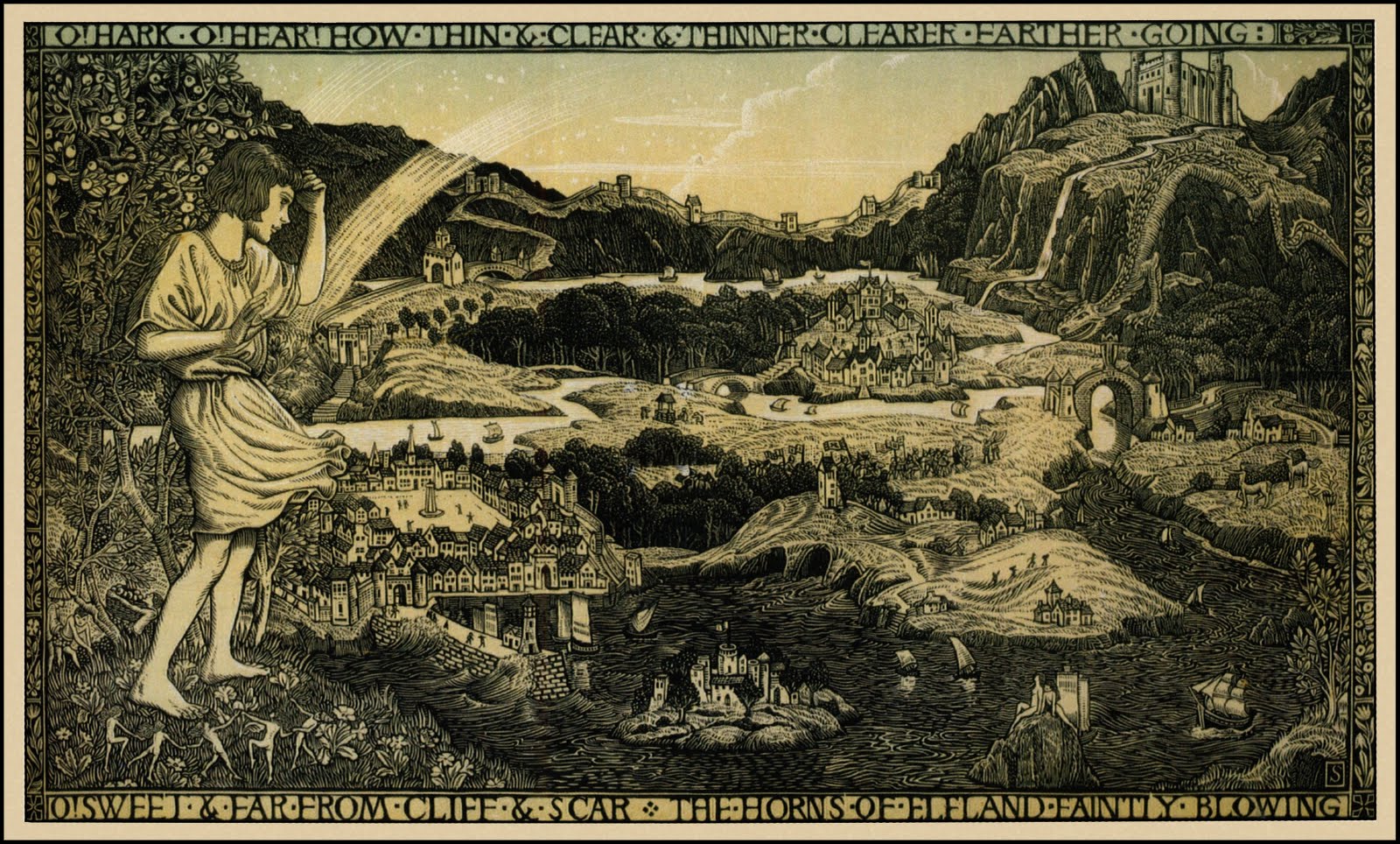
"The Enchanted People": a poem by Lord Dunsany


It came, it came again to the scented garden,

The call that they would not heed,

A clear wild note far up on the hills above them,

Blown on an elfin reed.


From the heath in the hidden dells of a moorland people

            It came so crystal clear

That they could not help a moment’s pause on their pathways,

            They could not choose but hear.


The very blackbird, perched on the wall by cherries,

            Ripe at the end of June,

Made never a stir through all of his glossy body,

            Learning that unknown tune.


They needs must hear as they walked in their valley garden,

            Surely they needs must heed

That it came from a folk as magical and enchanted

            As ever blew upon reed.


Surely they must arise in the heavy valley,

            Sleepy with years of night,

And go to the old immortal things out of fable,

            That danced young on the height.


But the moss was black and old on the paths about them,

            And the weeds were old and deep,

And they could not remember who were high on the uplands;

            And they needed sleep.


And they thought that a day might come when someone would call them

            With a song more loud and plain.

And the call rang past like birds going over a desert,

            And it never came again.


Dunsany wrote of this poem: ‘One night in June, after I had gone to bed, there came to me the scene of a poem more vividly than one had ever come before. It is hard to say what it is about; indeed I do not entirely know. I only know that I saw the scene very vividly, and [...] the feeling that I ought to get up and write it there and then was as strong as the vision itself. So for the first time in my life I got out of bed and and went downstairs to write a poem, and it came without any difficulty, and I feel sure that I should never have been able to write it had I left it till morning. ... Most of my poems are simple and very clear, but sometimes a vision may come as if from a far country.’


Picture credits:

The Horns of Elfland Faintly Blowing - by Bernard Sleigh 

Faun at the Gates of Horn - by Bernard Sleigh