Monday, 2 December 2019

The 'man in the oke' and other bugaboos


I love lists. Especially lists of mysterious creatures, like the well-known one by Reginald Scot in The Discoverie of Witchcraft (1584), a book in which he takes the robustly sceptical line that even if witches, ghosts and fairies do exist, most given instances of them are mere superstition and nonsense. ‘One knave in a white sheete hath cousened and abused many,’ he declares. ‘Miracles are knaveries, most commonly.’

But in Chapter XV comes his famous, breathlessly-delivered list of supernatural creatures fit to be believed only by those who ‘through weaknesse of mind and bodie, are shaken with vain dreames and continuall feare’:

In our childhood our mothers’ maids have so terrified us … with bull beggars, spirits, witches, urchens, elves, hags, fairies, satyrs, pans, faunes, sylens, Kit with the cansticke, tritons, centaurs, dwarfes, giants, imps, calcars, conjurors, nymphes, changelings, Incubus, Robin good-fellowe, the spoorne, the mare, the man in the oke, the hell waine, the fierdrake, the puckle, Tom thombe, hob gobblin, Tom tumbler, boneles, and such other bugs, that we are afraid of our owne shadows: in so much as some never fear the divell but on a darke night; and then a polled sheep is a perilous beast and manie times is taken for oure father’s soul, specialie in a churchyard…

This may or may not be a true indication of the range of creatures the Elizabethan populace actually believed in - satyrs, fauns, nymphs? really? - but it’s a magnificent rant. It’s as though Scot has thrown together every single supernatural entity he can possibly think of, one suggesting another. The classical ‘satyrs, pans, fauns, syl[v]ans’ run together easily, while ‘Robin good-fellowe, the spoorne, the mare, the man in the oke, the hell waine’ seem more homely night terrors. While many of them are still familiar, others are not. Bull beggars? Spoornes, calcars? What on earth are they? And it's hard to see how anyone could be frightened by the dimunitive Tom Thumb we know from the fairy tales, but perhaps in the 16th century he was more of a plaguey fairy nuisance like Puck. At any rate his name seems to have suggested ‘Tom Tumbler’ of whom we know nothing.


In her Dictionary of Fairies Katharine Briggs says there is or was a ‘Bullbeggar Lane’ in Surrey which ‘once contained a barn haunted by a bull beggar’. Did it have any resemblance to a bull, or was it some more ordinary bogeyman? ‘Kit with the Canstick’ or ‘candlestick’ is probably a variety of will o’ the wisp, leading travellers astray, but I know of no folktales about it and if I were writing one I'd be tempted to turn it into a domestic spirit, and a sinister one at that. What is a ‘calcar’? I’ve no idea, unless it could by some stretch be a corruption of the Gaelic ‘Cailleach’ – divine hag or old woman. What ‘the spoorne’ might be, no one knows. (Spawn?) The ‘mare’ is the night-mare. The hell-waine is the Devil’s wagon in which he carries souls to hell. In my children's fantasy 'Dark Angels' there's a hill called Devil's Edge, loosely based on Stiperstones in Shropshire; it has earned its name because:


Up on the very top ... there was a road.  A road leading nowhere, a road no one used. For if anyone was so bold as to walk along it, especially at night, he’d hear the clamour of hounds and the blowing of horns, the cracking of whips and the rumbling of a cart.  And out of the dark would burst the Devil’s own dog pack, dashing beside a black wagon drawn by goats with fiery eyes, crammed full of screaming souls bound for the pits of Hell.


As for the ‘man in the oke’, Katherine Briggs tells of '…scattered reference to oakmen in the North of England, though very few folktales about them…. Most people know the rhyming proverb “Fairy folks live in old oaks”; the Gospel Oak or King’s Oak in every considerable forest had probably a traditional sacredness from unremembered times, and an oak coppice in which the young saplings had sprung from the stumps of unfelled trees was thought to be an uncanny place after sunset…'

Many, many years ago I tried to write a poem about how it might feel to change into a tree:


I lie on oak leaves
And green, fronded moss:
Colder than new sheets
The earth and the frost.

Tree-roots twine under me,
Lulled, hushed I lie
With open face staring
Into the sky –

Bark sheathes my body and
Oh now I am
Not the tree’s prisoner
But the oke-man.

White sap runs in my veins,
Blood in the tree,
Leaves spout from my two arms,
Green as can be…

There was a vast and ancient ChĂȘne Jupitre or ‘Jupiter Oak’ in the Forest of Fontainebleau when I lived near there in the 1990’s, but it became dangerous and was taken down.

I’m sure Scot's list (which of course he knew) inspired the list of evil creatures named by CS Lewis in The Lion, The Witch and The Wardrobe    the ones who gather behind the White Witch at the Stone Table.

Ogres with monstrous teeth, and wolves, and bull-headed men; spirits of evil trees and poisonous plants; and other creatures whom I won’t describe because if I did the grown-ups would probably not let you read this book – Cruels and Hags and Incubuses, Wraiths, Horror, Efreets, Sprites, Orknies, Wooses and Ettins. 

Even more exuberant is a list of supernatural creatures compiled by Michael Aislabie Denham (he died in 1859) a well-read Yorkshire merchant who collected and published various ‘Rhymes, Proverbs, Sayings, Prophecies, Slogans, etc.’ as well as pamphlets and anecdotes. Denham goes even further than Reginald Scot, whose list is incorporated – one might almost say buried – in the midst of his own: many of the creatures he names here appear nowhere else, but one must assume that they were once genuine traditions. Some are ancient. 'Portunes', for example, are to be found only in a single instance in the De Nugis Curialium or Courtly Trifles of 12th century man-of-letters Walter Map, who describes them as tiny fairy creatures like little old men who toast frogs in the hearth-ashes at night.

It's highly unlikely Denham found any live oral tradition about portunes in the mid-19th century, and there's little chance of the name leaking back from the written to the oral tradition, since Map's Latin text was not published until 1850, nor translated into English until MR James's edition of 1914. So Denham is certainly overstating the case when he suggests that 'portunes', at least, were generally believed in ‘seventy or eighty years ago’. At this time, he claims,

... the whole earth was so overrun with ghosts, boggles, Bloody Bones, spirits, demons, ignis fatui, brownies, bugbears, black dogs, spectres, shellycoats, scarecrows, witches, wizards, barguests, Robin-Goodfellows, hags, night-bats, scrags, breaknecks, fantasms, hobgoblins, hobhoulards, boggy-boes, dobbies, hob-thrusts, fetches, kelpies, warlocks, mock-beggars, mum-pokers, Jemmy-burties, urchins, satyrs, pans, fauns, sirens, tritons, centaurs, calcars, nymphs, imps, incubuses, spoorns, men-in-the-oak, hell-wains, fire-drakes, kit-a-can-sticks, Tom-tumblers, melch-dicks, larrs, kitty-witches, hobby-lanthorns, Dick-a-Tuesdays, Elf-fires, Gyl-burnt-tales, knockers, elves, rawheads, Meg-with-the-wads, old-shocks, ouphs, pad-foots, pixies, pictrees, giants, dwarfs, Tom-pokers, tutgots, snapdragons, sprets, spunks, conjurers, thurses, spurns, tantarrabobs, swaithes, tints, tod-lowries, Jack-in-the-Wads, mormos, changelings, redcaps, yeth-hounds, colt-pixies, Tom-thumbs, black-bugs, boggarts, scar-bugs, shag-foals, hodge-pochers, hob-thrushes, bugs, bull-beggars, bygorns, bolls, caddies, bomen, brags, wraiths, waffs, flay-boggarts, fiends, gallytrots, imps, gytrashes, patches, hob-and-lanthorns, gringes, boguests, bonelesses, Peg-powlers, pucks, fays, kidnappers, gallybeggars, hudskins, nickers, madcaps, trolls, robinets, friars' lanthorns, silkies, cauld-lads, death-hearses, goblins, hob-headlesses, bugaboos, kows, or cowes, nickies, nacks, waiths, miffies, buckies, ghouls, sylphs, guests, swarths, freiths, freits, gy-carlins, pigmies, chittifaces, nixies, Jinny-burnt-tails, dudmen, hell-hounds, dopple-gangers, boggleboes, bogies, redmen, portunes, grants, hobbits, hobgoblins, brown-men, cowies, dunnies, wirrikows, alholdes, mannikins, follets, korreds, lubberkins, cluricauns, kobolds, leprechauns, kors, mares, korreds, puckles, korigans, sylvans, succubuses, blackmen, shadows, banshees, lian-hanshees, clabbernappers, Gabriel-hounds, mawkins, doubles, corpse lights or candles, scrats, mahounds, trows, gnomes, sprites, fates, fiends, sibyls, nicknevins, whitewomen, fairies, thrummy-caps, cutties, and nisses, and apparitions of every shape, make, form, fashion, kind and description, that there was not a village in England that had not its own peculiar ghost. Nay, every lone tenement, castle, or mansion-house, which could boast of any antiquity had its bogle, its spectre, or its knocker. The churches, churchyards, and crossroads were all haunted. Every green lane had its boulder-stone on which an apparition kept watch at night. Every common had its circle of fairies belonging to it. And there was scarcely a shepherd to be met with who had not seen a spirit!

Did you notice the 'hobbits', about two-thirds of the way through? All I can say is that here, indeed, is scope for the creative imagination.


Picture credits:

Witch and familiars: by Arthur Rackham
The fairy 'Yallery Brown': by John Batten
Aslan in the power of the White Witch: by Pauline Baynes 
From 'Goblin Market': by Arthur Rackham

Thursday, 21 November 2019

Folklore snippets: The Gwyllion


From ‘British Goblins’ by Wirt Sikes, 1880:

"The Gwyllion are female fairies of frightful characteristics, who haunt lonely roads in the Welsh mountains and lead night-wanderers astray.  The Welsh word gwyll is variously used to signify gloom, shade, duskiness, a hag, a witch, a fairy and a goblin; but its special application is to these mountain fairies of gloomy and harmful habits, as distinct from the Ellyllon of the forest glades and dingles, which are more often beneficent. The Gwyllion take on a more distinct individuality under another name – as the Ellyllon do in mischievous Puck – and the Old Woman of the Mountain typifies all her kind. She is very carefully described… in the guise in which she haunted Llanhyddel Mountain in Monmouthshire. This was the semblance of a poor old woman, with an oblong four-cornered hat, ash-coloured clothes, her apron thrown across her shoulder, with a pot or wooden can in her hand, such as poor people carry to fetch milk in. always going before the spectator, and sometimes crying ‘Wow up!’ This is an English form of a Welsh cry of distress, ‘Wwb!’ or ‘Ww-bwb!’  Those who saw this apparition would be sure to lose their way…

When people first lost their way and saw her before them, they used to hurry forward and try to catch her, supposing her to be a flesh-and-blood woman who could set them right; but they never could overtake her, and she on her part never looked back; so that no man ever saw her face. She has also been seen on the Black Mountain in Breconshire."

Thursday, 24 October 2019

Women Leading the Wild Hunt


Are there any female leaders of the Wild Hunt? The answer is yes, which shouldn’t surprise anyone who’s ever heard of a Valkyrie. Njal’s Saga tells of a man in Caithness named Dorrud, who on Good Friday sees ‘twelve people riding together to a women’s room’ who disappear inside. Looking in, he sees twelve women working on a loom. They use severed heads for the weights, and intestines for the thread. As they wind the finished cloth on to the loom beam, they chant a poem known as ‘The Song of the Spear’ which includes these lines:

Valkyries decide
who dies or lives...
Let us ride swiftly
on our saddle-less horses
hence from here
with swords in hand.
Njal’s Saga, tr. Robert Cook (Penguin Classics)

The women pull down the cloth and tear it into pieces: each keeping a torn piece in her hand, they climb on their horses and ride away, six to the south and six to the north...
In Gods and Myths of Northern Europe, Hilde Ellis Davidson cites an Old English charm known as Wið fĂŠrstice - Against sudden pain’ (probably cramp or stitch), which visualises the pain as ‘caused by the spears of certain supernatural women’:

Loud were they, lo, loud, riding over the hill.
They were of one mind, riding over the land,
Shield thyself now, to escape from this ill.
Out, little spear, if herein thou be.
Under shield of light linden I took up my stand
When the mighty women made ready their power
And sent out their screaming spears…

Davidson thinks this may once have been a battle-spell, though the charm addresses supernatural causes of pain – elf-shot, witch-shot, gods’-shot – rather than human. (Cramps do seem to come out of nowhere…)  In another Old English charm a swarm of bees is addressed as sigewif, ‘victory-women’. This implies that Anglo-Saxons correctly assumed worker bees to be female - a fact which was neither obvious, nor scientifically proved until the late 18th century. At any rate, the image conjured up is a flying host of warrior women, armed with stings.


Gold plaques embossed with bee goddesses, 7th C Rhodes. British Museum


In England one Wild Hunt still possesses a female leader. In Shropshire, the Lady Godda rides the hills with her partner Wild Edric at the head of their troop. First recorded in the late 12th century account of Walter Map, the tale tells  how the lord of the manor of Ledbury North, Edric Salvage (he's a real person, named in Domesday Book) snatches an unnamed fairy woman he has found dancing with her sisters in a cottage in the woods. She marries him on condition he must never reproach her with her fairy origin: when he breaks this prohibition she vanishes and Edric dies. However, as Katharine Briggs remarks in A Dictionary of Fairies: 'Tradition restored him to his wife, and they rode together over the Welsh borders for many centuries after his death.’  To see them was unlucky. Charlotte Burne in Shropshire Folklore (1883) knew a servant girl who as a child had seen them with her own eyes: by this time, this fairy lady had acquired a name:

It was in 1853 or 1854 or, just before the Crimean War broke out.  She was with her father, a miner, at Minsterley, and she heard the blast of a horn. Her father bade her cover her face, all but her eyes, and on no account speak, lest she should go mad. Then they all came by; Wild Edric himself on a white horse at the head of the band, and the Lady Godda his wife, riding at full speed over the hills.

Hold that thought please! -  and read this account from Jacob Grimm.

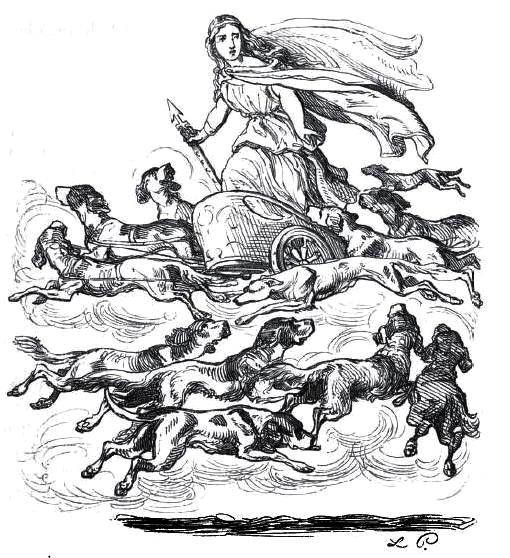
There was once a rich lady of rank named frau Gauden; so passionately she loved the chase, that she let fall the sinful word, ‘could she but always hunt, she cared not to win heaven’. Four-and-twenty daughters had dame Gauden, who all nursed the same desire. One day, as mother and daughters in wild delight hunted over woods and fields and once more that wicked word escaped their lips, that ‘hunting was better than heaven,’ lo, suddenly before their mother’s eyes the daughters’ dresses turn into tufts of fur, their arms into legs, and four-and-twenty bitches bark around their mother’s hunting car, four doing duty as horses, the rest encircling the carriage; and away goes the wild train into the the clouds, there betwixt heaven and earth to hunt unceasingly as they had wished, from day to day, from year to year.

They have long wearied of the wild pursuit, and lament their impious wish, but they must bear the fruits of their guilt till the hour of redemption comes. Come it will, but who knows when? During the twölven* (for at other times we sons of men cannot perceive her) frau Gauden directs her hunt towards human habitations; best of all she loves on the night of Christmas eve or New Year’s eve to drive through the village streets, and wherever she finds a street door open, she sends a dog in. Next morning a little dog wags his tail at the inmates, he does them no other harm but that he disturbs their night’s rest by his whining. He is not to be pacified or driven away. Kill him, and he turns into a stone by day, which, if thrown away, comes back to the house by main force and is a dog again at night. So he whimpers and whines the whole year round, brings sickness and death upon man and beast, and danger of fire to the house; not till the twölven comes round again does peace return to the house.

* twölven: the twelve nights of Yule or Christmas


Frau Gauden and the Lady Godda: both of them supernatural wild huntresses, and the names are surely too similar to be coincidence. But who was Frau Gauden? Grimm continues with another story:

Better luck befalls those who do Dame Gauden a service. It happens at times that in the darkness of night she misses her way and comes to a crossroad. Crossroads are to the good lady a stone of stumbling: every time she strays into such, some part of her carriage breaks, which she cannot herself rectify. In this dilemma she came, dressed as a stately dame, to the bedside of a labourer at Böck, awaked him and implored him to help her in her need. The man was prevailed on, followed her to the crossroads, and found one of her carriage wheels was off. He put the matter to rights, and by way of thanks for his trouble she bade him gather up in his pockets sundry deposits left by her canine attendants during their stay at the crossroads, whether as the effect of great dread or of good digestion. The man was indignant at the proposal … incredulous, yet curious, he took some with him. And lo, at daybreak, to his no small amazement, his earnings glittered like gold, and in fact it was gold.  He was sorry now that he had not brought it all away.

Notable here (apart from the enjoyable comic element) is that though like the Valkyries, Godda rides on a horse, Frau Gauden travels in a wagon, which seems a cumbersome thing to go hunting in. 


But...  here is a goddess or priestess riding on a wagon. It’s made of bronze and was found in a cremation grave of the 7th century BC, near Strettweg in Austria. The female figure in the middle who supports an offering bowl towers above a crowd of smaller figurines, male and female, some on horses. Facing outwards at both the front and back is a stag flanked by figures of indeterminate sex who are holding its antlers. There is of course no knowing for sure what all this may have meant, or of connecting it in any direct way to the Wild Hunt or to the wagons of Frau Gauden or Frau Holle. But deities in wagons are certainly known from prehistory. The Norse gods called the Vanir presided over fertility and the domestic arts: the two most powerful were brother and sister Freyr and Freyja – titles which mean simply ‘Lord’ and ‘Lady’, and from which the word ‘Frau’ is derived.  

If a sly story told in the 14th century Icelandic FlateyjarbĂČk (the ‘Flat Island Book’) has any truth in it, an image of Freyr used to be taken about the Swedish countryside in a wagon accompanied by a priestess: the wagon gets stuck in a snowstorm and all the attendants desert it except the priestess and a young man called Gunnar. The two keep each other warm in the time-honoured way: a few months later when the priestess is discovered to be with child, the worshippers are delighted at the fertility of their ‘god’. It’s quite possible that Freyr’s sister Freyja also travelled in a wagon. A beautifully carved ceremonial wagon was placed in the Oseberg ship, itself the burial-place of two high-status women who may have been priestesses. Carefully dismantled wagons have been found in Danish bogs, presumably cult offerings.


The Roman historian Tacitus (AD 56-120) tells of a Danish goddess, Nerthus, who represented ‘Mother Earth’ and  whose occasional dwelling was a sacred wagon in a grove of trees on an island:

One priest, and only one, may touch it. It is he who becomes aware when the goddess is present in her holy seat; he harnesses a yoke of heifers to the car, and follows in attendance with reverent mien. Then are the days of festival, and all places which she honours with her presence keep holiday. Men lay aside their arms and go not to war; all iron is locked away … until the priest restores her to her temple, when she has had enough of her converse with mortals. Then the car and the robes and (if we choose to believe them) the goddess herself are washed in a mystic pool. Slaves are the ministers of this office, and are forthwith drowned in the pool. Dark terror springs from this, and a sacred mystery surrounds those rites which no man is permitted to look upon.

Tacitus, Germania, 40, tr. RB Townshend, 1894

Wagons are associated with yet another supernatural woman, Frau Holda. Grimm suggests she is originally a sky deity associated with the weather – and therefore able to move through the air. She appears in the Grimms' fairytales as the kindly but powerful Mother Holle (KHM 24) whose country the heroine arrives at by jumping down a well.

At last she came to a little house, out of which an old woman peeped; but she had such large teeth that the girl was frightened, and was about to run away. But the old woman called out to her,  ‘What are you afraid of, dear child? Stay with me; if you will do all the work in the house properly, you shall be the better for it. Only you must take care to make my bed well, and to shake it thoroughly till the feathers fly – for then there is snow on the earth. I am Mother Holle.’


'The Old Woman is plucking her geese' was the phrase my mother used when I was small... In a story very similar to the one about Frau Gauden, Mother Holle needs the linchpin of her wagon mended, and rewards the helpful peasant with the woodshavings left from his work: these too turn to solid gold.

But Holda had her dark side. ‘At other times,’Jacob Grimm continues, ‘Holda, like Wotan, can also ride on the winds, clothed in terror, and she, like the god, belongs to the ‘wĂŒtende heer’ [furious army]. From this arose the fancy, that witches ride in Holle’s company … in Upper Hesse and the Westerwald, Holle-riding, to ride with Holle, is equivalent to the witches’ ride.’ The souls of unbaptised infants were held to join Holle’s wild company.  

The unnamed author of a 9th century document called the Canon Episcopi denounces the folly of those who believe in witches and their power. ‘Have you shared in a superstition to which some wicked women have given themselves?’ he demands. ‘Fooled by demonic phantasms, they believe themselves in the hours of the night to ride with Diana the pagan goddess, with Herodias and with innumerable other women, mounted on the backs of animals and travelling great distances in the silence of the night.’


Diana or Artemis is an obvious Wild Huntress. Nor is it surprising that a cleric should place Herodias in the witches' wild hunt, though it’s worth noting his main point is that witches don’t exist, not that they do. (It took a long time for the church to pass from this relatively healthy scepticism to the crazed witchhunts of later centuries). Herodias is the name given in the Middle Ages to the girl who danced before Herod and asked him for the head of John the Baptist. Though known today as Salome, that name is not in the Gospels; some Greek versions read ‘Herod’s daughter Herodias’, while in  the Latin she is named only ‘the girl’ or ‘the daughter of Herodias’ - who was her mother. Jacob Grimm suggests that Herodias ‘was dragged into the circle of night-women … because she played and danced, and since her death goes booming through the air as the “wind’s bride”.’  Medieval poets really went to town on Salome/Herodias’ fate; Grimm quotes from a medieval Latin poem which gives this creepy account:

 
From midnight to first cock-crow she sits on oaks and hazel-trees, the rest of her time she floats through the empty air. She was inflamed by love for John which he did not return: when his head is brought in on a charger she would fain have covered it with tears and kisses, but it draws back and begins to blow at her; she is whirled into empty space and there she hangs forever.


Frau Gauden and Frau Holle both have connections with crossroads. One of the many titles of the Greek goddess Hecate was ‘She of the crossroads’, and she was represented as three bodied, able to face in all directions.  Dogs were sacred to her, and she presided over thresholds and crossing-places, including the threshold between life and death. The dog is of course the guard-dog of the threshold into the underworld. According to Everyman’s Classical Dictionary Hecate was probably ‘a pre-Hellenic chthonian deity’ and Hesiod represents her as able, like the Norse Vanir, to gift mankind with wealth and all the blessings of daily life.  With her troop of ghosts and hell-hounds she visited crossroads where offerings of meat, eggs and fish were left for her. And in the 3rd century BC Argonautica, Medea tells Jason to sacrifice a ewe to Hecate, pour honey over the offering and leave without looking back – even if he hears the sound of footsteps or the baying of hounds. (Argonautica Book III lines 1020-1040)


Finally, what about the Breton legend of the Ankou who drives about the countryside in a cart, picking up souls? ‘At night,’ says the 19th century folklorish the Reverend Sabine Baring-Gould, ‘a wain is heard coming along the road with a creaking axle. It halts at the door, and that is the summons.’ The Ankou is a male figure, but as Baring Gould points out:

The wagon of the Ankou is like the death-coach that one hears of in Devon and Wales. It is all black, with black horses drawing it, driven by a headless coachman. A black hound runs before it, and within sits a lady – in the neighbourhood of Okehampton and Tavistock she is supposed to be a certain Lady Howard, but she is assuredly a personification of Death, for the coach stops to pick up the spirits of the dying.

This brings us back to the valkyries again – psychopomps, the choosers of the slain.

It’s hardly possible or even desirable to come up with a single explanation for stories of the Wild Hunt, but it does seem to me that its female leaders are even more complex in origin than the males. The leaders of most British Wild Hunts have assumed the names and characters of local heroes such as Edric Salvage, Hereward, King Arthur, Sir Francis Drake, a tendency which makes them somehow easier to grasp, more comprehensible. But the only remaining British Wild Huntress, Lady Godda, has a name similar to the German Frau Gauden, stories of whom include items – wagons, dogs, crossroads – reminiscent of ancient goddesses such as Nerthus and Hecate who held sway over domestic affairs such as fertility and farming, which literally implies over life and death.  And since the Wild Hunt has always been associated with death, its appearance in tales from Germany and Scandinavia also suggest the weaving in of a separate strand of bloody battle-spirits. Hilda Davidson thinks the valkyries may originally have been believed to devour the dead of the battlefield, rather than merely, as later, to escort them to Valhalla.

Herodias, whirling in the windy blast from the lips of John the Baptist’s severed head – Frau Gauden with her carriage and her dogs and their golden poo – Lady Godda riding on her white horse in her green gown like many a later Queen of Elfland – the phantasmal spear-women galloping over the hill while drops of blood shake from their horses’ manes – the lady in the black death-coach – these are wonderfully various stories which deserve to be better known.


Picture credits:


Hilde, one of the valkyries, by Ludwig Pietsch, 1894

Frigga or Frau Gode hunting, by Ludwig Pietsch, 1894
 
Gold plaques embossed with winged bee goddesses, perhaps the Thriai, found at Camiros Rhodes, dated to 7th century BCE (British Museum)

Strettweg cult wagon, photo by Thilo Parg, Wikimedia Commons  
 
Nerthus in her wagon, by Emile Doepler (1855-1922)

Goldmarie shaking Mother Holle's bedding, by Herman Vogel (1854-1921)
 
The Wild Hunt, by Peter Nicolai Arbo, 1831-1892

Salome dancing before Herod, by Gustave Moreau, Wikimedia Commons

Valkyries leading the slain to Valhalla, by Ludwig Pietsch, 1894