Showing posts with label Donellan Lectures. Show all posts

Tuesday, 23 August 2022

Dunsany on the Comma


Another brief extract from the first of the three ‘Donellan Lectures’ which Dunsany gave in 1943 at Trinity College, Dublin. Here he amusingly bewails the tendency of 1940s printers to add superfluous commas to texts. (Modern copy-editors are more likely to remove them!)


[Commas] are little things, but to ignore these fatal pests when speaking of prose is as though I were to speak of the splendours of Africa and never mention the malarial mosquito. Between the African traveller and the ends of all his journeys hovers a veil of these nearly invisible insects, often only irritating, sometimes thwarting his enterprise; so, between every writer and his readers come these little commas bred in the printer’s office, as the anopheles breed in marshes. Certain words are like treacle to them, and any writer who makes use of the word perhaps, must expect them to come to him in swarms. Perhaps I exaggerate, but certainly two will come. The writer puts down, ‘I am going to Dublin perhaps, with Murphy’. Or he writes, ‘I am going to Dublin, perhaps with Murphy’. But in either case these pestilent commas swoop down, not from his pen, but from the darker parts of the cornices where they were bred in the printer’s office, and will alight on either side of the word perhaps, making it impossible for the reader to know the writer’s meaning; making it impossible to see whether the doubt implied by the word perhaps affected Dublin or Murphy.

I will quote an actual case that I saw in a newspaper. A naval officer was giving evidence before a court, and said, ‘I decided on an alteration of course’. But since the words ‘of course’ must always be surrounded by commas, the printer’s commas came down on them, as surely as the mosquito upon a man’s ear, and the sentence read, ‘I decided upon an alteration, of course’. [...] I saw not long ago a story of my own in a New Zealand paper, where the commas seem to have bred more abundantly than they even do in our climate. I read for instance the words, ‘breathing, of course, ceased, too.’ Although this flight of commas looks absurd, it does no actual harm, but ... further on in the same story I had written, ‘for the surgeons had got his heart going again, and however the soul knew, it returned and got back in time’. But the word however is one of those sticky words which attract the printer’s commas, so down came two of them. It then read, ‘for the surgeons had got his heart going again, and, however,’ but I need read no further, for it is now merely nonsense.

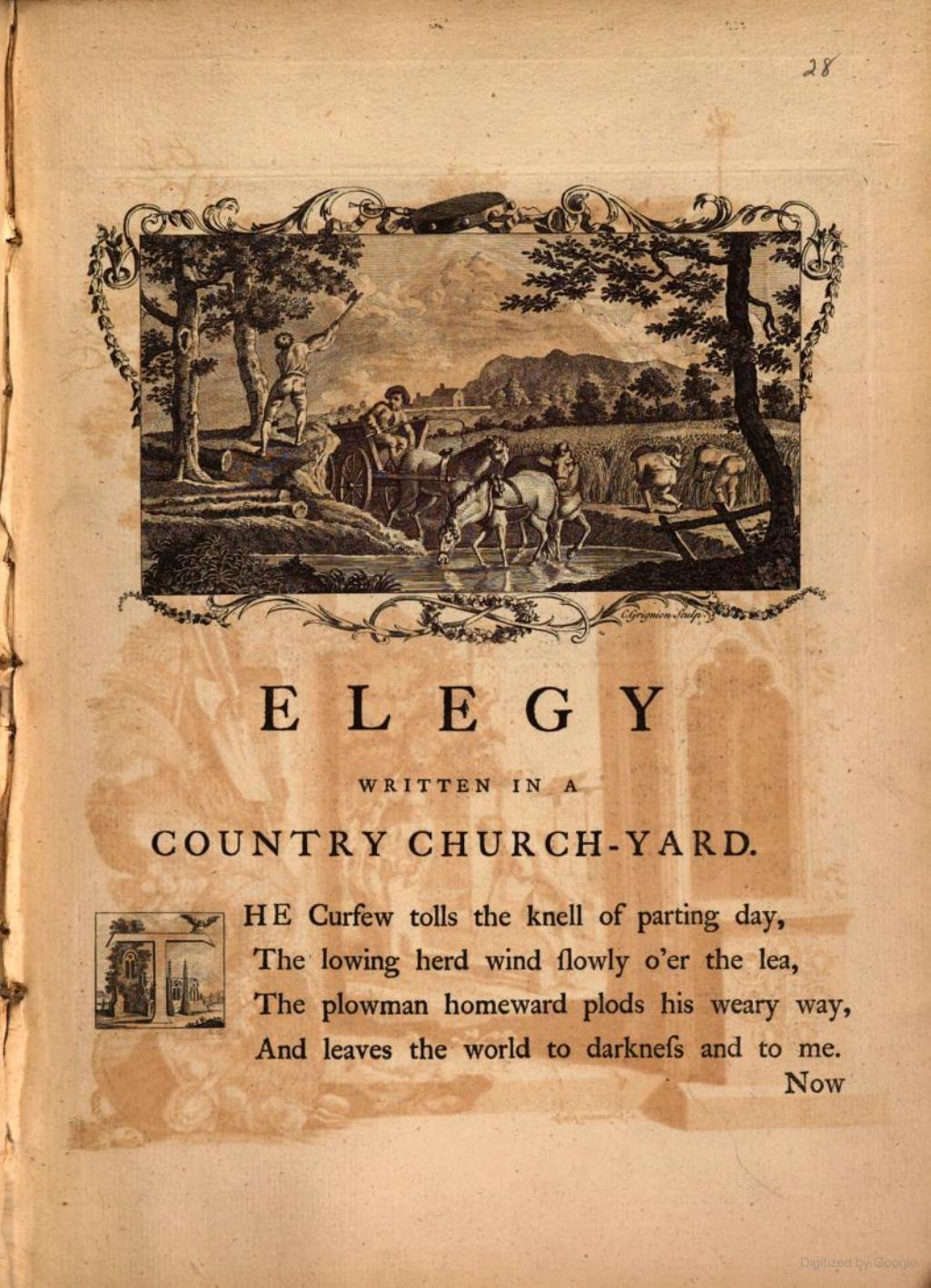
Once when I had written upon this subject in some paper there came a hoot of triumph from a printer’s reader, or one of his friends, and he described how printers had ruined a line of Gray’s Elegy: he said that Gray had written a comma after the third word, the curfew tolls, but that a printer had improved the line by leaving the comma out. I don’t know how he knew, but the moment I read what he wrote I saw the harm the printer had done, and saw for the first time that Gray would never have opened his elegy in the solemn hour when the curfew tolled for the dying day with so jingling a line as the one that has been handed down to us: 'The curfew tolls the knell of parting day'.

This must have been, as that friend of printers stated, what Gray wrote:

 'The curfew tolls, the knell of parting day'.


NB: I'm sceptical about this. (And how Dunsany can suggest that line is remotely 'jingling', I do not know!) It's true that adding the comma slows the pace to something more stately, transforming the second half of the line into a reverberant adjectival clause. (The tolling curfew does not produce, but IS 'the knell of parting day'.) However, the first lines of almost all the other verses flow smoothly and comma-less: 'Now fades the glimm'ring landscape on the sight' - 'The breezy call of incense-breathing morn' - 'Full many a gem of purest ray serene'...  Still, it's interesting to see the difference that can be achieved by the placement of one little comma. [KL] 


Picture credit:

Designs by Mr. R. Bentley, for Six Poems by Mr. T. Gray (1775) 


Tuesday, 16 August 2022

Dunsany on Prose


Extracts from Lord Dunsany’s first 'Donellan Lecture' given at Trinity College Dublin, in 1943. Here he speaks about prose: its rhythms and its relationship to poetry.


It is usually dangerous for anyone whose gift is one art to attempt to follow another, unless it so happens that he has more than one artistic gift. The pitfalls of following poetry when your gift is prose are obvious enough to be a bye-word, and a very common error is to follow the dramatic art for no better reason that that someone has written a successful novel, and has heard that managers pay better than publishers. Now, the difference between prose and the drama I can show you very easily. For instance the novelist may write: ‘Far away to the left the sun was sinking under the hill, touching the treetops with pink and gold and orange, leaving long layers of crimson across the sky and turning stray clouds to purple’; and a great deal more; but the dramatist will write: “Sun sets left.” The electrician, or whoever is responsible for the lighting in a theatre, will do all the rest. Yeats told me once that a play had been sent to him with the stage direction: ‘A bee buzzes across the evening, leaving a track of silence in its wake.’ The novelist had been at work there.

But between prose and poetry I find it so difficult to define the line, that I have never known at what point prose strays over it. Therefore I cannot tell you where this line goes, nor can I define exactly what poetry is or what prose is; I can only faintly indicate to you the difference by saying to you that in Ecclesiastes there is a melody in the words, and a frequent hurrying past of grand images, which from my earliest years has always suggested poetry to me, and does so still; whereas in the works of Pope there is a certain precision, a scientific and philosophical logic, which has always seemed to me to be of the nature of prose. So the essential thing about poetry is neither rhyme nor metre, and yet all thoughts of a certain elevation appear to demand appropriate words for their dwelling. [...]

Once a man showed me the opening pages of a novel he was writing, and he had something of a name. It began something like this: ‘The mountains stretched away into the blue distance, rising up sheer from the sea, some of them a thousand feet and one of them eleven hundred and twenty.’ I suggested his cutting out the measurements, which he did, but I then saw I could help him no further, for every paragraph had something like this, and I had no time to rewrite the book for him. What was wrong was that altitude, colour and distance, mountains and sea, are all significant, and are materials as useful to the poet as any colours a painter keeps in his tubes; but measurement is arbitrary and has no eternal significance. [...] Of course the book in question was not poetry but a novel, but I believe that the rhythms of prose are able to hold poetry, as Japanese craftsmen inlay gold in their gun-metal. [... ] I think myself that prose is a vessel capable of containing the molten gold of poetry; but it has to be the best prose, or it will crack and the gold will escape. The rhythms of prose are subtler than those of verse: you cannot name the rhythm at once as you name an Iambic. On what then do its rhythms depend? I think they depend upon the spoken word; I think they are suited to our breathing; and just as no weapon or implement can be handily used if not properly balanced, so the weight of a sentence should be adjusted as carefully as that of a spear... 

I would refer you to the last chapter of Ecclesiastes, beginning:

1.      Remember now thy Creator in the days of thy youth, while the evil days come not, nor the years draw nigh, when thou shalt say, I have no pleasure in them;

2.      While the sun, or the light, or the moon, or the stars, be not darkened, nor the clouds return after the rain:

For English prose has probably risen to few greater heights, especially perhaps the first eight verses, ending: 

6.      Or ever the silver cord be loosed, or the golden bowl be broken, or the pitcher be broken at the fountain, or the wheel broken at the cistern.

7.      Then shall the dust return to the earth as it was: and the spirit return to God who gave it.

8.      Vanity of vanities, saith the preacher; all is vanity. 

It is this that first made me believe that the boundary between poetry and prose was only an arbitrary line. I will not go into the meaning of it, beyond saying that it is as full of images as a picture gallery, as poetry should be; and indeed, long before much meaning was clear to me in it at all, those images shone for me very clearly, being carried into the sight of my imagination by the melody of the lines, though there is no metre there, and no rhyme, except for those rhymes of which the Old Testament is particularly full, the rhyme of ideas, such for instance, to take a verse almost at random out of the Song of Solomon, Thine head upon thee is like Carmel, and the hair of thine head like purple.

            But though prose has not metre, nor rhyme, it has its rhythms, and may share with poetry a certain chiming that is sometimes made with vowels, of which A.E. (George William Russell) was particularly fond, as he told me himself. He told me that, for this reason, his favourite poem in the whole of the Oxford Book of English Verse was that one that begins: 

            As ye came from the holy land

                        Of Walsinghame

            Met ye not with my true love

                        By the way as you came? 

            To hear A.E. himself quote that poem was to understand the theory at once, and the loss of his voice is one that will be hard to repair. But I wander from prose over that invisible line that so slightly divides it from poetry. What is there, then, in the rhythm by which you can test great prose lying so near to poetry that the Muses can hear it from across their frontier and understand its language? Well, there is a proverb that guides us here. And I have never known a proverb that was not wise. This one is: ‘The proof of the pudding is in the eating.’ Prose, therefore, should be read aloud to test its quality, and with great prose it will always be found that the emphasis is balanced upon the rhythm as a rider upon his horse, easily and in the right place.


Picture credit:

Mountain Landscape by Jean-Honoré Fragonard, Public domain, via Wikimedia Commons

Tuesday, 26 July 2022

Lord Dunsany on the magic of poetry (1)

In March 1943 Lord Dunsany delivered the three ‘Donellan Lectures’ at Trinity College, Dublin, choosing to speak about prose, poetry and drama. I’m repeating this post from 2020 as it’s just lovely, but also because I promised to follow it up with more of Dunsany’s thoughts on prose and poetry. I didn't get around to it then, but this time I will. Look out for more of Dunsany over the next few weeks!

"Nothing at all separates a poet in China from a poet in Ireland: both feel that beauty is sacred and is the outward and obvious expression of what is right and fitting: both labour to express those feelings worthily; their separation is only by centuries, and down these their thoughts travel until they meet in any land. And how does this strange magic work? 


"If I revealed that secret, the magicians of the world would be angry with me, for they have always guarded their mysteries. But they need have no fear that this great mystery will escape from my lips, because I do not know it; I can only guess that our minds, which are strangely different from that lumber with which they are stored and that we call facts, are created in harmony with many ancient things like ripples on water, or the wind going over the trees, and even inhuman and undisciplined things like the singing of birds; and that words that are attuned to this ancient harmony, to the voice of the woods and the hills, the old voice of the earth, come to us when we hear them like his own language suddenly spoken at night to a wanderer in a far country.

"However the magic may work, the power that metre has is best explained by Keats when, describing a kindred power, the song of the nightingale, he says that it

                                                                        oft-times hath

                        Charmed magic casements, opening on the foam

                        Of perilous seas, in faery lands forlorn.


"It is almost like the call of a horn heard in the morning by a busy man in a town, heard far off behind him from grassy uplands beyond the woods, with dew still on the grass and on the spider’s web … and sunlight streaming down valleys, that has not yet come to the town, for the golden morning has not yet peered over the high roofs. The man turns to the sound of the horn, but he cannot follow, for it is far away and he has much to do, and he has not the right clothes or boots for this: those distant valleys are not for him. Bodies are not moved so easily. But … the spirit, if once aroused, is up and away with a speed  of which our bodies know nothing, and which cannot indeed be compared with the movement of any body, though the sudden dart of a snipe out of Irish marshes is something more like it than anything we can attain.  


"But how is the spirit aroused by that haunting call, by that chiming of words that we call metre and rhyme? Our ears, our thoughts, our hearts, call it what you will, are made one way, and metre is made on the same plan, and so the two respond as two birds calling; singing and answering over a wide valley. How it is so I can only guess, but … it is certain that poets have the power to cast such spells.

 "The certainty can be readily demonstrated by a single experiment. Take for instance a sentence such as: ‘She and I were born about the same time, and used to live at Brighton.’ You may anticipate a story when you hear those words, but you cannot be thrilled by the anticipation. Now take something similar, but said by a magician, Edgar Allan Poe:

                        I was a child and she was a child

                        In a kingdom by the sea.

"There you have a spell at once, or at least the beginning of one, one is half enchanted already, one’s spirit is prepared already for a far journey, and a very far journey: those simple words call to it far from here, for a kingdom by the sea is far on the way to fairyland. We have no such kingdoms here; kingdoms with coastlines we have in abundance, but a kingdom by the sea is a long way off, like little countries of which our nurses might have read tales to us a very long while ago."


Picture credits:

Poet on a mountain top by Shen Zhou, 1427 - 1509, Wikipedia

Miranda by John William Waterhouse, 1916, Wikimedia Commons

Val d'Aosta by John Brett, 1858 Wikimedia Commons

Walton on the Naze, Ford Madox Brown, 1860, Birmingham Museums Trust