Monday, 17 April 2023

Naming and Identity in Myths, Legends, Fairy Tales & Fantasy


To begin near the beginning: the name Adam was originally not a proper name at all. In his book The Five Books of Moses: A Translation with Commentary, the Hebrew scholar Robert Alter remarks of Adam’s first appearance in Genesis 1.26:

The term ’adam, afterwards consistently used with a definite article, which is used both here and in the second account of the origins of humankind, is a generic term for human beings, not a proper noun. It also does not automatically suggest maleness [...]. And so the traditional rendering “man” is misleading, and an exclusively male ’adam would make nonsense of the last clause of verse 27:

And God created the human [the ’adam] in his image,

in the image of God He created him,

male and female he created them.

In case you’re thinking, ‘Wait a minute, there’s a ‘him’ right there in the second line,’ Alter adds:

In the middle clause of this verse, “him”, as in the Hebrew, is grammatically but not anatomically masculine. Feminist critics have raised the question as to whether here and in the second account of human origins, in chapter 2, ’adam is to be imagined as sexually undifferentiated until the fashioning of woman, though that proposal leads to certain dizzying paradoxes in following the story.

I love this and feel it could well be true: it’s a reminder that translating a word from one language to another is often far from straightforward. In the second chapter of Genesis, God fashions the ’adam from the ’adamah (‘the human from the soil’: an etymological pun) like a potter moulding a figure out of clay. ‘A person’ in French is une personne, grammatically feminine even if the person in question is male. French la table is feminine while German der tisch is masculine, but no one thinks tables are male or female. Grammatical gender need not and often does not correspond to biological gender. In any case, a clay figure has no biological gender. Whatever it looks like, it is asexual.

Name-giving is an act of power, 'deep magic from the dawn of time'. Even to speak is to exercise that power. Few of us choose our own names; they are given by our parents when we’re so young we can have no say in the matter, and as Adam and Eve ‘ruled’ over the animals, parents hold authority over their children. No matter how benevolent the relationship, this is probably why when children go to school, they often abbreviate their names or adopt nick-names. It’s a small act of self-assertion, part of the journey towards detaching themselves from parental rule. To change your name is in some way to change yourself.


This brings me to the Old Speech in Ursula Le Guin’s Earthsea series. In the first book, ‘A Wizard of Earthsea’ (above, see my much-read copy of 1971) the hero Ged, whose use-name is Sparrowhawk (a true name is kept secret) arrives at the Wizards’ School on the island of Roke to be sent with seven other apprentices to the Master Namer, Kurremkarmerruk, in the Isolate Tower.

No farm or dwelling lay within miles of the Tower. Grim it stood above the northern cliffs, grey were the clouds over the seas of winter, endless the lists and ranks and rounds of names that the namer’s eight pupils must learn. Amongst them in the Tower’s high room Kurremkarmerruk sat on a high seat, writing down lists of names that must be learned before the ink faded at midnight leaving the parchment blank again.

Hard as this is, Ged does not complain. ‘He saw that in this dusty and fathomless matter of learning the true name of each place, thing and being, the power he wanted lay like a jewel at the bottom of a dry well. For magic consists in this, the true naming of a thing.’ He learns that the Old Speech is the speech of the Making, ‘the language Segoy spoke who made the islands of the world’ and still spoken by dragons. We never learn much about Segoy, but in this origin myth it’s Segoy’s naming that brings Earthsea into existence – just as in the Book of Genesis, God brings the world into existence.

God said, ‘Let there be light,’ and there was light. [...] And God called the light Day, and the darkness He called Night. And it was evening and it was morning, first day. And God said, ‘Let there be a vault in the midst of the waters, and let it divide water from water.’ And God called the vault Heavens, and it was evening and morning, second day. And God said, ‘Let the waters under the heavens be gathered in one place so that the dry land will appear.’ And so it was. And God called the dry land Earth and the gathering of the waters He called Seas...

In Genesis 2, in contrast to the order of creation in Genesis 1, God creates animals after having created the ’adam, bringing each one of them to the human ‘to see what he would call it, and whatever the human called a living creature, that was its name.’ It’s as though, having created human beings ‘in his own image’, God delegates the naming of things to them. There’s a strong hint that the naming of things – language – is an integral part of human ‘rule’ over animals.  Names, or nouns, are single-word descriptions, the beginning of categorisation and a typically human and cerebral form of knowledge. When in prehistory did spoken languages begin? Probably we’ll never know, but the Language of the Making , the Words of Creation – is a powerful myth.

In learning the true names of things, Ged gains power over them, a power that should be used sparingly and never selfishly. He finds this out the hard way when prompted by pride and anger, he summons by her name the spirit of beautiful Elfarran, a thousand years dead. And she appears.

The shapeless mass of darkness he had lifted split apart. It sundered, and a pale spindle of light gleamed between his opened arms, a faint oval reaching from the ground up to the height of his raised hands. In the oval of light for a moment there moved a form, a human shape: a tall woman looking back over her shoulder. Her face was beautiful, and sorrowful, and full of fear.

She is glimpsed only for a moment. Then the gap Ged has opened widens and rips ‘and through the bright misshapen breach clambered something like a clot of black shadow, quick and hideous, and it leaped straight out at Ged’s face’, tearing and clawing him. It costs the life of the Archmage Nemmerle to close the gap, and for the rest of the book Ged is pursued by the shadow-beast he has let loose – until at last he has the self-knowledge to claim this darkness as himself and calls it by his own name.  


Many a medieval alchemist or renaissance doctor attempted to conjure up spirits using what they conceived to be the power of holy or unholy names. Katharine Briggs in ‘The Anatomy of Puck’ appends a spell from Bodleian MS. Ashmole (1406) ‘To Call a Fairy’, parts of which run:

I.E.A call the. Elaby: Gathan: in the name of the. father. of. the. son. and of the holy ghost. And. I Adjure. the. Elaby. Gathan: Conjure. and. Straightly. charge. and Command. thee. by. Tetragrammaton: Emanuell. Messias. Sether. Panton. Cratons. Alpha et Omega. [...] And. I. Conjure thee. Elaby. by. these. holy. Names. of God. Saday. Eloy. Iskyros, Adonay. Sabaoth. that thou appear presently. meekely. and myldly. in this glasse. without. doeinge. hurt. or. daunger. unto. me. or any other. livinge. creature...

Knowledge of the fairy’s name was only half the battle: the magician clearly felt the need of divine protection when it did appear. 


An even more egregious example is given by Reginald Scot in his scathing take-down of charlatans and superstition, ‘The Discoverie of Witchcraft’ (1584). Of many examples, he includes a ‘prayer’ (!) for binding and commanding angels ‘throwne downe from heaven’, which runs in part:

I require thee, O Lord Jesus Christ, that thou give thy virtue and power over all thine angels which were throwne downe from heaven to deceive mankind, to draw them to me, to command them to do all they can, and that [...] they obeie me and my saiengs, and fear me. [...] and I require thee, Adonay, Amay, Horta, Vegedora, Mitai, Hel, Suranat, Ysion, Ysesy, and by all thy holie names [...] that thou enable me to congregate all thy spirits throwne down from heaven, that they may give me a true answer of all my demands, and that they satisfy all my requests, without the hurt of my bodie or soule, or anything that is mine...

The word ‘require’ in the late 1580s hadn’t the force it has today; it meant something more like ‘request’ or ‘desire’ – but this magician is clearly attempting to bend Christ to his will by the use of the various ‘holy’ names he attributes to him, and through Christ to gain magical power over (and immunity from) devils. Talk about nerve! Some of the names look very made-up. ‘Vegedora’ sounds like a brand of soft margarine, but whatever is the Norse goddess of the underworld, Hel, doing in that list?

Besides summoning, it was of course possible to banish or exorcise an evil spirit, if you knew its name. In the Gospel of Mark, Chapter 5, Jesus casts out an ‘unclean spirit’ from a madman who was living ‘among the tombs’ and whom no one could restrain even with chains, for he broke them all. 

When he saw Jesus from a distance, he ran and bowed down before him, and he shouted at the top of his voice, ‘What have you to do with me, Jesus, Son of the Most High God? I adjure you, by God, do not torment me.’ (For Jesus had already said to him, ‘Come out of the man, you unclean spirit!’) Then Jesus asked him, ‘What is your name?’ He replied, ‘My name is Legion, for we are many.’ [...] Now there on the hillside a great herd of swine was feeding, and the unclean spirits begged [Jesus], ‘Send us into the swine.’ So he gave them permission. And the unclean spirits came out and entered the swine, and the herd ... rushed down the steep bank into the sea and were drowned.

In his book on the New Testament, ‘Scripting Jesus’ (2010) L. Michael White points out that ‘the demon actually tries to exorcize Jesus by saying, “I adjure you by God, do not torment me.” The word usually translated “adjure” here is the Greek orkizein (“conjure”), just as was used in demon spells.’  So, ironically, this demon tries calling on the name of God to negate Jesus’ power. It is unable to resist when Jesus demands its own name.

Given the belief that you could conjure up demons or fairies by name, it’s unsurprising that magical characters in fairy tales and folklore often keep their names secret. If they were known, others would wield power over them. In ‘The Water-Horse of Varkasaig, a folktale from Skye, the dangerous water-horse is foiled of his prey (a young maiden) when the girl’s mother threatens to ‘cry his name to the four brown boundaries of the earth’ and to prove she can do it, whispers it in his ear. On hearing it, with a terrible shriek the water-horse plunges into the river and vanishes.


Rumpelstiltskin famously tears himself in two with rage when the young woman whose straw he has spun into gold guesses his name. Variants of the story are found across Europe, and many’s the hero or heroine who manages to wriggle out of similarly unwise bargains. In his 'Teutonic Mythology' Jacob Grimm tells how King Olaf of Norway (later Saint Olaf) hired a large troll or jøtun to build him a fine church on the agreement that once it was finished, his payment should be the sun and moon, or else Olaf himself. Olaf set conditions which he thought the troll could not possibly meet: the church should be so large that seven priests could preach in it at once without disturbing one another, and the pillars and carvings were all to be made from the hardest flint. But soon the church was almost finished, with only the roof and spire left to complete. Understandably worried, Olaf ‘wandered over hill and dale, when suddenly inside a mountain he heard a child cry and a troll-woman lulling it: “Hush, hush! Thy father, Wind-and-Weather, will come home in the morning, and bring you the sun and moon, or else Saint Olaf himself!”’ Hurrying home in delight, for ‘the power of evil beings ceases when their name is known’, Olaf found the troll just placing the spire on the roof. ‘Vind och veder!’ he cried, ‘du har dat spiran sneder’ – ‘Wind and Weather! You’ve set the spire on crooked!’ – upon which the troll fell off the roof and burst into a thousand pieces. All variants include this accidental overhearing of the supernatural helper’s name. In a Danish version, St Olaf’s role is taken by one Esbern Snare (historically, a 12th century Danish chieftain and crusader), who hears a troll woman within a hill singing:

          ‘Lie still, baby mine!

Tomorrow comes Fin, father thine,

And giveth thee Esbern Snare’s eyes and heart to play with.’

It’s possible to feel rather sorry for the trolls or imps who lose their labour (or lives!) in this way. My friend the writer Inbali Iserles has remarked of Rumpelstiltkin’ that it is ‘a story where the greedy succeed, the victim is unsympathetic, and the villain curiously wretched.’ But it’s hard to feel sorry for the gleeful little imp Tom Tit Tot, eponymous villain of the splendid Norfolk dialect version. After the Queen has failed for the second time to guess its name (‘Is that Methuselem’ – ‘Noo, t’aint that neither’), the imp

looks at her with that’s eyes like a cool o’ fire, an’ that says, “Woman, there’s only to-morrer night, an’ then yar’ll be mine!” n’ away te flew.

However the King her husband has overheard the imp’s name. Remarking casually to his wife that ‘I reckon I shorn’t ha’ to kill you’ (seeing that she’s successfully spun the skeins each night so far), he sits down to supper with her and tells how out hunting he came across a curious little black thing singing, ‘Nimmy nimmy not/My name’s Tom Tit Tot’. Next day the Queen is well prepared:  

[T]hat there little thing looked soo maliceful when he come for the flax. An’ when night came she heerd that a knockin’ agin the winder panes. She oped the winder, an’ that come right in on the ledge. That were grinnin’ from are to are, an’ Oo! tha’s tail were twirling round so fast.

          ‘What’s my name?’ that says, as that gonned her the skeins.

          ‘Is that Solomon?’ she says, pretending to be afeared.

          ‘Noo, t’ain’t,’ that says, and that come fudder inter the room.

          ‘Well is that Zebedee?’ says she agin.

          ‘Noo, t’ain’t,’ says the impet. An’ then that laughed an’ that twirled that’s tail till yew cou’n’t hardly see it. ‘Take time, woman,’ that says’ ‘next guess, an you’re mine.’ An’ that stretched out that’s black hands at her.

          Well, she backed a step or two, an’ she looked at it, an’ then she laughed out, an’ says she, a pointin’ of her finger at it –

          ‘Nimmy nimmy not,

Yar name’s Tom Tit Tot.’

Well when that hard her, that shruck awful an’ awa’ that flew into the dark, an’ she niver saw it noo more.


Characters in fairy tales are often referred to either by generic descriptions 
– ‘the king’s daughter’, ‘the boy’, ‘the maiden’, and so on – or by the common names of whatever country the tale is set in, such as Hans, Klaus, Ivan, Kate, Jack. But many fairy tale names are purely descriptive. Little Red-Cap or ‘Red Riding Hood’ is so called after her red head-wear. The faithful servant in ‘The Frog King’ is named Iron Henry because ‘he had been so unhappy when his master was changed into a frog, that he had caused three iron bars to be laid round his heart, lest it should burst with grief’. The names Snow-White and Rose Red describe the innocence and beauty of the characters, and ‘The Mastermaid’ is an apt description of the lively, clever, magic-working young woman of that Norwegian story.

Sometimes these names are insulting. Cinder-lad, Aschenputtel, Tatterhood, Dummling are given their names by families which despise them: but since fairy tales always favour the underdog, we know they’re going to succeed. The princess known as ‘Allerleihrauh’ (All Kinds of Fur) escapes from her incestuous father dressed in a cloak of, yes, all kinds of fur. ‘Coat o’ Rushes’ disguises herself in a woven reed coat after her King Lear-like father throws her out, and the princess in the Norwegian fairy tale ‘Katy Woodencloak’ wears a clattering cloak of wooden laths. All three serve as kitchenmaids in these guises, and all three restore their fortunes. The names derived from their actions come to define them: ‘real’ names, if they had any, would be superfluous. It’s all very existential.


As I’ve said above, to change your name is to change yourself.  A seven year-old boy called Setanta son of Sualtim (his true father is Lugh of the Long Hand, Irish god of light and war) kills Culain the Smith’s savage guard-dog. When Culain complains, the boy offers to train up another hound for him, until which time: ‘I myself will be your watch-dog, to guard your goods and your cattle and your house.’ Hearing this, Cathbad the Druid renames the boy.

‘I could have given no better award myself,’ said Cathbad the Druid. ‘And from this out,’ he said, ‘your name will be Cuchulain, the Hound of Culain.’ ‘I am better pleased with my own name of Setanta, son of Sualim,’ said the boy. ‘Do not say that,’ said Cathbad, ‘for all the men in the whole world will some day have the name of Cuchulain in their mouths.’ ‘If that is so, I am content to keep it,’ said the boy. And this is how he came by the name Cuchulain.

                    Cuchulain of Muirthemne tr. Lady Gregory, John Murray, 1907, 11

Cuchulain’s offer of substitution – ‘I will be your watch dog’ – and his new name ‘Hound of Culain’ suggests that from now on dogs are Cuchulain’s kindred or totem. He is laid under two geasa: never to refuse a meal offered to him by a woman and never to eat the flesh of a dog. At the end of his life, riding out to fight against Maeve’s great army, both geasa are used against him by three witches.

After a while he saw three hags, and they blind of the left eye, before him in the road, and they having a venomous hound they were cooking with charms on rods of the rowan tree. And he was going by them, for he knew it was not for his good they were there.

          But one of the hags called to him, ‘Stop a while with us, Cuchulain.’ ‘I will not stop with you,” said Cuchulain. ‘That is because we have nothing better than a dog to give you,’ said the hag. ‘If we had a grand, big cooking hearth, you would stop and visit us, but because it is only a little that we have, you will not stop.’

          …Then he went over to her, and she gave him the shoulder-blade of the hound out of her left hand, and he ate it out of his left hand. And he put it down on his left thigh, and the hand that took it was struck down, and the thigh he put it on was struck through and through, so that the strength that was in them before left them.

Like the actions of those fairy tale princesses Allerleihrauh, Katy Woodencloak and Coat o’ Rushes, Cuchulain’s boyhood decision to ‘become’ Culain the Smith’s hound triggers his renaming, and changes the course of his life. Cathbad the Druid says, ‘All the men in the whole world will some day have the name of Cuchulain in their mouths.’ Cuchulain’s future identity as a hero is somehow bound up with his acceptance of this new name.

In Ursula le Guin’s collection ‘Tales From Earthsea’ there’s a wonderful story called ‘Dragonfly’, about a young woman who travels to the Isle of Roke hoping to enter the School for Wizards. Her use-name is Dragonfly, but the Doorkeeper asks for her true name – as he asks everyone who wishes for admittance – and her true name is one she’s accepted but has never felt really comfortable with.

‘Do you know whose name you must tell me before I let you in?’

          ‘My own, sir. It is Irian.’

          ‘Is it?’ he said.

          That gave her pause. She stood silent. ‘It’s the name the witch Rose of my village on Way gave me, in the spring under Iria Hill,’ she said at last, standing up and speaking truth.

          The Doorkeeper looked at her for what seemed a long time. ‘Then it is your name,’ he said. ‘But maybe not all your name. I think you have another.’

          ‘I don’t know it, sir.’ After another long time she said, ‘Maybe I can learn it here, sir.’

Irian does not find her other true name here on Roke; but she does discover her true nature and her power: and when Thorion the Master Summoner (who is literally a dead man walking) attempts to bind her, he fails.

Slowly he raised his arms and the white staff in invocation of a spell, speaking in the tongue that all the wizards and mages of Roke had learned, the language of their art, the Language of the Making: ‘Irian, by your name I summon you and bind you to obey me!’

          She hesitated, seeming for a moment to yield, to come to him, and then cried out, ‘I am not only Irian!’

The Summoner lunges at her, running up on to Roke Knoll where all things become their true selves.

They were both on the hill now. She towered above him impossibly, fire breaking forth between them, a flare of red flame in the dusk air, a gleam of red-gold scales, of vast wings – then that was gone, and there was nothing there but the woman standing on the hill path and the tall man bowing down before her, bowing slowly down to the earth, and lying on it.

Thorion’s return to death restores the Equilibrium, although from now on there will be a new balance. Irian departs ‘beyond the west’ to find the dragons, ‘Those who will give me my name. In fire, not water. My people.’ In dragon form she springs into the air and flies, and as ‘a curl of fire, a wisp of smoke’ drifts down through the darkening air, the men stand silent, watching. ‘What now?’ asks her friend the Master Patterner. And the Doorkeeper of the Wizards’ School on Roke answers simply, ‘I think we should go to our house, and open its doors.’ 

It is the last line of the story. And the story is all about difference. Who is Irian? Is she indeed a woman? Can you be two things at once? What is her truth?

In the world of Earthsea as Ursula le Guin developed it over decades, humanity and dragons were once one kind, one kindred: the dragons were there at the beginning: the Eldest, born knowing the True Speech. Then came the Division, the separation of dragons and humans: but some still are of both kinds. Irian is not only such a one, she is also female, a woman, considered by most of the Mages of Roke as less than a man. ‘I am not only Irian!’ she cries, refusing to be limited to a single identity. So yes, the story is about difference and prejudice, about names and the changing of names and the discovering of new identities. And it asks us not to prejudge, but to accept and open our doors to those who come to us with their differences. I think it is good advice.


Picture credits:

Adam and Eve in the garden with God: Hieronymous Bosch, The Garden of Earthly Delights, c. 1490-1510

A Wizard of Earthsea, Penguin 1971, cover art & design Brian Hampton

Dr John Dee (1507-1608). Artist unknown, Ashmolean, Oxford, image from wikipedia

The Discoverie of Witchcraft, title page, British Library, image from wikipedia

Rumpelstiltskin: Walter Crane, 1886

Tom Tit Tot: English Fairy Tales by Joseph Jacobs, ill. John D Batten

Setanta Kills the Hound: ill. Stephen Reid, imagefrom wikipedia


Wednesday, 5 April 2023

In Praise of Wise Fools and Jesters


There are fools. There are foolish fools and wise fools, and this essay will concern itself (mainly) with the wise ones. Foolish fools, in the oral tradition and in literature, are simpletons who make bad decisions. Granted three wishes, they squander their chances, wish for something as modest as a black pudding, wish it on to their partner’s nose during a marital squabble, and use up the third wish to remove it again (‘The Three Wishes’, ‘More English Fairytales’, Joseph Jacobs, 1894). Stories about them are intended as laughter-provoking demonstrations of how not to behave; yet sometimes they throw light upon the unsuspected absurdities of worldly wisdom. Wise fools on the other hand are often conscious critics and iconoclasts who, from a theoretically lowly but in fact often privileged social position, turn their wit upon their masters.

Perhaps ever since there have been rulers, there have been professional fools, jesters and comedians who have been given (or who have taken) license to expose and hold up to ridicule the kings, priests, presidents and public figures, the laws, mores, prejudices, injustices and – yes – follies of the societies in which they live.  They are a world-wide phenomenon. In her book ‘Fools Are Everywhere: The Court Jester Around the World’ (2001) Beatrice K. Otto chronicles court jesters not only from Europe but also Russia, India, and Imperial China. All employed the same type of impudence, requiring quick wits and strong nerves. She quotes Marais, jester to Louis XIII, remarking to his king: 

‘Il y a deux choses dans votre metier dont je ne me pourrais accommoder … De manger tout seul et de chier en compagnie.’  [‘There are two things about your job I couldn’t cope with – eating alone and shitting in company.’] 

It isn’t just a jibe: Marais strikes home to a truth about the surreal world of the court. Cocooned in stultifying ceremony, kings clearly found relief in the direct, disrespectful speech of their jesters, the only members of court permitted to speak to them man to man. Like the child in ‘The Emperor’s New Clothes’, Marais sees through the apparent splendour of Louis’s life, and acknowledges it as both lonely and bizarre. When Henry VIII of England was given the title ‘Defender of the Faith,’ one of his jesters is reported to have shaken his head and said to Henry (using the familiar tense), ‘Let thou and I defend one another, and let faith alone to defend itself.’ In both cases the role of jester or fool echoes that of the slave who would stand in the triumphal car directly behind a victorious Roman general and whisper in his ear from time to time, ‘Remember, thou art mortal.’ The work of these jesters was as much to keep the monarch grounded, even sane – as to keep him amused.


And a wise ruler would listen to what his fool told him. ‘King Lear’ is a play which examines folly and madness as closely as it does pride and ingratitude. Lear’s terrible folly is to relinquish power and divide his kingdom between his two elder daughters. It’s Lear’s fool who stays with him when everyone else has left him. And the fool gives good advice, as fools will.

Fool: Canst tell how an oyster makes his shell?

Lear: No.

Fool: Nor I neither; but I can tell why a snail has a house.

Lear: Why?

Fool: Why, to put his head in, not to give it away to his daughter and leave his horns without a case. … If thou wert my fool, nuncle, I’d have thee beaten for being old before thy time.

Lear: How’s that?

Fool: Thou shouldst not have been old before thou wert wise.

King Lear, I, vi


It’s the Fool’s privilege to speak the truth with safety. Erasmus, in his 1509 essay The Praise of Folly, places in the mouth of the goddess Folly various criticisms of society and the church which if he hadn’t been able to pass off as a brilliant jeu d’esprit (it made Pope Leo X laugh), might well have got him into trouble. Here he comments on the folly of even asking (let alone answering) some of the burning questions of the day.

The primitive disciples were very frequent in administering the holy sacrament, breaking bread from house to house; yet should they be asked … the nature of transubstantiation? the possibility of one body being in several different places at the same time? the difference betwixt the several aspects of Christ in heaven on the cross, and in the consecrated bread? what time is required for the transubstantiating of the bread into flesh? how it can be done by a short sentence pronounced by the priest?  Were they asked, I say, these and several other confused enquiries, I do not believe they could answer so readily as our mincing school-men now-a-days take pride in doing.

The Praise of Folly, Peter Eckler Publishing, NY 1922, p 214.

These were dangerous speculations, yet Erasmus could point out with perfect truth that it was not he, but Folly, who was speaking.

It’s not quite safe to laugh at a jester, or a live comedian. We know it’s best not to sit in the front row; he or she has a mastery of words and is likely to get the better of us if we cross verbal swords with them. But the jester, dependent on his nimble wits, is only one type of wise fool. There’s another type of folly, the folly of the simpleton.

            Simpletons pose no real danger to the bystander. (If you’re thinking we’re all too civilised now to laugh at ‘the village idiot’, stop for a moment to consider what that laughter consisted of.  Didn’t it – doesn’t it – consist of finding ignorance funny? Social ignorance, lack of nous – ignorance of ‘the way things are done’? Is such laughter dead?)

            Unlike real life, in stories simple fools come up smelling of roses. Jack and the Beanstalk is the best known example. There are different versions of this old tale, but in each of them Jack is such a simpleton, such a fool, that he sells his mother’s cow for a handful of beans which (after his angry mother hurls them into the garden) grow up to touch the clouds.

As he was going along, he met a butcher, who enquired why he was driving the cow from home? Jack replied, it was his intention to sell it. The butcher held some curious beans in his hat; they were of various colours, and attracted Jack’s notice: this did not pass unnoticed by the butcher, who, knowing Jack’s easy temper, thought now was the time to take advantage of it, and … asked what was the price of the cow, offering at the same time all the beans in his hat for her. The silly boy could not [sufficiently] express his pleasure at what he supposed so great an offer: the bargain was struck instantly and the cow exchanged for a few paltry beans.


This is the first printed version of the tale, published as ‘The History of Jack and the Beanstalk’ by Benjamin Tabart in 1807. According to Iona and Peter Opie in ‘The Classic Fairytales’ it is ‘the source of all substantial retellings of the story’. It’s a very literary version which includes a long, dull piece of back-story intended to show Jack is morally justified in stealing from the Giant, who has previously murdered Jack’s father. Tabart also explains away Jack’s stupidity in accepting the beans: it was due to the magical influence of a fairy who wished to benefit him. Another literary retelling published over eighty years later by Joseph Jacobs in ‘English Fairy Tales’ similarly attempts to dilute Jack’s folly: on meeting a ‘queer little old man’ who offers him five beans for his cow, Milky-White, Jack replies with sarcasm: “Go along,” said Jack; “wouldn’t you like it?”

            The old man has to explain to him that the beans are magic and will ‘grow right up to the sky’ before Jack will accept the bargain. It’s as though Tabart and Jacobs both found the traditional Jack too foolish to be an attractive hero. But his folly is more than half the point, and these literary additions haven’t survived very well, they haven’t stuck to the story. Most of us remember Jack as a simpleton who is cheated out of a valuable cow for a handful of apparently worthless beans. It’s as though the beans gain their magical properties in response to the folly of the hero. Ultimately, Jack wins out and the con-man loses. And the moral lesson is that sharp practice doesn’t always pay, and that good fortune watches over the innocent and trustful.

            This is a lesson repeated over and over in fairytales.  It’s nearly always the third son, the younger, slightly stupid one, whose innocence gives him the edge over his worldly elder brothers. 

There was a man who had three sons, the youngest of whom was called Dummling [Simpleton], and was despised, mocked and sneered at on every occasion.

            It happened that the eldest wanted to go into the forest to hew wood, and before he went his mother gave him a beautiful sweet cake and a bottle of wine in order that he might not suffer from hunger or thirst.

            When he entered the forest he met a little grey-haired old man who bade him good-day and said, ‘Do give me a piece of cake out of your pocket, and let me have a draught of your wine; I am so hungry and thirsty.’ But the clever son answered, ‘If I give you my cake and wine, I shall have none for myself: be off with you.’

Is the clever son really so clever? We know how these things go: not so very clever after all, for –

When he began to hew down a tree, it was not long before he made a false stroke, and the axe cut him in the arm, so he had to go home and have it bound up. And this was the little grey man’s doing.

Soon it’s the second son’s turn. Characterised as ‘sensible’, he fares no better; and now it is Dummling’s chance. His mother gives him poor fare: ‘a cake made with water and baked in the cinders, and a bottle of sour beer’. But, when the little grey man appears, Dummling readily agrees to share his food:

and when he pulled out his cinder-cake, it was a fine sweet cake, and the sour beer had become good wine. So they ate and drank, and after that the little man said, ‘Since you have a good heart and are willing to divide what you have, I will give you good luck. There stands an old tree, cut it down, and you will find something at the roots.’ Then the little old man took leave of him.

            Dummling went and cut down the tree, and when it fell there was a goose sitting in the roots with feathers of pure gold. 

You will have guessed the name of this story: it is the Grimms’ fairy tale ‘The Golden Goose’ (KHM 64) – not the goose that lays the golden eggs, but the one which causes anyone who tries to steal its golden feathers to stick to it (and to each other) like glue. Dummling soon has a whole train of greedy people running after him willy-nilly. Those who covet wealth, the story says, are forced to chase after it, become stuck to it in an undignified straggle. Good-hearted Dummling, who shares what he has, is worthy to own the golden goose and marry the King’s daughter. 


             Not all fools in folktales are wise. Stories like the Grimms’ tale ‘Frederick and Catherine’ (KHM 59), set out simply to amuse the listeners with catalogues of extreme folly. In this way, even foolish fools may provide object lessons. In ‘Frederick and Catherine’ simple, literal Catherine ricochets from one domestic disaster to another.

At midday home came Frederick: ‘Now wife, what have you ready for me?’ ‘Ah, Freddy,’ she answered, ‘I was frying a sausage for you, but whilst I was drawing the beer to drink with it, the dog took it away out of the pan, and whilst I was running after the dog, all the beer ran out, and whilst I was drying up the beer with the flour, I knocked over the can as well, but be easy, the cellar is quite dry again.’

In spite of the disasters she causes, Catherine is always good tempered.  Nothing upsets her, and this is true too of stories such as the Grimms’ tale ‘Hans In Luck’ (KHM 89), in which a young man trades away his years’ wages as he journeys home, delighted with each bad bargain he makes even when he’s left with nothing but a stone. The happiness of such characters poses a sly challenge to our own material values.

            Some tales involve entire villages full of fools: people have always enjoyed poking fun at their neighbours, as the old saying ‘Yorkshire born and Yorkshire bred, Strong in the arm and thick in the head’ bears out. (Insert any place-name you like that scans.) Typical of such stories is this one:

The men of Austwick in Yorkshire had only one knife between them, so they had a habit of keeping it always under one tree when it was not in use.  If it was not there when it was wanted, the man needing it called out, ‘Whittle to the tree!’  The plan worked well until one day a party of labourers took it to a neighbouring moor to cut their bread and cheese.  At the day’s end they decided to leave the knife there for the next day, and to mark the place where it lay they stuck it into the ground in the shadow of a great black cloud.  But the next day the cloud was gone, and so was the whittle, and they never saw it again.

‘Whittle to the Tree’, ‘A Dictionary of British Folk-tales’, Katherine Briggs, Routledge & Kegan Paul 1970, Part A, Vol. Two

At least one tale slyly suggests there may sometimes be method in this kind of madness. It recounts how the villagers of Gotham prevented King John from travelling over their meadows, because they believed any ground over which a king passed would thereafter become a public road (the king’s highway). The angry king sends messengers to punish this incivility, but:

The villagers … thought of an expedient to turn away his Majesty’s displeasure. … When the messengers arrived at Gotham, they found some of the inhabitants endeavouring to drown an eel in a pool of water; some were employed in dragging carts upon a large barn, to shade the wood from the sun; others were tumbling their cheeses down a hill; … and some were employed in hedging in a cuckoo… in short, they were all employed in some foolish way or other, which convinced the king’s servants that it was a village of fools, whence arose the old adage, ‘the wise men’ or ‘the fools of Gotham’!

‘The Wise Men of Gotham’, A Dictionary of British Folk-tales, Katherine Briggs, Routledge & Kegan Paul 1970, Part A, Vol. Two


Folly may be wisdom, cloaked. This story, as so often with stories about fools, asks us to dig deeper, not to accept things at face value. In the following exchange, Shakepeare’s fool Feste demonstrates the folly of his mistress the Lady Olivia:

Feste:  Good madonna, why mournest thou?

Olivia: Good fool, for my brother’s death.

Feste:   I think his soul is in hell, madonna.

Olivia: I know his soul is in heaven, fool.

Feste:   The more fool, madonna, to mourn for your brother’s soul, being in heaven. Take away the fool, gentlemen.

Twelfth Night, I,v

By this neat Socratic sleight-of-hand Feste demonstrates the limitations of both philosophy and religion, applied to the human condition. For we know very well how quickly such structures can crumble under the shockwave of grief. As a believing Christian, Olivia ought not to mourn her brother who is now in heaven. If she followed the logic of the elenchos, she should rejoice. But grief doesn’t work like that and Feste knows it. On the other hand, almost a year after her brother’s death perhaps it is time Olivia was teased out of what threatens literally to become a habit of over-the-top mourning:

The element itself till seven years heat

Shall not behold her face at ample view,

But like a cloistress she will veiled walk

And water once a day her chamber round

With eye-offending brine.

Twelfth Night, I.i

What Feste begins with his fool’s wisdom, his logical-illogical wisecracking, is a process that will eventually release Olivia from her shroud of grief. She will fall in love, and life will go on.

            ‘We are fools for Christ’s sake,’ says St Paul (1 Corinthians 4:10), and again: ‘For the message of the cross is foolishness to those who are perishing, but to us who are being saved it is the power of God.’ (1 Corinthians 1:18).  Perhaps this echoes Christ’s message ‘Suffer the little children to come unto me and forbid them not: for of such is the kingdom of God.  Whosoever shall not receive the kingdom of God as a little child, he shall not enter heaven.’ (Mark 10:14,15). As jesters resemble children in their undeceived clear-sightedness, so simpletons resemble children in their simplicity and innocence.  Many of the stories in ‘The Little Flowers of Saint Francis of Assissi’, a compilation of oral tales about the Franciscans, feature one Brother Juniper, a complete clown who might have walked straight out of a story like the ‘Wise Men of Gotham’ or ‘Frederick and Catherine’. Like Catherine he is utterly literal in his responses to requests and commands ... to an extent that is truly unsettling.

Once when he was visiting a sick brother at St Mary of the Angels he said to him all on fire with the charity of God, ‘Can I do thee any service?’ And the sick man answered, ‘Thou wouldst give me great consolation if thou couldst get me a pig’s foot to eat.’

Brother Juniper hurries into the forest with a knife, finds a herd of swine, cuts off a foot from one of them and runs back to prepare and cook it for the sick man. The angry swineherd follows and complains of his action to St Francis, who berates Brother Juniper: ‘Wherefore hast thou given this great scandal?’

At these words Brother Juniper was much amazed, wondering that anyone should have been angered at so charitable an action, for all temporal things appeared to him of no value, save in so far as they could be charitably applied to the service of our neighbour.

The Little Flowers of Saint Francis of Assissi, tr. Lady Georgina Fullerton, 1864

We miss the point if our only response is to wince on behalf of the pig. The Franciscan view of animals was a religious not a sentimental one, and animal rights lay a long, long way in the future. Whoever wrote this fable down fully expects the contemporary reader to regard Brother Juniper’s action as great folly (you don’t mutilate live pigs) and to understand St Francis’s anger. And yet we are asked to see his folly as saintly, to put aside our usual habits and enter a mindset which quite simply views all things, everything – as belonging already to God. ‘He would be a good Friar,’ said St Francis, ‘who had overcome the world as perfectly as Brother Juniper’. Brother Juniper’s single-minded concentration on God is at once ridiculous, frightening – and holy. Fools and saints are a bit frightening. They don’t operate by the normal rules. When we look at their actions we are sometimes startled into questioning our own. And that has been the purpose of fools down the ages – holding up the glass of folly to reflect back the image of what we thought was wisdom. Are you a fool? Am I?


Lear: Dost thou call me a fool, boy?

Fool: All thy other titles thou hast given away. That, thou wast born with.

King Lear, I, iv


[This essay, and others on fairy tales and folklore, can be found in my book: 'Seven Miles of Steel Thistles' available on Amazon at this link.]


Picture credits

Laughing jester, c 1500, possibly Jacob Cornelisz. van Oostanen wikipedia

Miniature of David and his fool, from the psalter of Henry VIII (likenesses of Henry himself and, probably, Will Summers). British Library

King Lear and his Fool in the Storm, William Dyce, c 1851 wikipedia 

Jack and the Beanstalk, 1807 frontispiece wikimedia commons 

The Golden Goose, Walter Crane, 1886 wikimedia commons

The Mad-Men of Gotham: 16th C. chapbook

Portrait of the Ferrara court jester Gonella, Jean Fouqet 1445 wikipedia


Monday, 27 March 2023

Fenrir's Fetter and the Power of Stories


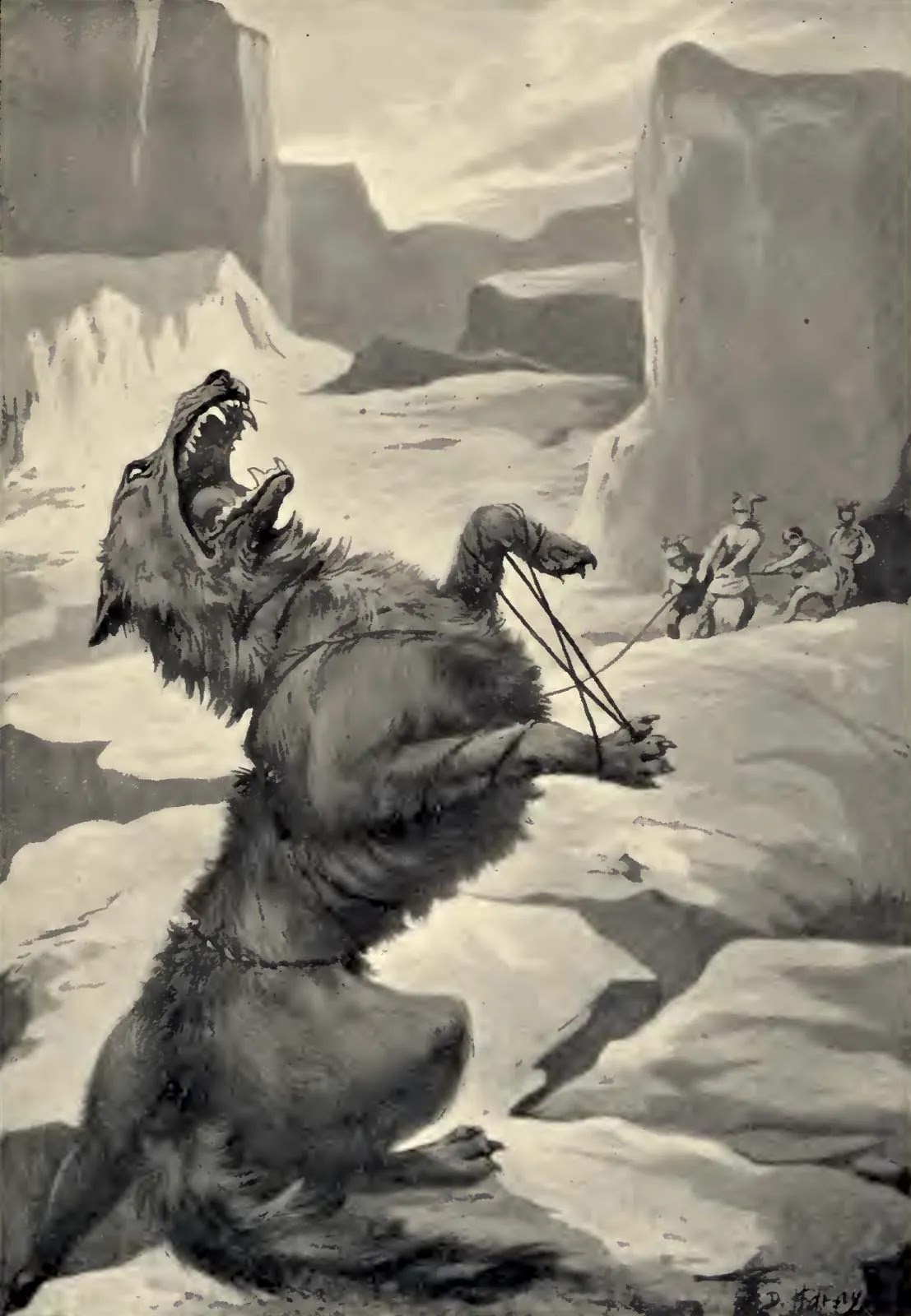
‘The Binding of Fenris’, ill. Dorothy Hardy

This is the full text of the Katharine Briggs Memorial Lecture as I gave it to the Folklore Society on 8th November 2022. If you would prefer to watch, there’s a link at the bottom to the Youtube recording of the event made by the Folklore Society. To everyone of whom, my thanks.


I am honoured to be speaking to you today, and not a little daunted when I think of the many eminent scholars who’ve given the Katharine Briggs Lecture before me. I am not an academic. However, I have loved folk- and fairy tales since I was a child and I’ve been writing and telling stories for most of my life, so when I received the Folklore Society’s invitation I knew I wanted to talk about the power stories have, for both good and ill, and about the different kinds of belief with which we approach them. So this evening I shall be talking about the gruesome tales children tell each other at sleepovers, about legends and fairy tales, and about those stories handed down in families, communities and nations which confer a sense of common identity and pride – sometimes at the cost of excluding others.

The Prose Edda tells of the wolf Fenrir, one of Loki’s three monstrous children by a giantess. Knowing that Fenrir was fated to harm them, the gods bound him with an iron fetter, pretending it was a game to try his strength. Fenrir snapped it easily, and he broke the next one they made, too, though it was twice as thick. Then the gods sent down to the home of the dark elves, where the dwarfs forged a fetter from mysterious, invisible, impalpable things: the footfall of a cat, a woman’s beard, the roots of a mountain, the breath of a fish, the spittle of a bird. It looked harmless – as smooth and soft as a silken ribbon, but Fenrir suspected a trick. He would not allow himself to be bound with it until Tyr agreed to place his right hand between the wolf’s jaws as a pledge of good faith. Tyr lost his hand, but for all his struggles Fenrir could not break the silken fetter.

Once upon a time, all stories existed only in the imaginations of those who told and heard them. Now stories are written down and printed in books, but a book is not a story. It’s just a container. If there are any stories in the Minoan script Linear A, they do not exist for us and never will, unless someone manages to decode and release them. Stories are words made of air, syllables on the lips, communications between minds: as invisible and impalpable as the things the dwarfs wrought into Fenrir’s fetter – and as strong.

In his essay ‘On Fairy-Stories’ JRR Tolkien says, ‘Spell means both a story told, and a formula of power over living men.’[1] It is we who give stories this power, we enspell ourselves: when we read or hear a story it becomes in some sense ‘real’ for us: we believe it. ‘In some sense’: belief is a sliding scale.

Coleridge in his Biographia Literaria defends the ‘supernatural, or at least romantic’ character of his poetry by explaining his intention to ‘transfer from our inward nature a human interest and a semblance of truth sufficient to procure for these shadows of the imagination that willing suspension of disbelief for the moment, which constitutes poetic faith.’ As Coleridge tells it then, ‘suspension of disbelief’ is the conscious action he calls ‘poetic faith’: a surrender to story on the understanding that although it is fiction, within its parameters it can tell important truths. And this surrender is or should be temporary: that’s what he means by ‘suspension of disbelief for the moment.’ Tolkien says something not dissimilar: he claims that the story-maker creates a Secondary World ‘which your mind can enter. You therefore believe it, while you are, as it were, inside.’[2]

Yet why should Coleridge feel the need to articulate a formula for enjoying stories, an activity which most people find easy as breathing? I suggest, because he was a child of the Enlightenment who assumes in his educated audience a rational scepticism towards the supernatural which he, and they, must work to overcome.

Childe Rowland: ill. John Batten

Coleridge’s contemporary, the antiquary Robert Jamieson, recounted how as a child, he was told the story-ballad of Childe Rowland by ‘a country tailor’ whom he patronisingly describes as ‘an ignorant and dull, good sort of man, who seemed never to have questioned the truth of what he related.’[3] His assumption of the man’s credulity may have been correct but seems unlikely given the fantastic nature of the tale, and I wonder whether Jamieson could differentiate, aged seven, between a tale told with conviction and one told as truth? But given the inference that belief in fantastic stories was for the lower classes, Coleridge’s ‘suspension of disbelief’ allowed sophisticated readers to engage with a poem like The Rime of the Ancient Mariner without feeling foolish. Cue: the Romantic period.

We may disbelieve in a story if it’s badly told (when it’s the storyteller’s fault) or if we are out of sympathy with the subject (when it is our fault), but to fully experience a story we must come to it as little children are said to come to the Kingdom of Heaven – with openness and trust. With belief in fact, belief that comes with risks unless at the end of the story the reader or listener can disengage from it. This is important.

Both Coleridge and Tolkien seem to suppose that when the story ends you are out of it – back in the real world, snap! – that disengagment from belief is automatic. But I am not so sure. Aged nine or ten, my daughters would sometimes go to sleepovers – particularly at Halloween – where the children would swap stories, scary ones, including some really gruesome urban legends. There was one of a murderous doll which climbs the stairs, calling to the cowering child above, ‘So-and-So, I’m on the first step! So-and-So, I’m on the second step!’ (A version of this was published in 1897 with an anxious note by the collector[4]: ‘It is hoped that this tale will not be reprinted in any book intended for children.’) There was the babysitter who answers the phone to a strange voice chanting, ‘Go check on the children! Go check on the children!’ and when she does there’s blood on the children’s pillows and a murderer hiding in their parents’ bed. And there was one with a serial-killer-clown whose grotesque, painted face peeps through the window at night. Maybe these tales were enjoyable in the context of a cosy bedroom full of other kids, with treats and drinks and fairy-lights – but for the next few nights at home there would be the patter of feet on the stairs and a distressed little voice crying, ‘I can’t get to sleep! I can’t help thinking about that story...’

It is no earthly use saying to a terrified child, ‘Don’t be silly, it was only a story.’ That is no comfort at all. Only a story? Children know what adults often fail to realise: a story is one of the strongest things there is. Indeed it’s not only children who sometimes find belief lingering uncomfortably beyond the end of a tale. Who hasn’t felt that prickle between the shoulderblades on finishing a ghost story rather too late at night?

The only thing powerful enough to counteract a story – is another story. I would sit down with my children and retell these tales, inventing banal explanations for the scary bits, to neutralise them. The doll on the stairs didn’t mean any harm. It was proud of having learned to climb them, and only wanted the little girl in the bedroom to know how high it could get! The caller who says ‘Go check on the children’ is their dad calling from the restaurant because he knows his kids are liable to misbehave. So the kids are listening from the top of the stairs, and when the babysitter comes up, they’ve squirted ketchup on the pillows to scare her and piled into their parents’ bed to hide. And the clown who peers through the windows? He’s not a murderer! He’s scared and lost and lonely. He fell out of the moving caravan and knocked himself out, and he’s just trying to catch up with his friends in the circus.

I promise you, this works when nothing else does. Once I had retold any of these stories it lost its power: the children were never frightened by it again. But you have to do it with complete confidence, with certainty. Tolkien is right: the storyteller casts a spell and stories are powerful magic. In remaking the scary stories I remade that world into a safe, ordinary one. I used magic to fight magic.

We believe stories differently according to how closely or not they seem to adhere to real life. Urban myths about murderers and clowns frighten children because clowns and murderers really exist, so the horrible things in the story might happen to them. They are not often frightened by giants or dragons. About ghosts, though, the jury is out. Plenty of adults believe in them, at least part of the time, and if a trusted friend tells us they have seen a ghost, what do we do? What we often do is withhold disbelief – which is not the same thing as Coleridge’s ‘suspension’. We suspend disbelief in stories we know to be fiction. Withholding disbelief is what we do when we’re not sure, when we don’t know what to think. The boundary between reality and unreality is porous, or people wouldn’t send Christmas cards to characters in soap operas (though perhaps from a desire to share in that world, rather than from naïvety). We live, far more than we realise, in our imaginations.

Frontispiece: The Fairy Mythology: ill. George Cruickshank


A tale recorded in Thomas Keightley’s The Fairy Mythology of 1828 illustrates our reluctance to disbelieve a tale told by somebody we know, and I suspect it’s also an early example of my own strategy for soothing frightened children. Keightley calls it Addlers and Menters[5]. The tale is narrated by two different voices.

An old lady in Yorkshire related as follows:– My eldest daughter Betsey was about four years old; I remember it was on a fine summer’s afternoon, or rather evening, I was seated in this chair which I now occupy. The child had been in the garden, she came into that entry or passage from the kitchen (on the right side of the entry was the old parlour-door, on the left the door of the common sitting-room; the mother of the child was in a line with both doors); the child, instead of turning towards the sitting room made a pause at the parlour-door, which was open. She stood several minutes quite still; at last I saw her draw her hand quickly towards her body; she set up a loud shriek and ran, or rather flew, to me crying out “Oh! Mammy, green man will hab me! green man will hab me!” 

It was a long time before I could pacify her; I then asked her why she was so frightened. “O Mammy,” said she, “all t’parlour is full of addlers and menters.” Elves and fairies I suppose she meant. She said they were dancing, and a little man in a green coat with a gold-laced cocked hat on his head, offered to take her hand as if he would have her as his partner in the dance. 

The mother, upon hearing this, went and looked into the old parlour, but the fairy vision had melted into thin air.  

“Such,” adds the narrator, “is the account I heard of this vision of fairies. The person is still alive who witnessed or supposed she saw it, and though a well-informed person, still positively asserts the relation to be strictly true.” * [Here Thomas Keightley adds an asterisk which leads to a cautious, sceptical footnote]: *And true no doubt it is: ie: the impression made on her imagination was as strong as if the objects had been actually before her.

Clearly Keightley didn’t believe the child really saw a fairy. But it wasn’t his story. He found it in a letter printed in The Literary Gazette and Journal of Belles Lettres, Arts, Sciences of 16th April1825. The anonymous correspondent had been reading Thomas Crofton Croker’s recently published Fairy Legends and Traditions of the South of Ireland, and wrote:

Mr Croker... says that fairies have not been seen for many years in the North of England. I can inform him, if not in the memory of man, they have been seen in the memory of woman, in a village in the East Riding of Yorkshire. A respectable female, who is nearly [ie: closely] related to the writer of this, and who is now alive, beheld, when she was a little girl, a troop of fairies “deftly footing a roundel daunce” in her mother’s large old wainscoted parlour… I have frequently heard it related by her venerable mother, and subsequently by herself.[6]

This was a family story, told first-hand. The little girl’s pause by the parlour door, the sharply observed gesture of ‘drawing her hand quickly towards her body’ and her terrified shriek, suggest a genuine experience, if only a frightening waking dream. We can be pretty sure that whatever little Betsey thought she saw, the words given to her are exactly what she said. ‘Addlers and menters’? Even her mother wasn’t sure what it meant. ‘Oh mammy, green man will hab me, green man will hab me!’ That sounds true too. But the civilized little man in green coat and gold-laced hat who invites the child to dance is hardly convincing as the source of such childish terror. 


Portrait of a Gentleman’, Joseph Wright c 1760


Gold laced cocked hats were high fashion in the first quarter of the eighteenth century, came briefly back in the 1770s, and vanished at the start of the French revolution in 1789. We do not know Betsey’s age in 1825, the date of the letter; she may have been middle-aged or more, but as a four year-old in an East Riding village would she even have seen such a hat – still less been able to describe it? You can hear the uncertainty in the letter-writer’s voice: he knows this lady, she’s positive about what she saw, and her mother witnessed her reaction to the event. Something happened. He can’t quite believe it – but he withholds his disbelief.

Whatever it was that scared Betsey, I can’t help thinking her mother invented the courtly little man to make it less terrifying, as I did for my children. ‘A green man, darling? Oh, a lovely little fairy man in a gold-laced hat! He didn’t mean to frighten you. He only wanted to ask you to dance!’ And such is the power of motherly suggestion, the child soon agrees that’s what she saw. This ‘explanation’ transforms a moment of fright into a more comfortable yet fascinating story, and ‘the time Betsey saw fairies dancing’ becomes a bit of family history that evokes pride and even wonder. 


Family photo: author's possession


This is my grandmother, Helena Beatrice Langrish, born into a British army family in India, in 1886. She was a great raconteur, and many of her stories involved men whose attentions she had to evade or fight off; these invariably emphasised her attractiveness and courage. She told one about four soldiers who surrounded her as she walked home from playing tennis: ‘They never said a word – they just looked at me. All I had with me was my tennis racket, Katherine!’ When an appeal to their honour failed – ‘You’re British soldiers! You wouldn’t hurt a woman!’ – she turned to threats: ‘I shall tell the colonel of you!’ – ‘They fled, Katherine! They fled!’ Left at that, this would be little more than an anecdote, but the tale continues to a punchline. The colonel, to whom she had indeed complained, paraded the battalion and lectured them on proper behaviour to women, after which he privately told her:

“You’re a very lucky woman, Mrs Langrish. Those men who accosted you”.... drumroll ... “were all gaolbirds!” And she would repeat, face vivid with the drama of it all, “All gaolbirds, Katherine!”            

 Like the ‘explanatory’ ending of Betsey’s tale, this coda in which my grandmother discovers the narrowness of her escape transforms a genuine yet brief scare into a memorable story. And do I believe it? There’s nothing obvious to disbelieve, so yes, mostly... but like Betsey’s, stories grow in the telling.

Belief is not an ‘on or off’ binary affair, but a whole spectrum. Stith Thompson has placed ‘the wonder story like The Dragon Slayer or Faithful John at one extreme of folk tradition and actual beliefs in various supernatural manifestations at the other’. And he adds: ‘sharp lines are hard to draw [...] All depends upon the attitude of hearer and teller.’[7]

Like family stories and ‘true’ ghost stories, local legends are located in the real world – with temporal and spatial reference points. They attract varying degrees of belief. The Cow and Calf Rocks on Ilkley Moor are said to have been dropped there by a giant called Rumbald, but I doubt anyone ever believed it, any more than they’d believe the moon is made of green cheese. People aren’t fools. The many comic folktales in which the devil comes off worst, as when St Dunstan pinches his nose with red-hot tongs, were surely always entertainment: but a scare-story of demonic apparitions in your own neighbourhood might be taken differently.

Detail: ‘Die Wilde Jagd' (anon) in 'Der Orchideengarten' 1920

The Peterborough manuscript of the Anglo-Saxon Chronicle tells of the appearance on February 6th 1127 of what we generally call the Wild Hunt:

Many people saw and heard many hunters hunting. The hunters were black and big and loathsome, and their hounds all black and wide-eyed and loathsome, and they rode on black horses and black goats. This was seen in the very deer-park in the town of Peterborough, and in all the woods ... between this town and Stamford, and the monks heard the horns blow that they were blowing at night.[8]

 The existence of a terrifying devil was church orthodoxy, and people may well have believed this. All the same, the appearance of the hellish hunters coincided with the arrival of a new, unpopular abbot who’d been foisted upon the monastery by Henry I. Supernatural or not, the event was used as propaganda to discredit the abbot. It’s always a good idea to ask who is telling the story, and why.

There are strange tales without an obvious purpose. That of the Green Children, said to have occurred in the reign of King Stephen, was recorded independently by William of Newburgh and Ralph of Coggeshall and still arouses curiosity. Two green children were found near Woolpit in Suffolk. They spoke an unknown language, ate nothing but beans, and later claimed to have come from an underground land suffused with a pale, unearthly light. Katharine Briggs remarked that the tale had ‘a curiously convincing and detailed air’[9], and modern commentators have found explanations ranging from ‘folk tale motif’, to ‘green skin caused by chlorosis or arsenical poisoning’ to ‘extraterrestrials’. The story is intriguing; people want to believe it – and exert themselves to find ways of doing so.

Devils are hard to believe in these days, but there are still people who claim to have seen fairies[10], while ghosts are evergreen. An article from July 2019 on the website ‘Kent Live’ reports a haunting on the A229 Blue Bell Hill road ‘with many motorists claiming to have seen a young bride waiting by the roadside. It is believed this ghost is that of 22-year-old bride Suzanne Browne, who was killed with two friends in a road traffic accident on the eve of her wedding on November 19, 1965.’ The details sound convincing. But in October 2020 the website ‘Wales Online’ ran a feature about the same stretch of road which repeats the story, but it’s now ‘Judith Langham, a young bride-to-be killed in a car collision on the day of her wedding’ who haunts the road. Those apparently specific details aren’t as anchored in fact as they seem.


Lord Raglan (wikipedia)

This rather grim-looking gentleman is Fitzroy Richard Somerset, 4th Lord Raglan, president of the Folklore Society from 1945-47. In his 1930s book The Hero: A Study in Tradition, Myth and Drama, he provides a delightful account of the stages by which a legend may grow from little acorn to great oak.

Stage 1: This house dates from Elizabethan times, and since it lies close to the road which the Virgin Queen must have taken when travelling from X to Y, it may well have been visited by her.

Stage 2: This house is said to have been visited by Queen Elizabeth on her way from X to Y.

Stage 3: The state bedroom is over the entrance. It is this room which Queen Elizabeth probably occupied when she broke her journey here on her way from X to Y.

Stage 4: According to local tradition, the truth of which there is no reason to doubt, the bed in the room over the entrance is that in which Queen Elizabeth slept when she stayed here on her way from X to Y. [11]

This is shrewd and funny. But such a story is going to be hard to kill in any individual case, because the Queen undoubtedly did spend the night in a great many different English country houses, and absence of evidence is not evidence of absence. The owner of the house, who takes pride in the story, is not going to listen to Lord Raglan casting cold water. Again it’s about wanting to believe. Pride trumps history.

Raglan was a hard-liner about folk tales. He didn’t think they preserved any historical information at all, which isn’t surprising when you read his definition of history: The recital in chronological sequence of events which are known to have occurred. Insisting that history depends entirely on written chronology, he claimed that since what he termed ‘the savage’ cannot write, ‘the savage can have no interest in history.’

When we read of the Irish blacksmith who said that his smithy was much older than the local dolmen … we are apt to suppose the speaker exceptionally stupid or ignorant, but [his] attitude towards the past is similar to that of the Australian black [sic] who began a story with: ‘Long long ago, when my mother was a baby, the sun shone all day and all night’, and is the inevitable result of illiteracy. [12]

Raglan’s contemptuous tone does him no credit; and he makes a category error: the Indigenous Australian storyteller is using an opening formula found all over the world, that places a traditional narrative far away and long ago: ‘Once upon a time’ and the tale, published in Folklore in September 1934, is an origin myth, a just-so story to explain solar eclipses. It tells of a golden age when everyone was happy and ‘the sun shone all day and all night’- as it would, in the golden age! Alas, some people became lazy and quarrelsome, upon which the sun and moon descended and split the earth in two, leaving the happy people on one side and the discontented ones – us! – on the other. When the happy people want to see what we are doing, they tip the sun on its side and crowd to look down on us, covering the sun and making it dark. I see no essential difference between this, and Hesiod’s account of the golden, silver and bronze ages of mankind, but I doubt Raglan would have sneered at Hesiod.

Compare that opening sentence with one from a Romanian fairy tale: ‘Once upon a time, far far away, as far as the spot where the Devil weaned his children...’[13]

Or one heard around 1860 by Henry Mayhew from a seventeen year-old lad in a London workhouse: ‘Once upon a time, and very good time it was, though it was neither in your time, nor my time, nor nobody else’s time...’[14]

            Or even this:  ‘A long time ago, in a galaxy far, far away…’

Such openings are not naïve. The storyteller knows very well there never was a time when the sun shone all day and night. The concept is deliberately surreal. Origin myths are not to be taken literally: they are fables to provoke thought and wonder. As for fairy tales, they openly flaunt their unbelievability. Shelves full of books have been written to prove or disprove the historicity of King Arthur or Robin Hood, but no one has ever asked if the story of Cinderella really happened, or pointed out the ruins of the Sleeping Beauty’s castle.

Like The Rime of the Ancient Mariner, fairy tales are full of ‘persons and characters supernatural, or at least romantic’ and we approach them with, let’s use Coleridge’s beautiful term, ‘poetic faith’. The wondrous events of fairy tales will not fool anyone, but this doesn’t mean they are trivial. The Ancient Mariner sins, suffers, repents, is forgiven – yet is left with the obsessive need to tell his tale over and over. Post-traumatic stress is nothing new.

Neither do fairy tales shrink from the dark side of life. Abuse, fraticide and child-murder are not uncommon; fairy tale families are frequently disfunctional. Mothers die, stepmothers are cruel, fathers are weak, selfish, even incestous, family friction often forces the protagonist out into the world. These things are not fantastic, but fairy tales mediate them to us within the bounds of an explicitly fantastic genre. The most unrealistic thing about the fairy tale is not the magic. It is the happy ending. 


Dorothea Viehman: portrait by Ludwig Grimm (wikipedia)

The people who made and told the tales were poor, often illiterate, and lived hard lives. I’ve already mentioned Robert Jamieson’s story-telling tailor. Here is Dorothea Viehmann, a tailor’s wife who contributed many stories to the Grimms’ first collection. William Larminie, who collected stories in Ireland in the 1880s, describes his contributors with considerable respect (in welcome contrast to Lord Raglan). Of Pat Minahan of Glencolumkill, for example, he says:

[F]rom him I obtained more stories than from any other man. He said he was eighty years of age; but he was in full possession of all his faculties. His style, with its short, abrupt sentences, is always remarkable and at its best I think excellent.[15]

Another was Pat McGrale, Jack-of-all-trades, boatman and fisherman, who ‘can read Irish but had very little literature on which to practise his accomplishment. He knows some long poems by heart.’ J F Campbell describes a seventy-nine year old man from South Uist: ‘He seemed to know versions of nearly everything I had got, and told me plainly that my versions were good for nothing. “Huch! Thou hast not got them right at all.”’ [16]

These were the folk who were telling, making and remaking the fairy tales we know. They sound a sharp, intelligent bunch, sophisticated storytellers who could and did link tales together into long chains that might run on for a whole night or series of nights. The Highland gamekeeper Hector Urquhart told J F Campbell: ‘It was a common saying, “The first tale by the goodman, and tales till daylight by the guest.”’[17] Here was live entertainment, exciting and colourful, and it bound communities together until, as Urquhart went on to say, ‘The minister came to the village in 1830, and the schoolmaster soon followed, who put a stop in our village to such gathering; and in their place we were supplied with heavier tasks than listening to the old shoemaker’s fairy tales.’ This suppression occurred because for two centuries the Presbyterian church had associated the fairies with the devil and witchcraft. In the clash of beliefs, as usual, the authorities won.


Hansel and Gretel: Anton Pieck

Told and disseminated by the common people, fairy tales favour the underdog. Hansel and Gretel is all about food and hunger: parents who choose between starving to death or abandoning their children. The Wolf and the Seven Little Kids features a single mum who must go out to work, leaving her children in danger – and yes, she’s a goat. Of the 145 Grimms tales that are actually about human beings (rather than animals or objects) – a whopping 84% follow the fortunes of poor people: peasants, millers, tailors, servants, shoemakers, tradesmen and furloughed soldiers. They nearly always end rich or married to royalty, or both: but that’s not how they start.

Fairy tales are aspirational and disruptive. The peasant lad marries the princess, the wicked king is thrown down. Young women possess the wit or magical skills to trick their giant or troll father-figures and save their lovers. The girl who sits in the ashes gets to wear the dress as golden as the sun. Fairy tales offer a world ruled by justice – not mercy. They are experiments in karma, if you like. Here if anywhere, the innocent and good will triumph, kindness and generosity will be rewarded, and the wicked will be punished: they will dance themselves to death in red-hot shoes, or be rolled downhill in barrels full of spikes. In Charles Perrault’s civilised Cendrillon the sisters are forgiven and marry lords, but in the Grimms’ version, which as a child I much preferred, they cut off their own heels and toes, and doves peck their eyes out. We may wince, but fairy tales are brisk about such things, and never graphic.

The context of GK Chesterton’s remark: ‘Children are innocent and love justice, but adults, being sinful, naturally prefer mercy’ was that he had been to see Maeterlinck’s play The Blue Bird with some children who were upset that the hero and heroine never find out that ‘the Dog was faithful and the Cat faithless’. The children were right. Justice comes before mercy, and the real world is and perhaps ever shall be short on both. Fairy tales offer the assurance that justice is important and does exist... on some Platonic plane, somewhere.

Changeling: Andrew Paciorek http://www.batcow.co.uk/strangelands/solitary.htm

Fairy tales, wonder tales, have undoubtedly contributed to the sum of human happiness. I doubt if they have ever done any harm. Only the stories that masquerade as truth can do that. Folktales of changelings and fairy abductions are found all over Britain and often include violent methods of bringing the ‘true’ child or wife back, such as burning, drowning or exposure. In 1827 the Dublin Evening Mail reported a trial at Tralee Assizes[18]:

Tralee Assizes, July 1826. – Child Murder – Ann Roche, an old woman of very advanced age, was indicted for the murder of Michael Leahy, a very young child, by drowning him in the Flesk. [...] The child, though four years old, could neither stand, walk or speak – it was thought to be fairy-struck – and the grandmother ordered the prisoner and one of the witnesses [...], to bathe the child every morning in that pool of the river Flesk [...] and on the last morning the prisoner kept the child longer under the water than usual [...]. Upon cross-examination, the witness said it was not done with intent to kill the child, but to cure it – to put the fairy out of it.

The magistrate directed the jury to find Ann Roche not guilty of murder, on account of her delusional beliefs. In 1885 a young Irish woman called Bridget Cleary was beaten and burned to death by her father and husband, who believed the real Bridget had been taken by the local fairies. And (though she gives no reference) Katherine Briggs, in A Dictionary of Fairies, mentions a child burned to death at the beginning of the 20th century ‘by officious neighbours who put it on a red-hot shovel in the expectation that it would fly up the chimney’.[19]

It’s not hard for people to believe narratives that fit ‘what everybody knows’. If we return to Lord Raglan’s definition of history, ‘the recital in chronological sequence of events which are known to have occurred’ – he thought, and a lot of people still think, history is all facts and dates and dated events, and being able to prove conclusively that certain things happened and where they happened, and when. But another view is that history is what goes on inside our heads – the things we remember, the stories we’ve been taught, shaped and driven by emotions like pride, patriotism, nationalism. Not just history, but our lived reality is made of stories, which may be neither accurate nor complete.

And deliberate efforts have been made by those in power to suppress tales of which they disapprove, as the minister and schoolmaster suppressed the Highland tales, and as I discovered while researching my 2007 children’s novel Troll Blood, set in an imaginary, magical Viking Age. The story took my characters across the Atlantic to Vinland: North America; the Greenlanders Saga tells how Thorvald Eiriksson and his men met, fought, and murdered indigenous people there: people my characters would also have to encounter. Since the book was a fantasy, I wanted to include on the North American scene creatures in some way parallel to the trolls, nisses and nixies my Norse characters knew. A belief in trolls characterises and differentiates a group of people from another group – one which believes in nymphs, for example. Without reference to the folklore and beliefs of the people I’d be writing about, I would be missing an important dimension. 

Clearly no one in the 10th century was collecting First Nations folklore, so instead I explored the later-recorded folklore of a range of North-East Woods peoples, especially the Mi’kmaq of New Brunswick and Nova Scotia, whose ancestors at least could have encountered Norse voyagers. I spent months in the Bodleian doing this: one particular story was collected in the mid 1920s by the anthropologist Elsie Clews Parsons from a Mi’kmaw woman called Isabelle Googoo Morris, about some creatures called the hamaja’lu:

 These are very small beings, no larger than two finger joints. There are thousands of them who live along the shore. [...] Once when some men landed on the shore for a short time, before they took to their boat again they saw a model of themselves and their boat made in stones by the hamaja’lu. They work very fast.[20]

Pebble figure on Lindisfarne: author's photo


This seemed delightful, and the hamaja’lu went into my book. When it was finished I sent it to be checked by Dr. Ruth Holmes Whitehead, an expert in Mi’kmaw studies, who set me right on several points. But I was rather dismayed when she asked me to correct ‘the hamaja’lu’ to  ‘the wiklatmuj’ik’, a far more difficult word to read and pronounce. I asked why, and she wrote back, ‘There is no ‘h’ in modern Mi’kmaq, and this word is obsolete. The word used today is the one I have given you.’ This surprised me: how could a word used freely in the 1920s – there were several stories about the hamaja’lu – have died out? Back came the reply: ‘You would not find it so surprising if you were aware that, during the course of the 20th century, generations of Mi’kmaq children were taken from their parents, put into homes, taught European ways, and punished – beaten, shut in cupboards, thrown down stairs – for speaking their own language.’ I took her advice.

Though stories about the hamaja’lu were written down in the 1920s, they’re not told any more. The wiklatmuj’ik are not the same; much bigger, for one thing. Such tales are more than curiosities. The now-forgotten hamaja’lu may never have had objective reality, but they were once part of a belief system, part of Mi’kmaq identity. And that was what the Canadian Government of the time was trying to eradicate. 

Despite such losses, the Mi’kmaw language survived, and so has the culture and people, but in the introduction to the Indigenous Australian origin myth I mentioned earlier, I found this unemotional but terrible statement: 

The myths and folktales presented in this paper were collected from the Wheelman [Wiilman] and neighbouring tribes of South-Western Australia which lived in the region inland from Bremer Bay. These tribes are now extinct so that the material included herewith probably represents all the tales which will ever be known from this part of Australia.[21]

The myths and tales were collected in the 1880s. The paper was published in 1934. Just fifty years. I checked and in fact the Wiilman people still exist, but their language is extinct: it will have been lost through the same tactic of taking children away from their parents. The sorry pattern of Western culture imposing itself on the cultures of indigenous peoples been repeated many times.

So what about our own national identity, what stories do we tell about ourselves? Probably the most resonant in popular memory are still those of the Battle of Britain, and the little ships at Dunkirk. They may well inspire us, but they are our grand-parents’ stories, not ours. We should be careful of bathing in unearned, reflected glory and clinging too closely to the past.


Here is OUR ISLAND STORY, a History of England for Boys and Girls by Henrietta Elizabeth Marshall, published in 1904. It is still in print.

The opening chapter tells how Neptune and Amphitrite had a son called Albion and gave him an island: ‘a beautiful gem in the blue water’. Albion ruled this island until he was killed in a fight with Hercules, and then Brutus arrived from Troy to fight and kill the giants who lived here, and when Neptune retired as a god, because he had loved Albion so much he gave his sceptre to the islands now called Britannia: ‘For we know – Britannia rules the waves.’   

Now that’s pure fairy tale, even if most of it’s based on Geoffrey of Monmouth’s 12th century History of the Kings of Britain which itself, as you’ll well know, is almost entirely fiction. The author ends the chapter with perhaps the blandest account of colonialism I’ve ever read:

In this book you will find the story of the people of Britain. The story tells how they grew to be a great people, till the little green island set in the lonely sea was no longer large enough to contain them all. Then they sailed away over the blue waves to far-distant countries. Now the people of the little island possess lands all over the world.[22]

No mention, you’ll notice, of the peoples our ancestors dispossessed. 

            David Cameron has gone on the record three times, describing how Our Island Story’s version of British history shaped his mind. He referenced it in a speech delivered in 2014 just before the Scottish Referendum, to deliver a message of national unity:

I have an old copy of Our Island Story, my favourite book as a child, and I want to give it to my three children, and I want to be able to teach my youngest, when she’s old enough to understand, that she is part of this great, world-beating story. And I passionately hope that my children will be able to teach their children the same.

 Our Island Story is almost entirely folktales. There’s Merlin, there’s King Arthur – ‘only fifteen when he was made king, but the bravest, wisest and best king that had ever ruled in Britain.’ There’s Robin Hood and his Merry Men...

Elizabeth and Raleigh: Herbert Moore 1908

... and Sir Walter Raleigh throwing down his cloak for Queen Elizabeth – for which there is no contemporary evidence. Marshall even presents Raleigh as a benefactor of the Irish: 

Two of the things Raleigh brought home [from the Americas] were tobacco and potatoes. [Queen] Elizabeth had given him estates in Ireland, and there he planted the potatoes and showed the people how to grow them. Even to this day the poor people in Ireland grow potatoes and live on them very largely.[23]

Raleigh received his Irish lands as a reward for helping to put down the Desmond Rebellions, when he took part in at least one massacre, so this account of him as a sort of kindly agriculturalist is alternative fact – if you remember that phrase coined by Kellyanne Conway – of a high order.

Our Island Story is not honest. It is propaganda designed to invest a child with a particular identity: the son or daughter of a heroic, benign and glorious British race. Blurbs on Amazon hail it as a ‘compelling narration’ that lauds ‘the valiant spirit of Richard Lionheart who led the Third Crusade’. The book of course includes no account of that king’s decision to massacre almost 3000 Muslim prisoners – men, women and children – at the Siege of Acre. No wonder then, that one five-star review reads: ‘Parents, grandparents and teachers, this timeless classic will help the children in your life learn their country’s history and be proud and grateful for it!’

            These stories, these folktales, are woven into the British historical narrative. They still influence real people, real politicians, real events. We live more than ever before in a world of conspiracy theories, fake news, competing versions of events – all stories, and it’s more important than ever to be able to distinguish between them. No history book can tell everything, but balance is required. It may not be pleasant to learn from David Olusoga[24] that even after the abolition of the Atlantic slave trade in 1807, much of Britain’s wealth continued to depend on the sugar plantations of the West Indies where slavery did not end until 1838 after a series of bloody uprisings – but it’s important. When we don’t hear these stories, and the statue of a slave-owner gets toppled into a harbour in Bristol, then people object and up goes the cry of ‘rewriting history’. But every nation has its dark side, and nations, like people, should admit their faults.

            Stories are wonderful. They entertain, instruct, frighten, comfort, amaze: they offer hope, wonder, solace. They bind us together in families, communities, nations. They have the power to command belief. We just need to be careful what sort.

Author's copy: frontispiece and title page

Friedrich de la Motte Fouqué’s 1814 romance Sintram and His Companions is a remarkable fairy tale set in a medieval Norway-that-never-was. It’s an eerie, powerful fable about temptation and the struggle for righteousness: Sintram’s terrible companions are a spectral Death and a dwarfish Sin. The preface to my1883 edition includes a wonderful quotation from ‘Mr Linklater, curate of St Peter’s, London Docks’, who read the tale aloud to ‘the rough lads’ of his Bible class:

It was my compact with them that if they were good and attentive at lessons I would afterwards tell them a story, or show them pictures. ... But I was most astonished at what I considered a daring experiment, the reading to them Sintram. It made the most wonderful impression on them. They wrought it into their own lives. They called the different localities of the parish by the names in the book. They literally hungered for the next week’s portion. I believe that nothing I have ever read or said to them has affected them so lastingly as this.[25]

I find that incredibly moving. In creating and believing in stories, we create and believe in ourselves. Among the many definitions of what it means to be human, the capacity to make up stories may endure as a distinguishing feature – although who knows what the whales are singing? Let me quote from an essay I wrote several years ago, for I don’t think I can put it any better:

We pass through the world surrounded by mysteries – things which are not, which have no physical existence. There is the past, which we remember but can no longer touch: a magician’s backward-facing glass in which the dead are still alive and the old are still young and can be seen going about their affairs, ignorant of our gaze, in tiny bright pictures with the sound turned down low. Then there is the distance – that blue trembling elsewhere on the rim of the horizon beyond which, perhaps, everything is different, new and wonderful. And there’s the invisible future into which we constantly travel with our baggage of hopes and promises, longings and fears.

The before-and-after of life is a great darkness, and we build a bonfire to light and warm and comfort ourselves – the bonfire of culture: myths, stories, songs, music, poetry, religion, art and science. All these things spring from the human struggle to apprehend the world and our place in it: and the untouchable existence of such things as the past, the future, the horizon, has given us confidence to imagine and discover and invent and delight in other things which can neither be seen nor approached nor touched. Right and  wrong. Gods, ghosts and mathematics. And of course...


Tyr and Fenrir: John Bauer

I began this evening with the wolf Fenrir, for whom the dwarfs wrought that cord of other, equally impossible things. He was suspicious of it from the start, saying: ‘This ribbon looks to me as if I would gain no renown from breaking it – it is so slight a cord; but if it has been made by guile and cunning, slender though it is, it is not going to come on my legs.’[27] But he was persuaded, and once entangled he was unable to get free. All the same, he will eventually break loose on the day of Ragnarok. Perhaps it was his belief in the cord that imprisoned him. Perhaps it was the guile, the cunning, the spell of story that bound him, after all.


The link to the Youtube recording of the event made by the Folklore Society:


[1] Tolkien, JRR, ‘On Fairy-Stories’, The Monsters and the Critics and Other Essays, George Allen & Unwin, 1983, 128

[2] Tolkien, ‘On Fairy Stories’, The Monsters and the Critics and Other Essays, George Allen and Unwin, 1983, p132

[3] Jamieson, Robert, Illustrations of Northern Antiquities, 1814, pp 397 et seq

[4] Addy, S.O.,‘The Old Man At the White House’: Four Yorkshire Folktales, Folklore Vol 8, no 4, December 1897

[5] Keightley, Thomas, The Fairy Mythology, 308 et seq

[6] op cit

[7] Thompson, Stith, The Folktale, Dryden Press 1951, p263

[8] Douglas & Greenaway, English Historical Documents, Vol II Eyre Methuen 1981, 204

[9] Briggs, KM, The Fairies in Tradition and Literature, Routledge & Kegan Paul 1967, 7

[10] Documented by Simon Young and Ceri Houlbrook, Magical Folk, Gibson Square 2018

[11] Raglan, Lord, The Hero: A Study in Tradition, Myth and Drama, Thinker’s Library 1948, 30 et seq

[12] Raglan,Lord: The Hero, Thinker’s Library 1948 p3

[13] ‘The Princess Who Would Be A Prince’: The Foundling Prince and Other Tales, Petre Ispirescu, tr. Julia Collier Harris & Rea Ipcar, Houghton Mifflin Co. NY 1917,241

[14] Mayhew, James, London Labour and the London Poor, Griffin, Bohn & Co, 1861, 391

[15] Larminie, William, West Irish Folk Tales, The Camden Library 1893, pxxv

[16] Campbell JF, Popular Tales of the West Highlands, Alexander Gardner 1890, Vol 1, xxii

[17] op cit vi

[18] Dublin Evening Mail, 17 April 1827, quoted by Thomas Crofton Croker, Fairy Legends and Traditions of the South of Ireland, 2nd edition, preface.

[19] Briggs, Katharine, A Dictionary of Fairies, Penguin 1977, 71

[20] Parsons, Elsie Clews, ‘Micmac Folklore’, Journal of American Folklore, v.38, 1925, 94


[21] Hassall, Ethel,’Myths and Folktales of the Wheelman Tribe of South-Western Australia’, selected & revised by D.S. Davidson, Folklore Vol 45, No 3, Sept 1934

[22] Marshall, HE, Our Island Story, TC & EC Jack, 1905, p4

[23] op.cit, 344

[24] Olusoga, David, Black and British: A Forgotten History, Pan Macmillan 2016, Chapter Six

[25] De La Motte Fouque, Friedrich, Sintram and His Companions, Seeley Jackson & Halliday 1883, vii

[26] Langrish, Katherine, ‘Desiring Dragons’, Seven Miles of Steel Thistles, Greystones Press 2016, 114

[27] Sturluson, Snorri, The Prose Edda, tr. Jean I Young, U. of California Press 1973, p38