Showing posts with label The Little Mermaid. Show all posts

Friday, 22 June 2012

"The Little Mermaid"


The Little Mermaid - Edmund  Dulac

 A guest post by Cassandra Golds


Once upon a time, when I was a very little girl, my father bought me and my younger sister a record.

It was one of the Tale Spinners for Children series — a collection of records so fondly remembered by some adults that there is a (very handy) website devoted to them. Tale Spinners for Children was a series of fully dramatised British adaptations of classic fairytales and stories — everything from “The Sleeping Beauty” to The Count of Monte Christo. They were lavishly produced in the manner of BBC radio drama, with appropriate classical music and British actors who were rarely credited on the sleeves, although they included such luminaries as Maggie Smith and Donald Pleasance — and who had voices to die for. They made some fifty of them altogether, throughout the sixties, and incidentally the brilliant producers and adaptors were not credited either. We as a family had several of them, but one of these had the dread hand of fate on it. It was the Tale Spinners adaptation of “The Little Mermaid” by Hans Christian Andersen. They used Grieg’s Piano Concerto in A minor as incidental music, and used it so masterfully, you would swear the work was written for the story. From the moment I first heard it — a moment some time before I could read — I was in love, with both the story and the concerto.


The first time I listened to it I remember sitting on the lounge in front of the big record player in my childhood home with  an aching throat and tears streaming down my face. The Tale Spinners version — which, although dramatised, stuck closely to the Andersen original — was about unrequited love, self-sacrifice and the hope of ultimate transcendence. In other words, it was not the Disney version. And yet, at the age of five or so, none of it seemed foreign to me. Not only did I think this was the most beautiful story I had ever heard — immediately I conceived a passionate allegiance to it. From this point on, for me, “The Little Mermaid” was what a good story should be — sad, noble, uplifting, passionate, desperate, extreme and big, opera-big. And it had to make you cry. It was the first time I was ever moved to tears by a work of art, and I have never fully lost the conviction that that is art’s first duty: the gift of tears.

And the dread hand of fate? Well, from the moment I first heard that record, I was destined to be a children’s author. It changed the course of my life. Or set me on it.

“The Little Mermaid” is not a traditional fairy tale or folk tale, but an original story by an author who is a legend in himself. What’s more, we know a good deal about the biography of the author, and like many of his stories, this one has strong autobiographical overtones. We are often told that folktales were not originally told specifically to children — that they were meant for an audience of all ages.  Original fairytales, on the other hand, such as Andersen’s and Oscar Wilde’s, are probably more truly children’s literature in the modern sense. And yet ever since I was an adult myself it has struck me that “The Little Mermaid” is a very adult story. Or at least, that it is an adult story told in the form of a children’s fairytale. Because it takes as its subject, not (for example) every child’s two greatest fears, as Adele Geras says so perceptively of “Hansel and Gretel”, but unrequited love, terrible self-sacrifice, and eventual transcendence, I have spent a good deal of time wondering what it was that I saw in it at that age. Why did I identify with it so strongly?
 

The Little Mermaid - Arthur Rackham

 
There are a number of possible answers to that question. One thing I believe with all my heart is that there is nothing trivial about childhood emotion. Children may be small, but their emotions are big, as big if not bigger than the emotions of adults. You will never be more passionate than you are at five. Things will never matter to you more, and you will never be capable of more suffering. It is also perfectly possible that you have already had your heart broken. I am the eldest of two sisters; my younger sister was born when I was eighteen months old. It is a family anecdote that, when my beloved grandfather came to see my baby sister for the first time, he walked past me and went first to her in her bassinet, the new baby. I’ve been told that I ignored him  completely for the duration of the visit which followed that betrayal and indeed that our relationship never recovered. I hope you are not shocked — in fact I think this is a fairly ordinary family story; one adult or another   must have made that kind of crucial false step every time a new baby has been born into this world. But I think, in common with many children, that must have been my first experience of losing a beloved to another, and that that was one of the things I was recognising in “The Little Mermaid”. You learn all the basics of romantic love before you hit kindergarten; I’m quite certain of that.

But romantic love is not the only subject of “The Little Mermaid”. It is also, crucially, about the longing for another state of existence; and about dignity and even triumph in humiliation in suffering. In a way, the Little Mermaid’s falling in love is just the trigger for a drama about personal identity; she doesn’t just love the prince, she wants to be him, that is, human, with an immortal soul, which in Andersen’s tale is the exclusive preserve of human beings. And — according to the Sea Witch — she can only truly become a human being, with a human being’s immortal privileges, if she wins the love of the prince. The Sea Witch can give her legs — at a dreadful price. Only the prince can give her a soul.
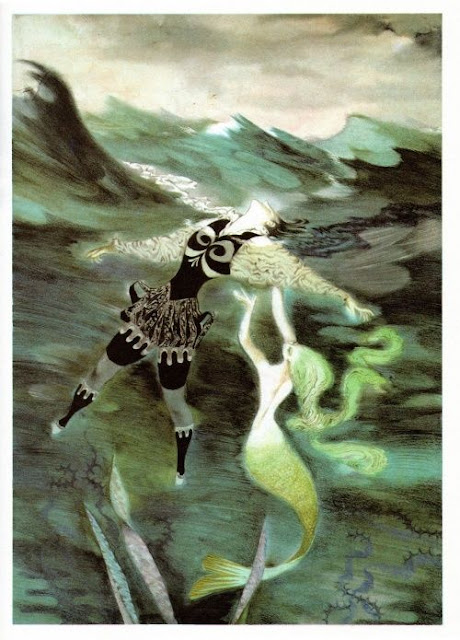
The Little Mermaid, Jiru Trnka


Many people seem to think that this story of Andersen’s is deeply anti-feminist. I think that is a profound misreading. I’m not arguing that he was a feminist in our terms or that he was anything other than a man of his time. But it astonishes me that such people haven’t noticed that he has identified himself completely with his female hero — she’s not the Other (as women continue to be for so many male authors), she is himself.  Furthermore, she is doing something completely atypical of traditional fairy tale heroines (or at least those belonging to the canon of the best known) — she is the lover, not the beloved, the active, not the passive one. Indeed, it is she who saves the prince from drowning in a feat that would take almost impossible strength and stamina, even for a mermaid. She’s only a fifteen-year-old girl with a fishtail, after all, and yet she holds the insensible prince above the waves during the entirety of a terrible storm at sea, which has wrecked his ship, and which rages all night. Then, as the story develops, she pursues him — but, lacking the voice she has given in payment to the Sea Witch for the magic that will split her fishtail into legs (and less obviously but just as importantly, being a foundling with no family or earthly breeding) — she is unable to win his love. (And incidentally, what an unforgettable character the Sea Witch is — laughing in scorn at romantic love, and cutting, with the Little Mermaid, one of the most chilling devil’s bargains in literature. And the Little Mermaid’s grandmother — what a marvelous creation! — with all her wise counsel against reaching too high, and being discontent with what she believes to be the pretty good wicket of mermaid-hood.) It is also crucial to note, not only that the Little Mermaid makes her own independent choices, creates her own destiny, throughout the story, but also that in the overwhelmingly powerful denouement, which is to some extent a twist, the Little Mermaid beats the Sea Witch and even the strictures of the story itself, at their own game. Two possible endings have been laid out for her by others; instead — by staying utterly true to her self, her principles and her conception of genuine love — she invents her own.

The Little Mermaid - Edmund Dulac

When I was twelve, because of the Robert Redford film, which I adored, I read "The Great Gatsby" for the first time. It had the same effect on me as “The Little Mermaid”, and when I was in my twenties and more capable of analysis it dawned on me that it is exactly the same story. Gatsby is the Little Mermaid. He, a poor boy, falls in love with a rich girl, Daisy. He cannot win her in the state of existence into which he was born — that is, poverty — and so he devotes his life, spectacularly, to transforming himself into a rich boy. He gets the mansion and the money, just like the Little Mermaid gets the legs. But he cannot win Daisy from the husband she has chosen from her own kind, just as the Little Mermaid cannot win the prince from his intended. For both of them, tragedy, and a strange kind of transcendence, results.

Unrequited love makes you question your entire existence. It is as if your whole self is worthless, because that self is worthless, or not worth enough, to the beloved. If you experience unrequited love profoundly, it will have a profound effect on your personality. You will be inclined to define yourself by it, as if it is the single most important aspect of your personality. And it will force you to find a means of transcendence — a sense of worth, even of personal destiny, that makes the indifference of the beloved bearable and even creatively and spiritually lucrative.

Here is something I will never know, but will wonder about all my life. When I first heard “The Little Mermaid”, was I already, at five or six, that kind of personality who would spend much of her life loving unrequitedly? Or could it be true — though, as a children’s author, I hope with all my heart that it is not — that the story affected me so deeply that it turned me into such a person?

I’m sure you already know why I hope that’s not true. It’s because I don’t want to have that much power. I don’t want any story to have that much power.
 
Cassandra Golds, Friday 19th November, 2010


Update Friday 22 June 2012: Cassandra writes:

P.P.S. Now here, gentle reader, is a post script which I feel bound in honour to add, for life is nothing if not surprising, and we would all do well to remember this -- especially those of us who are authors! The very week that I wrote this piece in late 2010 -- the very week -- I met the man who has become the love of my life. It took until well into my forties, but I have finally experienced a love that is not unrequited. And so you see, “The Little Mermaid” notwithstanding, my life has turned out quite unexpectedly. I seem almost to have gone from being a Hans Andersen heroine to a Jane Austen one. And as Emma discovered, we are not entirely the authors of our own biographies. For that matter, as Catherine Morland discovered, we are not characters in our favourite books, either! In the infinitely complex, utterly unpredictable stories that are our lives, we never know what plot twists we will encounter -- perhaps on the very next page.

Cassandra Golds is an Australian writer of children's and YA fantasy: she and I seem to have much in common, not least that we are both big fans of the wonderful, currently-neglected-and-out-of-print Scots author Nicholas Stuart Gray, whose wildly imaginative yet down-to-earth fantasies we both grew up on and both love.

Cassandra says, “I was born in Sydney and grew up reading Hans Christian Andersen, C.S. Lewis and Nicholas Stuart Gray over and over again.” She always knew she wanted to write for young people and had her first book accepted for publication when she was nineteen. Her beautifully-written novels, Clair-de-Lune, The Museum of Mary Child, The Three Loves of Persimmon and Pureheart (2013) are deeply influenced by the worlds of fairytale and 19th century literature. 


Friday, 8 June 2012

The Perilous Seas of Faeryland

 'The Little Mermaid', Arthur Rackham


Are 'mermaid books' a genre? There’ve been plenty of mermaid stories published in the last six to eight years – Helen Dunmore’s ‘Ingo’ series and Liz Kessler’s lovely ‘Emily Windsnap’ titles spring instantly to mind: but they've been too different to be connected or viewed as a genre – certainly not in the same way that vampire or werewolf stories have. This is no bad thing.  For even though what seems to be a sudden fashion is often no more than a different way of joining up the dots, I’ve got a feeling that mermaids (and their underwater kin the selkies and kelpies) offer more various kinds of opportunity to the writer than the biting of throats and sucking of blood.  Subtler, more lyrical.  A different world.

Mermaids and selkies represent the Other – they look like humans but they aren’t, or perhaps they are only half human.  In all the folklore I’ve read about mermaids, they have no souls, and sometimes they mourn this and sometimes they don’t care…  Hans Andersen’s little mermaid will disappear like foam on the sea if she doesn’t win a soul: but when she does gain a soul, she stops being a mermaid.  She becomes a spirit of the air, a sort of angelic Christian spirit – and so in either case she ceases to be, or at least loses her identity... Plus, mermaids and selkies physically inhabit a place we can’t survive in, the world of the sea: so to write a book about mermaids is to take the reader on an imaginative journey into a different world. 

Most mermaid stories are sad.  Some mermaids are actively dangerous. (One legend tells of a giant mermaid who rises out of the sea to demand of passing ships, ‘What news of King Alexander?’  Unless she receives the response, ‘He lives, reigns, and conquers the world!’ she wrecks the ship in her fury.)  So mermaids are also a metaphor for the beauty and danger of the sea, which has the power to wreck ships and take lives. There’s a lot going on in mermaid stories.

For me this sombre illustration by Arthur Rackham suggests the danger of desiring the Other

All fiction is affected by contemporary concerns.  Hans Christian Andersen’s ‘Little Mermaid’ was concerned with salvation because he wrote in a highly Christian century.  Nowadays, in our multi-cultural, multi-faith, multi-everything society, I think writing about mermaids offers an opportunity to explore issues of trust and communication between individuals who may look different from one another, who may appear to come from different worlds. What is it to be ‘human’? How do we define it?  How do we recognise similarities and reconcile differences?  In very different ways, Liz Kessler’s 'Emily Windsnap' books and Helen Dunmore’s ‘Ingo’ and its sequels explore these questions, as well as issues of pollution and climate change. In 'Ingo', merfolk and humans were once one people, who have diverged and now live in separate worlds - except that each race still impacts the other. Liz Kessler's 'Emily Windsnap' is a little girl who herself bridges the gap: her father is mer, her mother human. To which world does she belong?  Is it always necessary to choose?

And what about the original legends, such as the Cornish Mermaid of Zennor or the Scottish selkie and kelpie stories?  The legends are tremendously inspiring - but you have to think about them, find out what they are saying to you.  I wrote about the selkies, the shape-shifting seal people, in ‘Troll Mill’, the second part of my trilogy ‘West of the Moon’.  The legend is of a fisherman who sees the selkies dancing on the moonlit beach in the form of lovely women, and he snatches up one of their discarded sealskins so that the selkie girl can’t escape into the sea.  She has to marry him and bear his children, but one day she finds where he’s hidden the sealskin.  At once she throws it on, returns to the sea and abandons him and her human (half-human?) children forever. 

For me, this legend seemed to be about the difficulty of understanding one another, even in a bond as close as marriage – in a sense, one’s partner is always the Other.  It speaks of the power struggle between couples – and the grief of a failed partnership – and, very strongly I thought, about the new mother’s plunge into post-natal depression.  And that was how I used it in my book, though keeping the magic and lyricism. In my short mermaid book ‘Forsaken’, the human-mer partnership is the other way around, based on an old Scandinavian ballad about a Mer-king who marries a mortal woman, and one day she hears the church bells ringing above the sea, and goes back to the land and leaves him forever.  Rarely in folklore do these stories end happily.  But I read the legend, and my spine tingled, and I wanted to see what would happen if one of the half-mer children went looking for her mother…  Would the ending be different?

Margo Lanagan, in ‘The Brides of Rollrock Island’, has found something quite different in the selkie legends (see her post and my review).  In her book, the seals are used, manipulated, transformed, in a way which denies their nature and damages the wrongdoers. It’s a marvellous book which will keep me thinking for – I suspect – years. The beautiful women who step out of the seal carcasses appear, to the rough island men who have obtained them like mail-order brides, to be the culmination of delight: but they and their sons live with the guilt of the seal women’s ever-present mild but steadfast grief.

Franny Billingsley’s ‘The Folk Keeper’ is another story which is concerned with questions of identity and belonging, a wonderfully creepy take on the selkie legend.  And Gillian Philip’s ‘Firebrand’ and ‘Bloodstone’ include not only selkies, as sinister death-omens, but her heroes of the Sithe, the Scottish faeries, ride kelpies too (water horses from the lochs): sleek and dangerous and man-eating.  Kelpies appear again in Maggie Stiefvater’s wonderful ‘The Scorpio Races’, an evocative and thrilling story of racing the savage water horses on a wild Scottish island.  Should men take and attempt to tame these otherworldly creatures?  Is it courage or cruelty?  Should they, perhaps, be left to their own world and their own nature?

These are all strong, and wonderfully written books.  If you feel like taking a plunge into the perilous seas of fairyland, do try them!


Thursday, 2 June 2011

Exciting Things!

Two exciting things, actually.  The first is the lovely cover of the new book I’ve written. ‘Forsaken’ will be published in November by Franklin Watts EDGE, and is one of a series, commissioned from several different well-known children’s authors (*modest cough*), of quick reads for children aged nine and over – children who are competent readers but might feel daunted by a thick, 350 page novel.

This is as sophisticated a story as I’ve ever written, so I hope some of you adults will like it too.  You can fit a lot into a little room. 

Last week I was thinking about waterspirits – naiads and undines and kelpies – the denizens of fresh water, rivers, lakes and tarns.  But the salt sea has always been the province of mermaids.  And rather as fairies were downgraded to flowery little creatures with butterfly wings and sparkly wands, so mermaids – ever since Disney’s Ariel, perhaps – have gone sparkly too.  Long blonde hair, mirrors and combs: perhaps the accessories don’t help – and don’t get me wrong, I don’t mind this at all, any more than I mind little girls poring over the Flower Fairy books, as my own daughters used to do.  Sweet little mermaids are safe and happy reading for little girls.  But what about older children?

I’m not even going down the route of the siren, the mermaid as death omen, precursor of shipwrecks.  No, where I started from in this little book was the original legend behind Matthew Arnold’s classic poem ‘The Forsaken Merman’.  It’s called ‘Agnete and the Merman’ and I found it in an old book of Scandinavian poetry.  In it, as in Arnold’s poem, a mortal woman marries a Merman and has seven children by him.  One day, as she sits singing under the blue water she ‘hears the clocks of England clang’ and seeks leave to revisit land and go to church once more. 

Once back on shore, however, she refuses to return to the sea.  In Arnold’s poem, which I really love, the Merman and his children call wildly and vainly for their lost wife and mother from the bay, until at last they accept that she will never return.

But children, at midnight,
When soft the winds blow,
When clear falls the moonlight,
When spring-tides are low:
When sweet airs come seaward
From heaths starr’d with broom,
And high rocks throw mildly
On the blanch’d sands a gloom,
Up the still, glistening beaches,
Up the creeks we will hie,
Over beds of bright seaweed
The ebb-tide leaves dry:
We will gaze, from the sand-hills
At the white, sleeping town,
At the church on the hillside –
And then come back down,
Singing, ‘There dwells a loved one,
But cruel is she.
She left lonely for ever
The kings of the sea.


There seems to me a great tragic tension in this poem and in the older ballad – the same tension that is found in the Orkney stories of the selkie wife who leaves her fisherman husband to return to the sea.  (Which is the same story in reverse, and an important element of my book Troll Mill, the second part of West of the Moon). These stories are about an unbridgeable strangeness between husband and wife, perhaps more specifically the terrible strangeness caused by post-natal depression.  They’re about seeing someone – even someone as close to you as your partner – as alien. In the Merman story, and with Andersen’s story of The Little Mermaid, despite the little mermaid’s bargain with the sea-witch – it’s not really the physical fact that the mer-people have tails and the humans have legs that causes the trouble.  It’s the perceived ‘fact’ that mer-people don’t have souls.  This will cause the eventual eternal separation of any mer/human marriage anyway; so no wonder the Merman husband, though he calls so desperately, and even climbs on the gravestones in the churchyard to peep through the church windows, will never win his Margaret back. 

Then I thought, but what if one of the children went after her mother to try and bring her back?  And with that idea, which totally grabbed me, this book just flowed.


And my second Very Exciting Thing is that a new series of  Fairytale Reflections will begin on this blog next Friday, and the opening essay will be from the amazing Terri Windling, author of  'The Wood Wife'  - which won the Mythopoeic Award for Novel of the Year in 1996 - and fantasy editor extraordinaire.

I'm posting a little early this week, as I'm going away for a few days.  Have a good weekend, everyone!

Friday, 19 November 2010

Fairytale Reflections (10) Cassandra Golds

Cassandra Golds is another writer whose acquaintance I am fortunate enough to have made because of this blog – although I was already aware of her fiction through Adele Geras, whose Fairytale reflection on Hansel and Gretel was the second in this series, and who is also a big fan.

Meeting Cassandra via email and the internet has been great fun. We seem to have much in common, not least because we are both big fans of that wonderful, currently-neglected-and-out-of-print Scots author Nicholas Stuart Gray, whose wildly imaginative yet down-to-earth fantasies we both grew up on and love. In fact, Cassandra has started a Facebook page in his honour.

Cassandra says, “I was born in Sydney and grew up reading Hans Christian Andersen, C.S. Lewis and Nicholas Stuart Gray over and over again.” She always knew she wanted to write for young people and had her first book accepted for publication when she was nineteen. Her three novels, Clair-de-Lune, The Museum of Mary Child and The Three Loves of Persimmon (just out in Australia) are all deeply influenced by the worlds of fairytale and 19th century literature.

Cassandra’s writing is beautiful, delicate and strong; and her books are not like anyone else’s at all. Clair de Lune is about a young girl who has never spoken a word since the death of her mother, a great ballerina. Then she meets Bonaventure, a dancer-mouse, who takes her to a mysterious monastery hidden away in the building where she lives... And The Three Loves of Persimmon is also about a friendship between a girl and a mouse living in a vast railway station. Does that sound sweet, cute? Maybe it does, but believe me these are not twinkly books. Cassandra’s writing takes the reader into surreal places where dark emotions and the hidden places of the human soul can be explored.

The Museum of Mary Child just blew me away. It begins with a prisoner, a young man chained in a dark cell, who is visited in his sleep by birds – a society of birds, in fact: The Caged Birds of the City. It moves on to the city madhouse, where a young woman has just been turned out into the streets. And it concerns a young girl called Heloise who lives with her cold, unloving godmother, the guardian of the strange museum next door, the Museum of Mary Child, where ‘visitors enter smiling and depart with fear in their eyes’. Heloise’s godmother even censors the Bible wherever there is any passage concerning love. So when one day Heloise finds a beautiful doll buried under a loose floorboard in her room, she knows she must keep the discovery secret. She names the doll Maria, and one day, sewing in her room, muses aloud,

“I wonder what you would say to me, Maria dear, if you could talk?”

She glanced casually at Maria’s serene little face. Then a strange thing happened. There was a shift in the air, a shimmer, and something changed. Was it Maria’s face, or was it the world itself? For the briefest moment, Maria’s features became fluid with expression, and Heloise heard a voice, as clear as a bell, and yet inside her head, answering promply:
“I would say, I love you.”
Heloise froze.
“Oh, Maria, dearest,” she whispered with all her heart. “I love you too.”


… For this – this – was love. This closeness, this affection, this protectiveness, this respect, this joy between Maria and herself was not charity but love. And this fear of losing her, and the sadness and loneliness that would come if ever she did – that too was love. Love was allowing someone to matter to you. Not for their usefulness to you, or even for your usefulness to them, but for no reason, except that they were they and you were you. Love was everything, all that mattered. And yet, in a strange kind of way, her godmother had been right. For love was a kind of folly, a losing game. The Greatest of all Wastes of Time.


But then, that depended on what you thought time was for.

The Museum of Mary Child was recently short-listed for the Young Adult section of the Australian Prime Minister's Literary Awards. Cassandra says it was inspired by the worst nightmare she ever had…

And her Fairytale Reflection is -

THE LITTLE MERMAID


Once upon a time, when I was a very little girl, my father bought me and my younger sister a record.

It was one of the Tale Spinners for Children series — a collection of records so fondly remembered by some adults that there is a (very handy) website devoted to them. Tale Spinners for Children was a series of fully dramatised British adaptations of classic fairytales and stories — everything from “The Sleeping Beauty” to The Count of Monte Christo. They were lavishly produced in the manner of BBC radio drama, with appropriate classical music and British actors who were rarely credited on the sleeves, although they included such luminaries as Maggie Smith and Donald Pleasance — and who had voices to die for. They made some fifty of them altogether, throughout the sixties, and incidentally the brilliant producers and adaptors were not credited either. We as a family had several of them, but one of these had the dread hand of fate on it. It was the Tale Spinners adaptation of “The Little Mermaid” by Hans Christian Andersen. They used Grieg’s Piano Concerto in A minor as incidental music, and used it so masterfully, you would swear the work was written for the story. From the moment I first heard it — a moment some time before I could read — I was in love, with both the story and the concerto.


The first time I listened to it I remember sitting on the lounge in front of the big record player in my childhood home with  an aching throat and tears streaming down my face. The Tale Spinners version — which, although dramatised, stuck closely to the Andersen original — was about unrequited love, self-sacrifice and the hope of ultimate transcendence. In other words, it was not the Disney version. And yet, at the age of five or so, none of it seemed foreign to me. Not only did I think this was the most beautiful story I had ever heard — immediately I conceived a passionate allegiance to it. From this point on, for me, “The Little Mermaid” was what a good story should be — sad, noble, uplifting, passionate, desperate, extreme and big, opera-big. And it had to make you cry. It was the first time I was ever moved to tears by a work of art, and I have never fully lost the conviction that that is art’s first duty: the gift of tears.

And the dread hand of fate? Well, from the moment I first heard that record, I was destined to be a children’s author. It changed the course of my life. Or set me on it.

“The Little Mermaid” is unusual in this series in that it is, not a traditional or folk tale, but an original story, by an author who is a legend in himself. What’s more, we know a good deal about the biography of the author, and like many of his stories, this one has strong autobiographical overtones. We are often told that folktales were not originally told specifically to children — that they were meant for an audience of all ages.  Original fairytales, on the other hand, such as Andersen’s and Oscar Wilde’s, are probably more truly children’s literature in the modern sense. And yet ever since I was an adult myself it has struck me that “The Little Mermaid” is a very adult story. Or at least, that it is an adult story told in the form of a children’s fairytale. Because it takes as its subject, not (for example) every child’s two greatest fears, as Adele Geras says so perceptively of “Hansel and Gretel”, but unrequited love, terrible self-sacrifice, and eventual transcendence, I have spent a good deal of time wondering what it was that I saw in it at that age. Why did I identify with it so strongly?

There are a number of possible answers to that question. One thing I believe with all my heart is that there is nothing trivial about childhood emotion. Children may be small, but their emotions are big, as big if not bigger than the emotions of adults. You will never be more passionate than you are at five. Things will never matter to you more, and you will never be capable of more suffering. It is also perfectly possible that you have already had your heart broken. I am the eldest of two sisters; my younger sister was born when I was eighteen months old. It is a family anecdote that, when my beloved grandfather came to see my baby sister for the first time, he walked past me and went first to her in her bassinet, the new baby. I’ve been told that I ignored him  completely for the duration of the visit which followed that betrayal and indeed that our relationship never recovered. I hope you are not shocked — in fact I think this is a fairly ordinary family story; one adult or another   must have made that kind of crucial false step every time a new baby has been born into this world. But I think, in common with many children, that must have been my first experience of losing a beloved to another, and that that was one of the things I was recognising in “The Little Mermaid”. You learn all the basics of romantic love before you hit kindergarten; I’m quite certain of that.

But romantic love is not the only subject of “The Little Mermaid”. It is also, crucially, about the longing for another state of existence; and about dignity and even triumph in humiliation in suffering. In a way, the Little Mermaid’s falling in love is just the trigger for a drama about personal identity; she doesn’t just love the prince, she wants to be him, that is, human, with an immortal soul, which in Andersen’s tale is the exclusive preserve of human beings. And — according to the Sea Witch — she can only truly become a human being, with a human being’s immortal privileges, if she wins the love of the prince. The Sea Witch can give her legs — at a dreadful price. Only the prince can give her a soul.


Many people seem to think that this story of Andersen’s is deeply anti-feminist. I think that is a profound misreading. I’m not arguing that he was a feminist in our terms or that he was anything other than a man of his time. But it astonishes me that such people haven’t noticed that he has identified himself completely with his female hero — she’s not the Other (as women continue to be for so many male authors), she is himself.  Furthermore, she is doing something completely atypical of traditional fairy tale heroines (or at least those belonging to the canon of the best known) — she is the lover, not the beloved, the active, not the passive one. Indeed, it is she who saves the prince from drowning in a feat that would take almost impossible strength and stamina, even for a mermaid. She’s only a fifteen-year-old girl with a fishtail, after all, and yet she holds the insensible prince above the waves during the entirety of a terrible storm at sea, which has wrecked his ship, and which rages all night. Then, as the story develops, she pursues him — but, lacking the voice she has given in payment to the Sea Witch for the magic that will split her fishtail into legs (and less obviously but just as importantly, being a foundling with no family or earthly breeding) — she is unable to win his love. (And incidentally, what an unforgettable character the Sea Witch is — laughing in scorn at romantic love, and cutting, with the Little Mermaid, one of the most chilling devil’s bargains in literature. And the Little Mermaid’s grandmother — what a marvelous creation! — with all her wise counsel against reaching too high, and being discontent with what she believes to be the pretty good wicket of mermaid-hood.) It is also crucial to note, not only that the Little Mermaid makes her own independent choices, creates her own destiny, throughout the story, but also that in the overwhelmingly powerful denouement, which is to some extent a twist, the Little Mermaid beats the Sea Witch and even the strictures of the story itself, at their own game. Two possible endings have been laid out for her by others; instead — by staying utterly true to her self, her principles and her conception of genuine love — she invents her own.

When I was twelve, because of the Robert Redford film, which I adored, I read The Great Gatsby for the first time. It had the same effect on me as “The Little Mermaid”, and when I was in my twenties and more capable of analysis it dawned on me that it is exactly the same story. Gatsby is the Little Mermaid. He, a poor boy, falls in love with a rich girl, Daisy. He cannot win her in the state of existence into which he was born — that is, poverty — and so he devotes his life, spectacularly, to transforming himself into a rich boy. He gets the mansion and the money, just like the Little Mermaid gets the legs. But he cannot win Daisy from the husband she has chosen from her own kind, just as the Little Mermaid cannot win the prince from his intended. For both of them, tragedy, and a strange kind of transcendence, results.

Unrequited love makes you question your entire existence. It is as if your whole self is worthless, because that self is worthless, or not worth enough, to the beloved. If you experience unrequited love profoundly, it will have a profound effect on your personality. You will be inclined to define yourself by it, as if it is the single most important aspect of your personality. And it will force you to find a means of transcendence — a sense of worth, even of personal destiny, that makes the indifference of the beloved bearable and even creatively and spiritually lucrative.

Here is something I will never know, but will wonder about all my life. When I first heard “The Little Mermaid”, was I already, at five or six, that kind of personality who would spend much of her life loving unrequitedly? Or could it be true — though, as a children’s author, I hope with all my heart that it is not — that the story affected me so deeply that it turned me into such a person?

I’m sure you already know why I hope that’s not true. It’s because I don’t want to have that much power. I don’t want any story to have that much power.


P.S. You can hear what I heard as a five-year-old at this site, if you can play an mp3 file. Scroll down until you see The Little Mermaid and download to your heart’s content!


Picture credits: The Little Mermaid swimming by Edmund Dulac
                                 The Little Mermaid saving the prince by Jiri Trnka