Showing posts with label The Snow Queen. Show all posts

Monday, 21 December 2020

Flying Reindeer, Little Gerda, and the different histories of Father Christmas and Santa Claus


Re-reading Hans Andersen’s ‘The Snow Queen’ recently, I noticed how in this lovely illustration by Errol le Cain the reindeer turns its antlered head to watch as the Snow Queen stops to lift little Kay into her sleigh. In contrast to the Queen’s smile of welcome (as she opens her fur cloak to envelop Kay), the reindeer’s expression is narrow-eyed, even predatory. Then taking a closer look at the text I realised that in fact Andersen never specifies what animal – if any – draws the Snow Queen’s sleigh. In no matter what translation, the story only says: 

One day, while the boys were playing, a great white sleigh came into the square, driven by someone in a thick fur coat and white fur hat. Kay quickly tied his little sled to the big sleigh and began to ride behind.  They went faster and faster, out of the square and … out of the city gates. Kay was afraid and managed to loosen the rope at last. It was no good – the little sledge still sped after the big one; they flew like the wind. 

‘They flew like the wind…’ but did they actually fly? I have always assumed they did, but the story doesn’t say so. Then, what about the reindeer little Gerda rides, the one given to her by the robber girl to take her north, and north, and further north? ‘Faster and faster the reindeer ran, day and night alike. The ham and the loaves came to an end – and then they were in Lapland.’ From Lapland the pair run on to Finland, and from there ‘the reindeer ‘ran till he came to the bush with the red berries, and there he set Gerda down’ near the Snow Queen’s palace.’ Nowhere does it say he flew – but surely such a long and magical journey could only be accomplished so swiftly by flight? 


In his wonderful book ‘Reindeer People: Living with Animals and Spirits in Siberia’ (Harper Perennial, 2005) Piers Vitebsky introduces us to the Eveni people whose ancestors migrated from north-east China ‘and spread for thousands of miles across forests and tundra, swamps and mountain ranges, from Mongolia to the Arctic Ocean, from the Pacific almost to the Urals, making them the most widely spread indigenous people on any landmass.’ The animal that made such an immense distribution possible was the reindeer: and Vitebsky, an anthropologist who spent twenty years visiting, living and travelling with a small community of the Eveny people, goes on to describe the significance of this animal: the power of reindeer transport goes far beyond terrestrial journeys. In the 1980s, Vitebky listened as Nomadic elders of the people told his Eveny friend Tolya that: 

Reindeer were created by the sky god Hรถvki, not only to provide food and transport, but also to lift the human soul up to the sun. From their childhood, seventy, eighty or more years before, they remembered a ritual that was carried out each year on Midsummer Day, symbolising the ascent of each person on the back of a winged reindeer. 

The elders told how in the ‘white night’ of the Arctic summer a rope would be stretched between two trees to signify a gateway to the sky, and as the sun rose the gateway would be filled with aromatic smoke from two bonfires. The people would circle the fires, anti-clockwise to symbolize the death of the old year, then clockwise to celebrate the birth of the new one: prayers would be said for success in hunting, increase of the reindeer herds, and healthy children. ‘Then each person was said to be borne aloft on the back of a reindeer to a land of happiness and plenty near the sun.’

Vitebsky explains that ‘the association between reindeer and flying is very ancient – much, much older than European or American ideas about Santa Claus.’ More than 3000 years ago, across the steppes of western Mongolia, people were erecting ‘reindeer stones’ either to mark graves – ‘kurgans’ – or else places of ritual celebration and sacrifice. These stones are carved with representations of various animals: the reindeer being far the most frequent.  


Sometimes the deer’s antlers hold a sun-disc, or ‘a human figure with the sun as its head.’ Over a period of about 500 years the reindeer carvings grew more elaborate: their legs stretch into a galloping leap, their bodies are elongated, and they have long flowing antlers whose prongs develop into the beaked heads of birds. 


In a fascinating work ‘Fantastic Beasts of the Eurasian Steppes’, Petya Andreeva of the University of Pennsylvania says it’s possible to track over time how the representation of the reindeer travels ‘out of Northern Mongolia and the Transbaikal … in the direction of Pazyryk valley and the larger Altai region’, undergoing significant changes along the way. ‘The composition of fantastic flying deer diminishes its presence on carved monuments above ground as it reached the Sayan-Altai area, only to find a new life in portable goods which furnish underground burial spaces such as the frozen kurgan mounds of Pazyryk’. Here, the flying deer motif appears (along with other hybrid animals) on furnishings, head-dresses and textiles, and tattoos on the bodies of those interred – all preserved by the water which filled the graves and turned to ice. 


The Pazyryk burials date from 500 BC, Vitebsky tells us, but the climate was becoming too dry for reindeer to survive there. However, the animal: 

… persisted in the imagination like a mythic or archetypal creature. By the second century AD one of the horses sacrificed in a grave wears a face-mask made of leather, felt and fur and adorned with life-size antlers [see above], clearly dressed up to imitate a reindeer. It seems a reindeer was still better than a horse for riding into the afterlife. Some 1500 years later, in the 17th  century … a Mongolian chronicle tells us that the wife of the Kham Daldyn Bashig Tu rode into battle on ‘a reindeer with branching antlers.’ Since real reindeer had been absent from this region for 2000 years, this probably indicates a continuation of the custom of dressing a horse in a reindeer mask. 

Is it pure coincidence that Santa Claus drives a sleigh drawn by flying reindeer? The answer is yes; there is no connection at all. Nor was St Nicholas, who is of course the origin of Santa Claus, though there is no historical evidence for his existence - associated with reindeer or with any other kind of deer. In ‘The Book of Christmas Folklore’ (Seabury Press, 1973) the American folklorist Tristram Potter Coffin (great name!) says there’s no doubt that the 17th century Dutch brought their tradition of the arrival of St Nicholas on December 6 to 'Nieuw Amsterdam', as New York then was. But by the 1820s the saint had been transformed into Santa by the author of the poem we usually call 'The Night Before Christmas' and by the German-born illustrator Thomas Nast. The former is usually considered to be Clement Clarke Moore, but Professor Coffin argues entertainingly that the credit should go to ‘a sometime Major in the Revolution … Henry Livingston Jr, 1748-1828’. Whoever wrote it, the poem provided Santa with a sleigh drawn by reindeer - in place of the white horse and wagon in which he had previously travelled. Thomas Nast popularised the image, producing an annual portrait of the ‘jolly old elf’, but as a staunch Republican and abolitionist, he often utilised it for propaganda.

In this engraving of 1863, in the two roundels we see a wife praying for her husband, a Civil War soldier, while in the upper right corner Santa’s sleigh visits the camps and alights on a house roof to the left. Nast went on producing Santa portraits until 1886: here's his Merry Old Santa Claus of 1881, in which Santa wears an army backpack to draw attention to a campaign for higher wages for soldiers.


As Arctic exploration gripped the imagination of the country, Nast situated Santa’s home at the still unvisited North Pole - thereby closing the circle to meet the flying reindeer of ancient Siberia of which neither he nor the poet could have had the slightest notion.

However! In Britain we have Father Christmas not Santa Claus: and Father Christmas has an entirely different history from his American counterpart. For a start, he has no connection with St Nicholas. Rather, he is a spirit or personification of the festive season: on St Thomas’s Day (then held on December 21st, the winter solstice) a man dressed as ‘Father Yule’ would ride through the city of York carrying a loaf of bread and a leg of lamb, until the custom was suppressed in 1572 by an annoyed Archbishop. We’re not told what Father Yule rode on, or drew him along: but see below. In masques and entertainments throughout the Tudor period, a ‘Captain Christmas’ or a ‘Sir Christmas’ might appear, and in a court masque of 1638 in which Shrovetide and Christmas vie for precedence, Christmas appears as ‘an old reverend Gentleman in a furr’d gown and cap’ who proclaims ‘I am the King of good cheere and feasting, though I come but once a yeare to raigne over baked, boyled, roast and plum-porridge…’

During the Interregnum following the English Civil War, the Puritans did their best to suppress Christmas, which – or whom – they portrayed as a popish relic. In a pamplet of 1658, ‘The Triall and Examination of Old Father Christmas’ (the earliest recorded use of that version of his name) the author Josiah King defends Christmas and the jury acquits. This was bold, for the restoration of the monarchy was still two years in the future. It seems to have taken Christmas a couple of centuries fully to recover from the Puritan suppression: when he does turn up again, he rides on a goat. In 1836 Thomas Hervey, later editor of the Athenaeum, wrote in 'The Book of Christmas’ how:

Old Father Christmas, at the head of his numerous and uproarious family, might ride his goat through the streets of the city and the lanes of the village, but he dismounted to sit for a few moments by each man’s hearth…


The illustration by Robert Seymour shows Father Christmas in a fur gown, crowned with holly and riding a goat. Apart from the unsettling way in which both he and the goat are regarding us (to say nothing of the bodiless head tucked under his arm) Seymour's Old Father Christmas is a clear influence on the classic illustration of the Ghost of Christmas Present, crowned with holly and wearing a furred gown – green like that of the Green Knight, another winter spirit – surrounded by a feast complete with plum pudding and wassail bowl.


And of course the Yule goat takes us right back to pagan times again. The Norse god Thor rode in a chariot pulled by two goats, which he could slaughter, devour and restore to life. Another goat, Heiรฐrรบn, stands on the roof of the gods’ hall Valhalla, nibbling the leaves of the tree Lรฆraรฐr (which may be another name for Yggdrasil, the World Tree). Her udders run with mead which collects in a basin beneath her. A deer is her companion, the hart Eikรพyrnir; he bites the branches while his horns drip water that is the fount of all rivers. As you can see in this charming 18th century illustration, these are clearly life-giving animals. (I love the flag with VH for Valhalla on the peak of the hall.)


Could there be any connection between the goat upon which Father Christmas rides, the goats which pull Thor’s chariot, the goat on the roof of Valhalla – and the flying reindeer of the Siberian shamans? Probably not, even if goat and reindeer are both semi-domesticated horned animals, both valued for transport and food, both connected with the otherworld... but – it’s worth pondering. Happy Christmas! Merry Yule!


Picture credits:

The Snow Queen, by Errol le Cain

Gerda and the Reindeer, by Boris Diodorev

Deer stones from Uushiglin-uver in the Mongolian province of Khรถvsgol -Wikipedia 

A gilded wooden figurine from the Pazyryk burials, c. 5th century BCE - Wikipedia 

Griffin holding in its jaws  a reindeer whose antlers are tipped with beaked bird-heads: Pazyryk, late 4th - early 3rd century BCE. Huntingdon Archive for Buddhist and Related Art.   

Mask with antlers for a horse's head:Pazyryk Barrow No. 1(excavations by M.P. Gryaznov, 1929). Hermitage Museum, St Petersburg

Santa Claus - two images by Thomas Nast, plus article: Smithsonian Magazine 

Father Christmas in fur gown, crowned with holly and riding a goat - by Robert Seymour, British Library

The stag Eikรพyrnir and the goat Heiรฐrรบn on top of  Valhalla: Icelandic Manuscript, SรM 66, รrni Magnรบsson Institute for Icelandic Studies

Gerda and the Reindeer: from The Snow Queen - by Errol le Cain


Friday, 17 February 2012

The Snow Queen

by Katherine Roberts


Hans Christian Andersen’s “The Snow Queen” has haunted me all my life, so I was delighted when Kath gave me an excuse to revisit this one. It’s a fairly complex fairytale, with its story of Kai who gets a splinter of the devil’s mirror in his eye, rejects his sweetheart Gerda, and runs away with the Snow Queen. But like all the old tales, there are layers of meaning hidden under the story too. I think that’s what makes them endure over the years, so I hope you’ll be interested in my personal interpretation.

As a little girl I enjoyed the story mostly for its adventure and magic. Living in the southwest of England, Torbay in Devon, where we seldom see snow even in the coldest winters, I also liked the otherworldly beauty of the snowy mountains and the enchantment of the Snow Queen’s ice palace – see, I was a budding fantasy writer even then! I remember the book I owned as a child (now sadly lost) had a beautiful full-colour picture of the Snow Queen dressed in white fur, driving her sleigh pulled by prancing white horses with silver bells on their harness through the Northern Lights across a winter’s sky. Being pony crazy, I think it was probably these horses that drew me to the story initially. I never much liked later versions where the horses were replaced by reindeer or swans, or – as in the DVD version I have starring Bridget Fonda – an engine! Talk about destroying the magic…


But back to the story. As soon as I discovered that in this fairytale it is the boy – Kai – who gets kidnapped, and the girl – Gerda – who sets out on a quest to rescue him, I was hooked. After all those sugary little princess stories, here was a true heroine setting out on her own adventures! (I was Gerda, of course.) My memory of the actual adventures Gerda had on her quest is hazy, and I know these are often edited for simplicity, so maybe that’s why. The version of the tale I re-read for this post has Gerda encountering a witch living in a cottage in the woods who tries to keep her as her own little girl, then a princess with a long line of suitors seeking her hand who tries to marry her off, followed by a robber girl who supplies her with a reindeer, and finally two old women – a Lapp and a Finn – living alone in the snow, who feed and warm Gerda on her journey. The DVD version leaves out the Lapp and Finn women entirely, linking each of Gerda’s encounters to a different season so that she journeys through spring, summer, and autumn to find winter and the Snow Queen. I don’t think the details really matter. However, I do think that, on a deeper level, Gerda’s quest represents the stages of womanhood she will travel through in the world and perhaps that’s why this fairytale speaks to me so strongly.

This is how I see Gerda’s journey:

Spring – In the witch’s cottage, Gerda is cared for and allowed to play in the garden but is forbidden to step outside the gate into the dangerous wood. The witch banishes all the roses that might remind her of Kai and does everything she can to keep the little girl from continuing her quest. Having a clingy mother myself, I can identify only too well with this stage. Even now, my mother seems unable to accept that I might want to open that gate and have adventures of my own in the big wide world.


Summer – At the Princess’ palace, Gerda at first thinks Kai is the prince, and is disappointed when he turns out to be a stranger. In my DVD version a line of charming suitors try to win her hand, but Gerda rejects them all and escapes. This season represents the young and fertile woman chased by boys and making herself beautiful for them. It seems summer will last forever, with its dances and its roses and its declarations of love. But it is over all too soon.


Autumn – Here, I see the robber girl and her bandit mother representing the menopause, when a woman has finished with being a wife and mother and is beginning to find her own way in the world, coming into her power. It might be the autumn of her life, but autumn is a period of fruitfulness and harvest where the seeds sown in spring that blossomed in summer are ripening. Here, Gerda finds strength she didn’t know she had and escapes by riding the robber girl’s reindeer.


Winter – The Finn and Lapp women, living alone in their modest, cosy houses isolated in the snow, represent old age. They help Gerda, but warn her that if she chooses to continue her quest she must leave the reindeer and go on alone. This last part of her journey represents death, which everyone must face alone.


Finally, Gerda reaches the Snow Queen’s palace, where she finds Kai trying to form a word out of shards of ice. The word is LOVE, but Kai’s heart has been turned to ice by the Snow Queen’s kiss, and the splinter of the devil’s mirror in his eye means he cannot complete the puzzle. (In the DVD version, Kai’s task is to reassemble the actual mirror). Of course he cannot do it, until Gerda kisses him and melts his heart. He weeps with joy at seeing her, and the splinter comes out of his eye. Like all fairytales, it is a happy ending. Kai completes his impossible task, winning his freedom from the Snow Queen, and the two young people return to their rose garden, where (one imagines) they got married and had a gloriously happy life bringing up their own children with the advantage of the lessons they have both learnt… I like to think so, anyway!

The splinter in Kai’s eye is a powerful image. The devil – or hobgoblin or elf – made this mirror to reflect beautiful things as ugly and make ugly things seem normal. It’s very true that the way you look at something can change completely the way you see life, and I’ve certainly gone through phases myself when a splinter of the devil’s mirror gets lodged in my eye, and I have to make a conscious effort to squeeze it out before I can see the good around me.

Breaking a mirror is also very symbolic, bringing seven years of bad luck according to some. I broke a large mirror seven years ago… of course I’m not superstitious AT ALL, but it is rather spooky how, after almost seven years of being out in the cold as an author following the death of my agent, this year sees the publication of a brand new quest for my readers beginning with “Sword of Light”. And happily, I’ve no need to worry about breaking another mirror, since my lovely editors at Templar sent me this silver unicorn horn as a publication day present, which as everyone knows is a powerful charm against bad luck…


Katherine Roberts grew up in the wild, rocky counties of Devon and Cornwall with their brooding moors and rugged coasts.  She gained a first class degree in mathematics from Bath University, and went on to work as a mathematician, computer programmer, racehorse groom and farm labourer - before her first novel, ‘Spellfall’, won the Branford Boase Award in 1999 and enabled her to fulfil her dream of becoming a full time writer. Her many fantasy books for children and young adults include 'The Echorium Sequence' (beginning with Song Quest), 'The Seven Fabulous Wonders' series of historical fantasies (beginning with 'The Pyramid Robbery'), and 'I Am The Great Horse', the story of Alexander the Great told by his famous horse Bucephalus.  

Katherine's latest book, 'Sword of Light', the first of four Arthurian fantasies for children, has just been published by Templar. 


Visit Katherine's website!


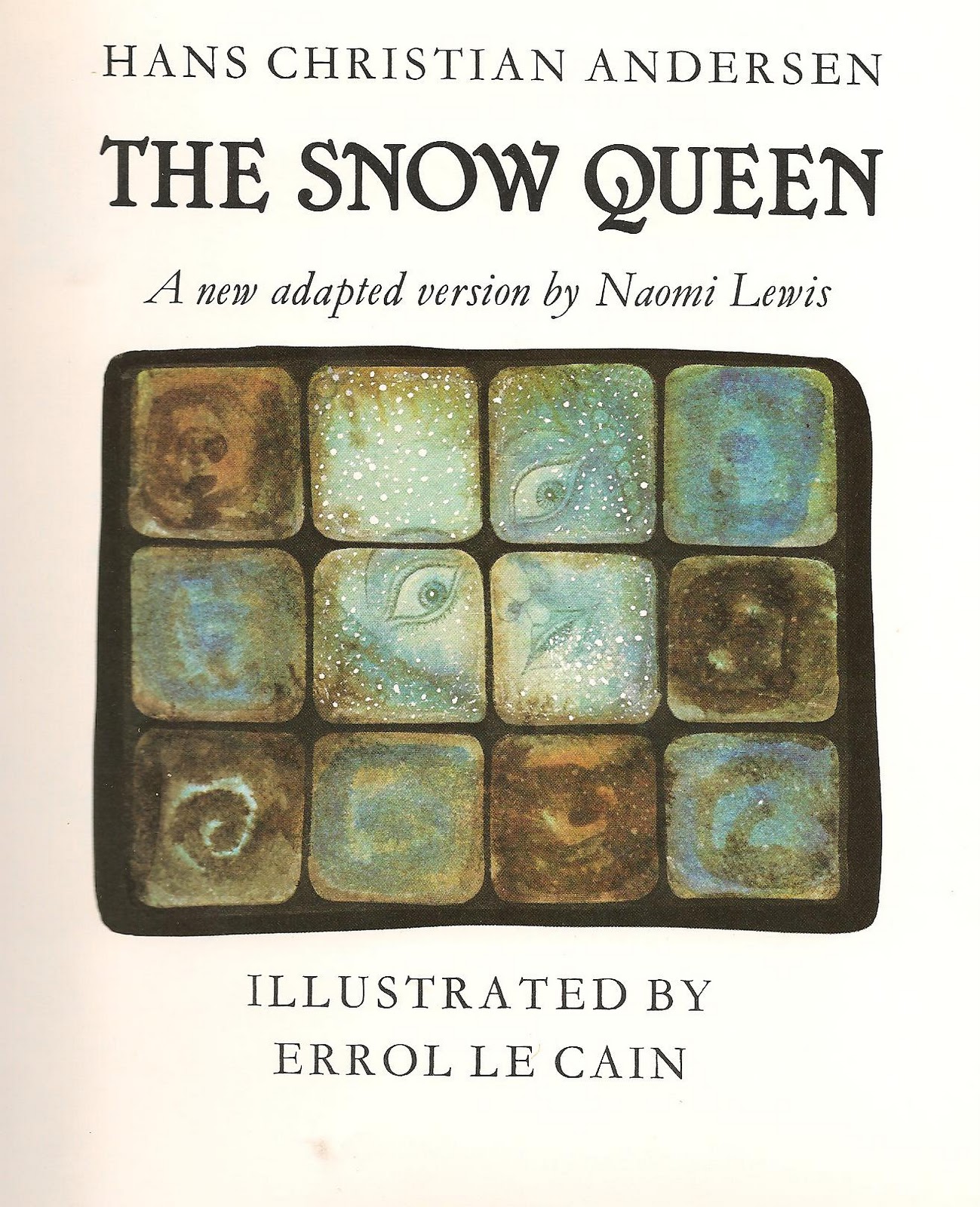
Picture credits: images from The Snow Queen by Hans Christian Andersen, illustrated by Errol le Cain

Thursday, 21 October 2010

Fairytale Reflections (6) Katherine Roberts

I am a long-term fan of Katherine Roberts' books. She has a wonderful gift for conjuring up other worlds – whether set in the legendary past, or entire sub-creations (in Tolkien’s phrase), fully realised and vivid. Her trilogy the The Echorium Sequence is set in an utterly fresh and underivative fantasy world which I already wrote about in this post here.  (If I absolutely had to come up with a comparision, I'd suggest not Tolkien's or Lewis's worlds, but Ursula K Le Guin's Earthsea.  Really though, the books stand alone.)

Here is the evocative opening of the first in her Seven Fabulous Wonders series, ‘The Great Pyramid Robbery’, set in a magical ancient Egypt:

Senu sat cross-legged in the shade of an awning on the river bank with the other children from the hemetiu village, a limestone slate balanced across his sunburnt knees, a reed pen clutched in one sweaty hand. It was far too hot for serious work. The stink of open sewers and raw fish blew down from the plateau, mosquitoes swarmed, and dust from the building site got into everything.

I just love the vivid smells and sensations...

Katherine grew up in the wild, rocky counties of Devon and Cornwall with their brooding moors and rugged coasts.  She gained a first class degree in mathematics from Bath University, and went on to work as a mathematician, computer programmer, racehorse groom and farm labourer - before her first novel, ‘Song Quest’, won the Branford Boase Award in 1999 and enabled her to fulfil her dream of becoming a full time writer.

If a writer’s life provides material for a writer’s work, such a varied background must be a bonus.  It means that in her recent book ‘I Am the Great Horse’, the story of Alexander seen through the eyes of his warhorse Bucephalus  ( ‘I am no black beauty!’)  Katherine can draw upon her own close knowledge and love of horses. One-eyed Bucephalus is strong and macho – after all, he’s a stallion! – and his understanding of his human master Alexander’s deeds is both touchingly limited and slily illuminating. (Kings sending warlike messages to one another are, for Bucephalus, like stallions dropping fresh dung on top of an old pile, to obliterate another’s dominance.) Moreover, Bucephalus has senses beyond the human. He can see ghosts. As Alexander punishes a prisoner by having him dragged to death behind a chariot –


The horses take off immediately, as they’ve been trained to do.  The prisoner’s body jerks as the rein attached to his ankles tightens, and he bounces along behind the chariot in the dust and flying sand.  The grooms run after it.

That is the last I see of the governor of Gaza, though later his ghost screams past the horse lines, lifting our manes and making us all shiver.


Visit Katherine’s own blog Reclusive Muse for a truly fascinating series of posts on the secret history of the writing of that book. Now here she is in person to reflect upon her particular fairytale –

THE SNOW QUEEN


Hans Christian Andersen’s “The Snow Queen” has haunted me all my life, so I was delighted when Kath gave me an excuse to revisit this one. It’s a fairly complex fairytale, with its story of Kai who gets a splinter of the devil’s mirror in his eye, rejects his sweetheart Gerda, and runs away with the Snow Queen. But like all the old tales, there are layers of meaning hidden under the story too. I think that’s what makes them endure over the years, so I hope you’ll be interested in my personal interpretation.

As a little girl I enjoyed the story mostly for its adventure and magic. Living in the southwest of England, Torbay in Devon, where we seldom see snow even in the coldest winters, I also liked the otherworldly beauty of the snowy mountains and the enchantment of the Snow Queen’s ice palace – see, I was a budding fantasy writer even then! I remember the book I owned as a child (now sadly lost) had a beautiful full-colour picture of the Snow Queen dressed in white fur, driving her sleigh pulled by prancing white horses with silver bells on their harness through the Northern Lights across a winter’s sky. Being pony crazy, I think it was probably these horses that drew me to the story initially. I never much liked later versions where the horses were replaced by reindeer or swans, or – as in the DVD version I have starring Bridget Fonda – an engine! Talk about destroying the magic…

But back to the story. As soon as I discovered that in this fairytale it is the boy – Kai – who gets kidnapped, and the girl – Gerda – who sets out on a quest to rescue him, I was hooked. After all those sugary little princess stories, here was a true heroine setting out on her own adventures! (I was Gerda, of course.) My memory of the actual adventures Gerda had on her quest is hazy, and I know these are often edited for simplicity, so maybe that’s why. The version of the tale I re-read for this post has Gerda encountering a witch living in a cottage in the woods who tries to keep her as her own little girl, then a princess with a long line of suitors seeking her hand who tries to marry her off, followed by a robber girl who supplies her with a reindeer, and finally two old women – a Lapp and a Finn – living alone in the snow, who feed and warm Gerda on her journey. The DVD version leaves out the Lapp and Finn women entirely, linking each of Gerda’s encounters to a different season so that she journeys through spring, summer, and autumn to find winter and the Snow Queen. I don’t think the details really matter. However, I do think that, on a deeper level, Gerda’s quest represents the stages of womanhood she will travel through in the world and perhaps that’s why this fairytale speaks to me so strongly.

This is how I see Gerda’s journey:

Spring – In the witch’s cottage, Gerda is cared for and allowed to play in the garden but is forbidden to step outside the gate into the dangerous wood. The witch banishes all the roses that might remind her of Kai and does everything she can to keep the little girl from continuing her quest. Having a clingy mother myself, I can identify only too well with this stage. Even now, my mother seems unable to accept that I might want to open that gate and have adventures of my own in the big wide world.

Summer – At the Princess’ palace, Gerda at first thinks Kai is the prince, and is disappointed when he turns out to be a stranger. In my DVD version a line of charming suitors try to win her hand, but Gerda rejects them all and escapes. This season represents the young and fertile woman chased by boys and making herself beautiful for them. It seems summer will last forever, with its dances and its roses and its declarations of love. But it is over all too soon.

Autumn – Here, I see the robber girl and her bandit mother representing the menopause, when a woman has finished with being a wife and mother and is beginning to find her own way in the world, coming into her power. It might be the autumn of her life, but autumn is a period of fruitfulness and harvest where the seeds sown in spring that blossomed in summer are ripening. Here, Gerda finds strength she didn’t know she had and escapes by riding the robber girl’s reindeer.

Winter – The Finn and Lapp women, living alone in their modest, cosy houses isolated in the snow, represent old age. They help Gerda, but warn her that if she chooses to continue her quest she must leave the reindeer and go on alone. This last part of her journey represents death, which everyone must face alone.

Finally, Gerda reaches the Snow Queen’s palace, where she finds Kai trying to form a word out of shards of ice. The word is LOVE, but Kai’s heart has been turned to ice by the Snow Queen’s kiss, and the splinter of the devil’s mirror in his eye means he cannot complete the puzzle. (In the DVD version, Kai’s task is to reassemble the actual mirror). Of course he cannot do it, until Gerda kisses him and melts his heart. He weeps with joy at seeing her, and the splinter comes out of his eye. Like all fairytales, it is a happy ending. Kai completes his impossible task, winning his freedom from the Snow Queen, and the two young people return to their rose garden, where (one imagines) they got married and had a gloriously happy life bringing up their own children with the advantage of the lessons they have both learnt… I like to think so, anyway!

The splinter in Kai’s eye is a powerful image. The devil – or hobgoblin or elf – made this mirror to reflect beautiful things as ugly and make ugly things seem normal. It’s very true that the way you look at something can change completely the way you see life, and I’ve certainly gone through phases myself when a splinter of the devil’s mirror gets lodged in my eye, and I have to make a conscious effort to squeeze it out before I can see the good around me. Breaking a mirror is also very symbolic, bringing seven years of bad luck according to some. I broke a mirror five years ago… of course I’m not superstitious AT ALL, and greater forces than a broken mirror have influenced my life over the past five years… but I’ll admit I’m looking forward to 2012.

So where am I on Gerda’s quest? Somewhere between leaving the princess’ summer palace and being ambushed by the robber girl, I fear – though, of course, the heroine’s journey changes depending upon the version being told. Perhaps the best thing about being an author is that we can create our own adventures, and – better still – our very own fairytale ending.

Here I must leave my journey with the Snow Queen before the “too much scrolling” bit kicks in. Call me a romantic, but there’s only one ending I really want… you’ve probably already guessed it… and they all lived happily ever after!