This wintry Russian fairy
tale is my loose adaptation of ‘Morozko’ (‘Frost’), collected by Aleksandr
Afanasiev and translated by W.R.S. Ralston in his book ‘Russian Folk Tales’
(Smith, Elder & Co, 1873).
There was once an old man who had three daughters. The
wife had no love for the eldest of the three, her step-daughter Marfa. She made
her get up ever so early in the morning, gave her all the work to do and never
stopped scolding. The girl fed the cattle, fetched in wood and water, lit the
stove, swept the floor and mended the clothes: she did her best, but her
stepmother was never satisfied. ‘What a lazybones,’ she would grumble, ‘what a
slut! Look, she’s left the brush out, and here’s some dust, and she’s left a speck
here on the dishes!’
The
old man was sorry for his eldest daughter but he didn’t help her. He was feeble
and didn’t dare stand up to his wife. And the younger daughters were no better.
They were always rude to Marfa, quarrelling and lying in bed till noon.
Well,
the girls grew and grew until they were old enough to be married. The old man
began thinking how he could get them settled, but his wife was wondering how to
get rid of the eldest girl. One day she said to him,
‘Hey old man, let’s get Marfa
married.’
‘Gladly!’ said he, creeping off to
the warm sleeping place above the stove. But she called after him, ‘Get up
early tomorrow, old man, harness the mare to the sledge and drive away with
Marfa. And you, Marfa, get your things together in a basket and put on a clean
shift: tomorrow you’re going on a visit.’
Marfa was delighted with this change
in her fortunes. She slept well, and next morning she washed, prayed to God,
packed her things and dressed in her best. Poor though that was, she looked
such a pretty lass – a bride fit for any place whatsoever!
It was winter, and out of doors there
was a rattling frost. In the hour before sunrise the old man harnessed the mare
to the sledge and led it up to the door. Then he went inside. ‘Now then! Everything’s
ready.’
‘Sit down and eat your breakfast,’
replied the old woman.
The old man sat, and made his
daughter sit at his side. He took bread from the bread-basket, and broke it for
himself and his daughter. Meanwhile the old woman served Marfa a dish of old
cabbage soup and said,
‘There, my pretty pigeon, eat this and
be off; I’ve put up with you for long enough. Drive Marfa to her bridegroom,
old man! See here, old greybeard, this is what you do. You drive straight along
the road until you come to the turning on the right that leads into the forest.
Take her all the way up to the big pine that stands on the hill, and there hand
her over to Morozko – to Father
Frost.’
The old man opened his eyes wide, his
mouth too. He stopped eating, and Marfa began to cry.
‘What have you got to squeal about?’
said her stepmother. ‘Your bridegroom is a beauty, and he’s rich! See how many
things belong to him! Look at the firs, pines and birches, all dressed in
snow-white ermine! He has resources anyone might envy, and he himself is a
mighty lord.’
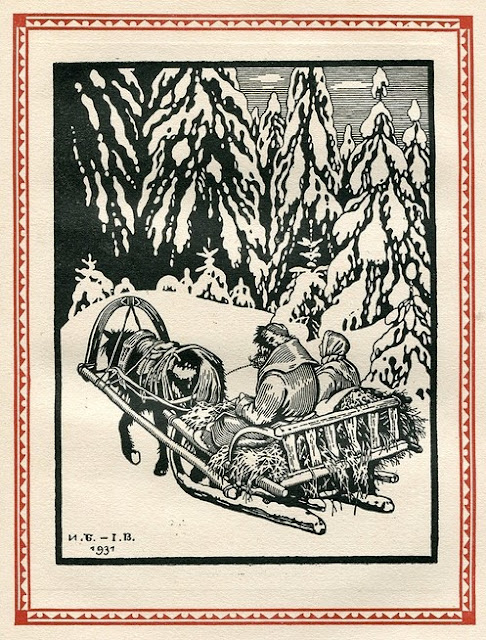
Silently the old man loaded the
things on the sledge, wrapped his daughter in a cloak, and set off on the
journey. After a while he reached the forest, turned off the road and drove
across the frozen snow till they came to the middle of the forest. Here he
stopped, made his daughter get out, laid her basket under the tall pine-tree
and said, ‘Sit here and wait for the bridegroom. And mind you receive him as pleasantly as you can.’
Then he turned the horse around and
drove off homewards.
Marfa sat and shivered. The cold had
pierced her through. She would have cried for help, but no one would hear and she
didn’t have the strength; only her teeth chattered. After a while, she heard something
– a cracking and crackling among the fir boughs. Not far away, Frost was leaping
from fir to fir, snapping his fingers. The sound came closer and closer. Presently
he appeared on the very pine under which the girl was sitting, and from over
her head he cried,
‘Art thou warm, maiden?’
‘Warm? Yes! I am warm, dear Father
Frost,’ she answered.
Frost began to descend lower, all the
time cracking and snapping his fingers. And he said to the girl,
‘Art thou warm, maiden? Art thou
warm, fair one?’
Marfa could scarcely breathe in the
freezing air, but she answered, ‘I am warm, Frost dear. I am warm, dear
father!’
Frost began crackling more than ever;
he snapped his fingers even more loudly, and he said to the girl,
‘Art thou warm, maiden? Art thou warm,
pretty one? Art thou warm, my darling?’
By now Marfa was shuddering with
cold. Through rattling teeth she whispered, ‘Yes, I am q-quite warm – d-dear
Father Frost!’
Then Frost took pity on her. He
wrapped her in warm furs, and robes embroidered with gold and silver threads,
and he gave her a chest full of gold and jewels for her dowry. Dressed in this
finery the girl was a real beauty. She sat on the chest in the snowy woods and
sang for joy.
Next morning the old woman began
baking the cakes for her step-daughter’s funeral. She told her husband to go
and bring back the girl’s dead body: ‘Drive out, old greybeard, and wake the married
couple up!’ As the old man harnessed the horse and drove off, the dog under the
table began to bark:
‘Taff! Taff!
The
master’s daughter in silver and gold
By
the wedding guests will be carried along,
But
the mistress’s daughters are wooed by none.
Taff!
Taff!’
The old woman scolded the dog, but he kept on barking.
Then she threw him a cake to shut him up, but nothing would stop him until the
old man’s sledge drew up outside, the door flew open, and in came Marfa dressed
in all her glory.
The
old woman was thunderstruck. ‘Ah, you hussy!’ she cried. ‘But you won’t get the
better of me. Husband, tomorrow morning you’ll take my daughters out to meet
the bridegroom themselves. He’ll give them far better presents than he’s given
her!’ So early next morning the two
girls set out in the sledge, dressed in their finest, and the old man drove
them into the forest and left them under the pine tree.
The
girls sat there together, wrapped up well, but still they felt the cold.
‘This
frost is skinning me alive!’ one grumbled. ‘I hope my bridegroom hurries up.’
‘Your bridegroom?’ said her sister. ‘Why
shouldn’t he choose me? My
bridegroom, you mean.’
‘You,
why should he choose you? I’m far the prettier.’ And they began to argue and squabble,
while the cold numbed their hands and stole under their wrappings, and their toes
began to freeze. Soon, still a good way off, Frost began crackling and snapping
his fingers and leaping from fir to fir. To the girls, it sounded as though
someone was coming.
‘Listen!
Here he comes at last, with bells on his sleigh!’
‘He
may be coming, but he certainly won’t marry you. Look, your face is blue with
cold.’
‘Your face is red, and peeling!’
And they both began blowing on their
fingers.
Nearer
and nearer came Frost, until he was rustling in the pine-tree right above them,
and he called down,
‘Are
you warm, maidens? Are you warm, pretty ones? Are you warm, my darlings?’
‘Oh,’
cried the girls, ‘it’s only old Frost. Of course we’re not warm! We’re chilled
to the bone. We’re waiting here for our bridegroom, but the wretched fellow is
late.’
Frost
slid lower down the tree, cracking twigs and branches, snapping his fingers
harder than ever.
‘Are
you warm, maidens? Are you warm, pretty ones?’
‘In
this terrible cold, are you joking? Our hands and feet are quite dead!’
Frost
came even lower, and icy crystals showered around them. ‘Are you warm,
maidens?’
‘We’re
perishing, you old fool! Off to the bottomless pit with you!’ cried the girls –
and froze to death.
Next
morning, the old woman said to her husband, ‘Go harness the sledge and fetch my
daughters. Make sure to take sheepskin wraps along, in case they’re cold.
There’s a fierce frost outside.’ And as the old man drove away she began baking
bridal cakes. But the dog under the table barked,
‘Taff!
Taff!
The
master’s daughter will be carried along
By
the wedding guests with laughter and song;
But
the mistress’s daughters will be carried back
As
bunches of bones in an old brown sack.
Taff!
Taff!’
It kept barking like that and couldn’t be silenced
until the yard-gates opened and the old man drove in. Then the old woman ran
out to greet her daughters and found them lying in the sledge, frozen as stiff
as boards.
But
Marfa married a neighbour’s son. They are now living happily together, and to show
their respect for Father Frost, they make sure to leave out a bowl of sweet
porridge for him, every Christmas Eve.
The 19th century translator adds:
To
the Russian peasants, Moroz – Frost –
is a living personage. On Christmas Eve it is customary for the oldest man in
each family to take a spoonful of kissel,
a sort of pudding; and then, having put his head out of the window, to cry:
‘Frost,
Frost, come and eat kissel! Frost,
Frost, do not kill our oats! Drive our flax and hemp deep into the ground.’
The Tcheremisses
[people of Cheremushki, Eastern Siberia]
have similar ideas, and are afraid of knocking the icicles off their houses,
thinking that if they do, Frost will wax wroth and freeze them to death. In one
of the Skazkas [wonder tales], a
peasant finds his field of buckwheat all beaten down. His wife tells him, ‘It
is Frost who has done this. Go and find him, and make him pay for the damage.’
So the peasant goes into the forest, and after wandering for some time, lights
upon a path which leads him to a cottage made of ice, covered with snow and
hung with icicles. He knocks at the door and out comes and old man – ‘all
white’. This is Frost, who makes compensation by giving him with the magic
cudgel and tablecloth which work wonders in so many tales.
Sometimes
the Frost is described by the people as a mighty smith, who forges strong
chains with which to bind the earth and the waters – as in the saying ‘The Old
One has built a bridge without axe and without knife’: for the river is frozen
over.
Picture credits:
Illustration to the fairytale Ded Moroz (Morosko) - by Elena Dmitryevna Polenova (1888)
The old man drives Marfa into the forest - by Ivan Bilibin, 1931
Morozko (Father Frost) - by Ivan Bilibin, 1932
Marfa and Father Frost - by Arthur Dickson (1853 - 1959)
Illustration to the fairytale Ded Moroz (Morosko) - by Elena Dmitryevna Polenova (1888)




_-_Le_Froid_2.jpg)