Showing posts with label Russian fairy tales. Show all posts

Monday, 13 December 2021

Father Frost: a winter fairy tale


This wintry Russian fairy tale is my loose adaptation of ‘Morozko’ (‘Frost’), collected by Aleksandr Afanasiev and translated by W.R.S. Ralston in his book ‘Russian Folk Tales’ (Smith, Elder & Co, 1873). 


There was once an old man who had three daughters. The wife had no love for the eldest of the three, her step-daughter Marfa. She made her get up ever so early in the morning, gave her all the work to do and never stopped scolding. The girl fed the cattle, fetched in wood and water, lit the stove, swept the floor and mended the clothes: she did her best, but her stepmother was never satisfied. ‘What a lazybones,’ she would grumble, ‘what a slut! Look, she’s left the brush out, and here’s some dust, and she’s left a speck here on the dishes!’

            The old man was sorry for his eldest daughter but he didn’t help her. He was feeble and didn’t dare stand up to his wife. And the younger daughters were no better. They were always rude to Marfa, quarrelling and lying in bed till noon.

            Well, the girls grew and grew until they were old enough to be married. The old man began thinking how he could get them settled, but his wife was wondering how to get rid of the eldest girl. One day she said to him,

‘Hey old man, let’s get Marfa married.’

‘Gladly!’ said he, creeping off to the warm sleeping place above the stove. But she called after him, ‘Get up early tomorrow, old man, harness the mare to the sledge and drive away with Marfa. And you, Marfa, get your things together in a basket and put on a clean shift: tomorrow you’re going on a visit.’

Marfa was delighted with this change in her fortunes. She slept well, and next morning she washed, prayed to God, packed her things and dressed in her best. Poor though that was, she looked such a pretty lass – a bride fit for any place whatsoever!

It was winter, and out of doors there was a rattling frost. In the hour before sunrise the old man harnessed the mare to the sledge and led it up to the door. Then he went inside. ‘Now then! Everything’s ready.’

‘Sit down and eat your breakfast,’ replied the old woman.

The old man sat, and made his daughter sit at his side. He took bread from the bread-basket, and broke it for himself and his daughter. Meanwhile the old woman served Marfa a dish of old cabbage soup and said,

‘There, my pretty pigeon, eat this and be off; I’ve put up with you for long enough. Drive Marfa to her bridegroom, old man! See here, old greybeard, this is what you do. You drive straight along the road until you come to the turning on the right that leads into the forest. Take her all the way up to the big pine that stands on the hill, and there hand her over to Morozko – to Father Frost.’

The old man opened his eyes wide, his mouth too. He stopped eating, and Marfa began to cry.

‘What have you got to squeal about?’ said her stepmother. ‘Your bridegroom is a beauty, and he’s rich! See how many things belong to him! Look at the firs, pines and birches, all dressed in snow-white ermine! He has resources anyone might envy, and he himself is a mighty lord.’  
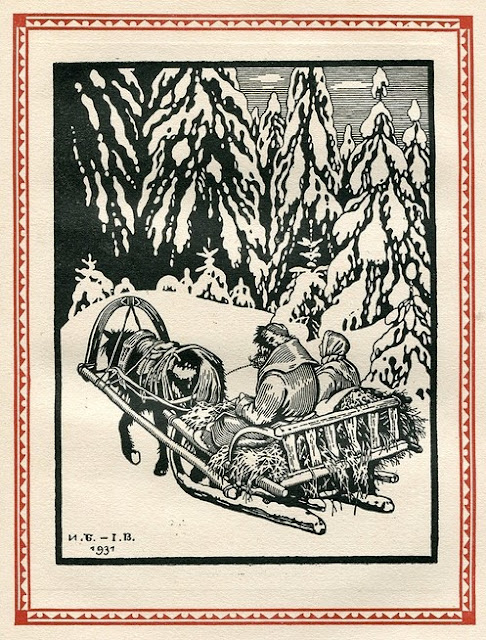


Silently the old man loaded the things on the sledge, wrapped his daughter in a cloak, and set off on the journey. After a while he reached the forest, turned off the road and drove across the frozen snow till they came to the middle of the forest. Here he stopped, made his daughter get out, laid her basket under the tall pine-tree and said, ‘Sit here and wait for the bridegroom. And mind you receive him as pleasantly as you can.’

Then he turned the horse around and drove off homewards.

Marfa sat and shivered. The cold had pierced her through. She would have cried for help, but no one would hear and she didn’t have the strength; only her teeth chattered. After a while, she heard something – a cracking and crackling among the fir boughs. Not far away, Frost was leaping from fir to fir, snapping his fingers. The sound came closer and closer. Presently he appeared on the very pine under which the girl was sitting, and from over her head he cried,

‘Art thou warm, maiden?’

‘Warm? Yes! I am warm, dear Father Frost,’ she answered.

Frost began to descend lower, all the time cracking and snapping his fingers. And he said to the girl,

‘Art thou warm, maiden? Art thou warm, fair one?’


Marfa could scarcely breathe in the freezing air, but she answered, ‘I am warm, Frost dear. I am warm, dear father!’

Frost began crackling more than ever; he snapped his fingers even more loudly, and he said to the girl,

‘Art thou warm, maiden? Art thou warm, pretty one? Art thou warm, my darling?’

By now Marfa was shuddering with cold. Through rattling teeth she whispered, ‘Yes, I am q-quite warm – d-dear Father Frost!’

Then Frost took pity on her. He wrapped her in warm furs, and robes embroidered with gold and silver threads, and he gave her a chest full of gold and jewels for her dowry. Dressed in this finery the girl was a real beauty. She sat on the chest in the snowy woods and sang for joy.


Next morning the old woman began baking the cakes for her step-daughter’s funeral. She told her husband to go and bring back the girl’s dead body: ‘Drive out, old greybeard, and wake the married couple up!’ As the old man harnessed the horse and drove off, the dog under the table began to bark:


                       ‘Taff! Taff!

            The master’s daughter in silver and gold

            By the wedding guests will be carried along,

            But the mistress’s daughters are wooed by none.

            Taff! Taff!’


The old woman scolded the dog, but he kept on barking. Then she threw him a cake to shut him up, but nothing would stop him until the old man’s sledge drew up outside, the door flew open, and in came Marfa dressed in all her glory.

            The old woman was thunderstruck. ‘Ah, you hussy!’ she cried. ‘But you won’t get the better of me. Husband, tomorrow morning you’ll take my daughters out to meet the bridegroom themselves. He’ll give them far better presents than he’s given her!’  So early next morning the two girls set out in the sledge, dressed in their finest, and the old man drove them into the forest and left them under the pine tree.

             The girls sat there together, wrapped up well, but still they felt the cold.

            ‘This frost is skinning me alive!’ one grumbled. ‘I hope my bridegroom hurries up.’

            Your bridegroom?’ said her sister. ‘Why shouldn’t he choose me? My bridegroom, you mean.’

            ‘You, why should he choose you? I’m far the prettier.’ And they began to argue and squabble, while the cold numbed their hands and stole under their wrappings, and their toes began to freeze. Soon, still a good way off, Frost began crackling and snapping his fingers and leaping from fir to fir. To the girls, it sounded as though someone was coming.

            ‘Listen! Here he comes at last, with bells on his sleigh!’

            ‘He may be coming, but he certainly won’t marry you. Look, your face is blue with cold.’

            Your face is red, and peeling!’  

And they both began blowing on their fingers.

            Nearer and nearer came Frost, until he was rustling in the pine-tree right above them, and he called down,

            ‘Are you warm, maidens? Are you warm, pretty ones? Are you warm, my darlings?’

            ‘Oh,’ cried the girls, ‘it’s only old Frost. Of course we’re not warm! We’re chilled to the bone. We’re waiting here for our bridegroom, but the wretched fellow is late.’

            Frost slid lower down the tree, cracking twigs and branches, snapping his fingers harder than ever.

            ‘Are you warm, maidens? Are you warm, pretty ones?’

            ‘In this terrible cold, are you joking? Our hands and feet are quite dead!’

            Frost came even lower, and icy crystals showered around them. ‘Are you warm, maidens?’

            ‘We’re perishing, you old fool! Off to the bottomless pit with you!’ cried the girls – and froze to death.

            Next morning, the old woman said to her husband, ‘Go harness the sledge and fetch my daughters. Make sure to take sheepskin wraps along, in case they’re cold. There’s a fierce frost outside.’ And as the old man drove away she began baking bridal cakes. But the dog under the table barked,


                        ‘Taff! Taff!

                        The master’s daughter will be carried along

                        By the wedding guests with laughter and song;

                        But the mistress’s daughters will be carried back

                        As bunches of bones in an old brown sack.

                        Taff! Taff!’


It kept barking like that and couldn’t be silenced until the yard-gates opened and the old man drove in. Then the old woman ran out to greet her daughters and found them lying in the sledge, frozen as stiff as boards.

            But Marfa married a neighbour’s son. They are now living happily together, and to show their respect for Father Frost, they make sure to leave out a bowl of sweet porridge for him, every Christmas Eve. 


 The 19th century translator adds:

            To the Russian peasants, Moroz – Frost – is a living personage. On Christmas Eve it is customary for the oldest man in each family to take a spoonful of kissel, a sort of pudding; and then, having put his head out of the window, to cry:

            ‘Frost, Frost, come and eat kissel! Frost, Frost, do not kill our oats! Drive our flax and hemp deep into the ground.’

            The Tcheremisses [people of Cheremushki, Eastern Siberia] have similar ideas, and are afraid of knocking the icicles off their houses, thinking that if they do, Frost will wax wroth and freeze them to death. In one of the Skazkas [wonder tales], a peasant finds his field of buckwheat all beaten down. His wife tells him, ‘It is Frost who has done this. Go and find him, and make him pay for the damage.’ So the peasant goes into the forest, and after wandering for some time, lights upon a path which leads him to a cottage made of ice, covered with snow and hung with icicles. He knocks at the door and out comes and old man – ‘all white’. This is Frost, who makes compensation by giving him with the magic cudgel and tablecloth which work wonders in so many tales.

            Sometimes the Frost is described by the people as a mighty smith, who forges strong chains with which to bind the earth and the waters – as in the saying ‘The Old One has built a bridge without axe and without knife’: for the river is frozen over. 


Picture credits:

Illustration to the fairytale Ded Moroz (Morosko) - by Elena Dmitryevna Polenova (1888)

The old man drives Marfa into the forest - by Ivan Bilibin, 1931

Morozko (Father Frost) - by Ivan Bilibin, 1932

Marfa and Father Frost - by Arthur Dickson (1853 - 1959)

Illustration to the fairytale Ded Moroz (Morosko) - by Elena Dmitryevna Polenova (1888)


Tuesday, 29 September 2020

Strong Fairy Tale Heroines #30: VASILISA THE PRIEST'S DAUGHTER


This Russian tale from the collection of Aleksander Afanas’iev, translated by Norbert Guterman, brings my series of traditional fairy tales with strong heroines to a close. There are many Vasilisas in Russian fairy tales, and most of them are strong. In the well-known story of Vasilisa the Beautiful, for example, a young woman is sent to borrow fire from the witch Baba Yaga, while Vasilisa the Wise (#17 in this series) is a magic-worker who rescues the prince from her father the Sea King. 

Vasilisa the Priest's Daughter works no magic of any kind. She simply uses wits and nerve to out-smart and rebuke an impertinently curious king. Her preferred way of life dressing and behaving as a young man is accepted by her father and raises no eyebrows among her neighbours, and she easily evades the efforts of the king – and the witch who advises him – to discover her real gender. I particularly like the trumphant note she sends him, at the end, where she compares him to a raven and herself to a falcon. That's telling him!

Those of you who've been following the series will remember similar attempts by the king and his pet lion in Grimms’ The Twelve Huntsmen #27 and by a genie and his mother in the Romanian tale The Princess in Armour #3. (Don't you love the infinite variations on themes in fairy tales?) Naturally all such ingeniously contrived tricks are doomed to fail, and why? Because they rely upon crude and inadequate stereotypes of the character and capacities of women. This is a deliberate narrative choice:  we are absolutely expected to enjoy seeing the heroines of these stories run rings around their often ridiculous male adversaries.

Still, the women of fairy tales have no real need to impersonate men, any more than the male heroes of fairy tales often resemble warriors with swords. Far more frequently, fairy tales celebrate humble protagonists, underdogs who succeed beyond their wildest dreams through chutzpah, kindness, endurance and luck. Girls and women in fairy tales are no less energetic, witty, clever, brave and persistent than the brothers and lovers they often rescue. In fact, they are often more so! 
 
My next post will examine one more story in close detail, before I move on to a different subject.
Witches!


In a certain land, in a certain kingdom, there was a priest called Vasily who had a daughter named Vasilisa Vasilyevna. She wore man’s clothes, rode horseback, was a good shot with a rifle and did everything in a quite unmaidenly way, so that only a very few people knew that she was a girl: most people thought she was a man and called her Vasily Vasilyevich, all the more so because she was very fond of vodka. This is, as is well known, entirely unbecoming to a maiden… 

One day, King Barkhat – for the was the name of the king of the country – went hunting game and he met Vasilisa Vasilyevna. She was riding horseback in men’s clothes and was also hunting. When he saw her, King Barkhat asked his servants, ‘Who is that young man?’ One servant answered him, ‘Your majesty, that isn’t a man but a girl; I know for sure that she is Vasilisa Vasilyevna, the daughter of the priest Vasily.’

As soon as the king returned home he wrote a letter to the priest Vasily asking him to permit his son Vasily Vasilyevich to visit him and eat at the king’s table. Meanwhile, he himself went to the little old backyard witch and began questioning her as to how he could find out whether Vasily Vasilyevich was really a girl. 

The little old witch said to him, ‘Hang up an embroidery frame on the right side of your chamber, and on the left side hang up a gun: if she is really Vasilisa Vasilyevna she will notice the embroidery frame first; if she is Vasily Vasilyevich she will notice the gun.’ The king followed the little old witch’s advice and ordered his servants to hang up an embroidery frame and a gun in his chamber.

As soon as the king’s letter reached Father Vasily and he showed it to his daughter, she went to the stable, saddled a grey horse with a grey mane, and went straight to King Barkhat’s palace. The king received her; she politely said her prayers, made the sign of the cross as is prescribed, bowed low to all four sides, graciously greeted King Barkhat, and entered the palace with him. They sat together and began to drink heady drinks and eat rich viands. After dinner, Vasilisa Vasilyevna walked with King Barkhat through the palace chambers; as soon as she saw the embroidery frame she began to reproach the king: ‘What kind of junk do you have here, King Barkhat? In my father’s house there is no trace of such womanish fiddle-faddle, but in King Barkhat’s house, womanish fiddle-faddle hangs in the chambers!’ Then she politely said farewell and rode home, and the king was none the wiser as to whether she was really a girl.

 And so two days later – no more! – King Barkhat sent another letter to the priest Vasily, asking him to send his son Vasily Vasilyevich to the palace. As soon as Vasilisa Vasilyevna heard about this she went to the stable, saddled a grey horse with a grey mane, and rode straight to King Barkhat’s palace. She graciously greeted him, politely said her prayers to God, made the sign of the cross as is prescribed and bowed low to all four sides. King Barkhat had been advised by the little old backyard witch to order kasha cooked for supper, and to have it stuffed with pearls. The little old witch had told him that if the youth was really Vasilisa Vasilyevna, he would put the pearls in a pile, and if he was Vasily Vasilyevich, he would throw them under the table. 

Supper time came. The king sat at table and placed Vasilisa Vasilyevna on his right hand, and they began to drink heady drinks and eat rich viands. Kasha was served after all the other dishes, and as soon as Vasilisa Vasilyevna took a spoonful of it and discovered a pearl, she flung it under the table together with the kasha and began to reproach King Barkhat. ‘What kind of trash do they put in your kasha?’ she said. ‘In my father’s house there is no trace of such womanish fiddle-faddle, yet in King Barkhat’s house, womanish fiddle-faddle is put in the food!’ Then she politely said farewell to King Barkhat and rode home. Again the king had not found out whether she was really a girl, though he badly wanted to know.

Two days later, upon the advice of the little old witch, King Barkhat ordered that his bath be heated; she had told him that if the youth really was Vasilisa Vasilyevna he would refuse to go to the bath with him. So the bath was heated.

Again King Barkhat wrote a letter to the priest Vasily, telling him to send his son Vasily Vasilyevich to the palace for a visit. As soon as Vasilisa Vasilyevna heard about it, she went to the stabel, saddled her grey horse with the grey mane, and galloped straight to King Barkhat’s palace. The king went out to receive her on the front porch. She greeted him civilly and entered the palace on a velvet rug; having come in, she politely said her prayers to God, made the sign of the corss as is prescribed, and bowed very low to all four sides. Then she sat at table with King Barkhat and began to drink heady drinks and eat rich viands. 

After dinner the king said, ‘Would it not please you, Vasily Vasilyevich, to come with me to the bath?’

‘Certainly, your Majesty,’ Vasilisa Vasilyevna answered. ‘I have not had a bath for a long time and should like very much to steam myself.’ So they went together to the bathhouse. While King Barkhat undressed in the anteroom, she took her bath and left. So the king did not catch her in the bath either. Having left the bathhouse, Vasilisa Vasilyevna wrote a note to the king and ordered the servants to hand it to him when he came out. And this note ran:

‘Ah, King Barkhat, raven that you are, you could not surprise the falcon in the garden! For I am not Vasily Vasilyevich, but Vasilisa Vasilyevna.’ And so King Barkhat got nothing for his trouble, for Vasilisa Vasilyevna was a clever girl, and very pretty too!


Picture credits:
As there seem to be no illustrations of this fairy tale, I have chosen to use  'A prince arrived'  by John Bauer. 

Tuesday, 21 July 2020

Strong Fairy tale Heroines #22: THE FLYING HEAD


Home of the Leshy. "Fairy Forest at Sunset" by Ivan Bilibin, 1906.


This Russian fairy tale, collected by Ivan Khudyakov in the 1860s (and rather clunkily titled ‘The Stepmother’s Daughter and the Stepdaughter’) is outlined in ‘Russian Folk-Tales’ translated by WRS Ralston (1873). Ralston quotes just a couple of paragraphs of the story and merely summarises the second half. I cannot source any other English translation, so since it’s quite clear what happens and it’s a great story, I’ve filled in the outline. 

The basic motif (AT 480: ‘The Kind and the Unkind Girls’) is common to many fairy tales: the Grimms’ ‘Mother Holle’, Perrault’s ‘Diamonds and Toads’, and the Scots tale ‘The Well at the World’s End’(#16 in this series)  in this series are good examples. Are these heroines 'strong'? In what way are they not? They deal with their own problems in their own way. Men are quite unimportant in this type of tale, rarely even making an appearance: the message is that kindness, courtesy and hard work will be rewarded with riches, not marriage. Anyway, the details of this particular version are so peculiarly sinister, I can’t resist including it.  

Magical disembodied heads in European fairy tales usually rise out of wells or springs rather than flying (or rolling?) through woods, and they usually ask for the heroine to comb their hair or wash them. (Do what they request, and do it nicely!) The one in this fairy tale may (possibly) be some incarnation of the Leshy, the spirit of the woods - or it may not: Russian fairy tale experts out there, please let me know! Interestingly though, forest-dwelling flying heads are to be found in North-East Coast Native American folklore. These whirl through the trees and may emit shrieks so terrible as to bring death to the hearer. The Passamaquoddy tell of a creature named K’Cheebellok, a head without a body, but with ‘heart, wings and long legs’ (Fewkes, ‘Contribution to Passamaquoddy Folk-Lore’, Journal of American Folklore 1890, 271); and in their collection of Native American stories for children, ‘When the Chenoo Howls’ (Walker, 1998), Joseph and James Bruchac tell a story based on Senecan and Iroquois legends, of Dagwaynonyent, a malevolent and voracious Flying Head. (Being polite to this one wouldn’t have worked.) 

What’s also interesting that even the ‘kind’ heroine of this story appears to feel uneasy about the Head. Why else would she rely upon the clarion call of cock-crow to banish it – usually the cue for ghosts and evil spirits to depart?  


There was once an old woodcutter who had two daughters, one by his first wife  and one by his second. The second wife became jealous of her stepdaughter. She treated her badly and never stopped nagging her husband, telling him they were too poor to raise two girls. ‘You had better take her into the forest and leave her,’ she said. ‘She is no good to us!’

            At last, ground down by her complaints, the woodcutter agreed. He took the girl away into the forest with him, and left her in a kind of hut, telling her to prepare some soup for their dinner while he was cutting wood. 

            At that time, there happened to be a gale blowing. The old man tied a log to a tree in such a way that when the wind blew, the log struck the tree and made a knocking sound. This made the girl think the old man was cutting wood nearby, but in reality he had gone away. 

            When the soup was ready, she called to her father to come to dinner. No reply came from him, so she called again and again. 

            Now, deep in the forest there was a human head, and it heard the girl calling out, ‘Come to dinner! Come to dinner!’ 

So it answered her: ‘I’m coming! I’m coming!’

            And when the Head arrived, it cried, ‘Maiden, open the door!’ 

She opened the door.

            ‘Maiden, Maiden! Lift me over the threshold!’ 

She lifted it over.

‘Maiden, Maiden! Put the dinner on the table!’

She did so, and she and the Head sat down to dinner. When they had dined, ‘Maiden, Maiden!’ said the Head, ‘take me off the bench!’ 

She took it off the bench and cleared the table. It lay down to sleep on the bare floor; she lay down on the bench. As soon as she was fast asleep, the Head went into the forest and called its servants. When the maiden woke, the hut had become a house. Servants, horses and everything one could think of suddenly appeared. 

The servants came to the maiden and said, ‘Get up! It’s time to go for a drive!’ So she got into a carriage along with the Head, but she took a cock along with her. As they drove along, she told the cock to crow, and it crowed. Again she told it to crow; it crowed again. And a third time she told it to crow. When it had crowed for the third time, the Head fell to pieces and became a heap of golden coins. 

The girl told the servants to drive her back to her home. When her father and stepmother saw the gold treasure she had brought back with her, they were amazed, and the stepmother wanted her own daughter to have the same good fortune.  ‘Take the girl into the woods with you,’ she told her husband, ‘and leave her in the hut!’ And the woodcutter did so.

Alone in the hut, the girl stirred the soup until it was ready, and then she called out, ‘Come to dinner! Come to dinner!’

Deep in the forest, the human head heard her. 

‘I’m coming! I’m coming!’ it answered. 

And when it arrived, it cried, ‘Maiden, open the door!’ 

So the girl opened the door. When she saw the Head, she was so frightened she hid behind the door and tried to push it shut. But the Head was in the way, and it said, ‘Maiden, Maiden! lift me over the threshold!’

‘No, I won’t touch a horrible Head like you!’

So the Head rolled itself into the hut.

‘Maiden, Maiden! put the dinner on the table!’

‘No, I won’t eat with a horrible Head like you!’

So the Head had to dish up its own dinner. The bowl and spoon flew on to the table, and the spoon worked hard and flew back and forth from the bowl, serving the Head until all the soup was gone.  

‘Maiden, Maiden,’ said the Head. ‘Take me off the bench!’ 

But still the girl wouldn’t touch the Head, so it sprang down by itself and lay on the bare floor to sleep. 

And the girl was too frightened to creep past it, so she lay down on the bench and was so weary that she fell asleep. 

And when she was fast asleep, it ate her. 


I can find no illustrations of this Russian fairy tale, but I have found some great depictions of flying heads from other cultures. This Japanese yokai, from the Bakemono zukushi scroll (Edo period, 18th/19th century) is a cloud dwelling monster with a mouth large enough to swallow the world!