Friday, 20 July 2012

Folklore Snippets: The Fairy Rade


Sir Joseph Noel Paton: 'The Fairy Rade: Carrying Off A Changeling - Midsummer's Eve

In honour of my recent stay in the beautiful Scottish border country (it rained every day, but we had a lot of fun anyway), here's an eye-witness account, from an unnamed 'old woman of Nithsdale’,  of a Fairy Ride or cavalcade of the fairies, also known as the Seelie Hunt.

It’s taken from Thomas Keightley’s Fairy Mythology which was first published in 1828 - my second edition copy dates from 1850 – and, as is often the way of folk accounts, is strangely convincing.  (A Scots mile (now obsolete) was about 220 yards longer than an English mile.)


“In the night afore Roodmass I had trysted with a neebor lass a Scots mile frae hame to talk anent buying braws i’ the fair.  We had nae sutten lang aneath the haw-buss till we heard the loud laugh of fowk riding, wi’ the jingling o’ bridles, and the clankin’ o’ hoofs.  We banged up, thinking they wad ride owre us.  We kent nae but it was drunken fowk ridin’ to the fair i’ the forenight.  We glow’red roun’ and roun’ and sune saw it was the Fairie-fowks Rade.  We cowred down till they passed by.  A beam o’ light was dancin’ owre them mair bonnie than moonshine: they were a wee wee fowk wi’ green scarfs on, but ane that rade foremost, and that ane was a good deal larger than the lave wi’ bonnie lang hair, bun about wi’ a strap whilk glinted like stars.  They rade on braw wee white naigs, wi’ unco lang swooping tails, an’ manes hung wi’ whustles that the win’ played on.  This an’ their tongue when they sang was like the soun’ of a far-away psalm.   Marion and me was in a brade lea fiel’, where they came by us; a high hedge o’ haw-trees keepit them frae gaun through Johnnie Corrie’s corn, but they lap owre it like sparrows, and gallopt into a green know beyont it.  We gaed i’ the morning to look at the treddit corn; but the fient a hoofmark was there, nor a blade broken.”


Here's my tamer English version:

In the night before Roodmas [the Feast of the Cross, May 3rd] I had met up with a neighbour lass, a Scots mile from home, to talk about buying pretty things at the fair. We hadn’t been sitting long under the hawthorn bushes when we heard the loud laugh of folk riding, with jingling bridles and clattering hoofs.  We jumped up, thinking they would ride over us.  We assumed it was drunken folk riding to the fair in the early evening. We stared round and about and soon saw it was the Fairy-folks Ride.  We cowered down as they passed by.  A beam of light was dancing over them, prettier than moonshine: they were tiny little folk with green scarves on, all but the one who rode in front, who was a good deal bigger than the rest, with lovely long hair bound about with a ribbon that glinted like stars. They rode on fine little white horses, with uncommonly long sweeping tails, and manes hung with whistles which the wind played on.  This, and their voices when they sang, was like the sound of a far-away psalm. Marion and I were in a broad pasture field, where they came by us; a high hedge of hawthorn trees prevented them from going through Johnnie Corrie’s cornfield, but they leaped over it like sparrows and galloped into a green hill beyond it.  We went next morning to look at the trodden-down corn, but devil a hoofmark  [ie: not a single hoofmark] was to be seen, nor a blade broken. 


Richard Dadd: Bacchanalian scene

Monday, 16 July 2012

On Making Things


I'm lucky to have the sort of mother who never throws things out - at least, not things her children have made, no matter how long ago or how badly.  I was over at her house the other day, helping her go through drawers, and out of one of them emerged this rather sorry-looking embroidered bird.  I'll explain more about him in a minute.

In Chaucer’s time, the word for a poet or author was ‘a maker’ - as witness the Scots poet William Dunbar’s luminous ‘Lament for the Makers’, in which he lists poet after poet taken by ‘the strong unmerciful tyrant’, death:

‘He has done piteouslie devour
The noble Chaucer, of makers flower;
The Monk of Bery, and Gower all three:
Timor mortis conturbat me.’

(In fact, damn it, go and read the poem first, and come back and read this after you’ve done.)

‘Maker’: I’ve always liked it. It’s less high-falutin’ than ‘author’ or ‘poet’: it links us inextricably – as we ought to be linked – with every other sort of human creativity. People make furniture. We make paintings, musical instruments and gardens. We make brain scanners, television programmes and films. We make homes. We make love – which as Ursula K Le Guin once wrote in the ‘The Lathe of Heaven’ (go and read that too), ‘doesn’t just sit there like a stone; it has to be made, like bread; re-made all the time, made new.’

None of these things (furniture, gardens, brain scanners etc) just happen. You can’t make anything worth having without a great deal of effort. I should know, because every spring I spend days digging weeds (mainly bindweed roots: thick, white, snappy coiling things) out of my flower beds. But what a difference the work makes when summer comes!

Children love to make things, and they ought to be encouraged to do so and praised for the results - even if the results aren't perfect in some adult, idealistic, Platonic sense. Writing is 'making something' just as much as modelling with clay or painting a picture: and primary school children especially ought to be allowed to experiment and have fun and feel proud of themselves - not to be marked and judged and compared and made to feel unskilled and inadequate. My brother and I were part of the Blue Peter generation, and he was fantastic at making things out of Squeezy bottles and cornflakes packets. He went on to construct model planes that really flew, and can now turn his hand to just about anything, including boats, house extensions, and beautiful, glossy musical instruments like mandolas. He’s become an accomplished folk musician who can compose his own tunes.

Me, I tried. I longed to own a model sailing ship, so I made my own very ugly one out of balsa wood (d'you remember balsa wood, light and fragile, and soft enough to be cut with scissors?) and painted it yellow. It had so many holes in the hull, it would have sunk like a stone, but I made it and loved it till it was squashed flat in a house removal by heartless, careless men from Pickfords. I longed to own an exquisite piece of Chinese embroidery I’d seen framed in a big house, smothered in birds and flowers – so I found a bit of frayed blue satin and laboriously stitched away.  And the result?  The puckered, lumpy, clumsy bird at the head of this post.

I wanted a miniature Chinese garden like one I’d read about in a book – so I borrowed a tray and arranged gravel and stones and moss around a tin lid (for the pool) and stood some china ornaments around it till the moss dried and the tray got knocked over. Oh, and I wanted an eighth Narnia book, so I got an old blue notebook and wrote my own. Here it is:


(You can see more of it on my website.) And although none of the things I made may have been any good by some unrealistic ultimate critical standard, it was the making that counted.

Even while I was making it I knew perfectly well that my embroidered bird fell short - far, far short - of the beautiful thing I'd seen and wanted to copy.  And no, I never became any more competent with a needle than that.  But at least I tried to be a maker. For me, the writing is what has lasted. I’m not an embroiderer or a woodworker or a musician. I'd love to be, but I know I haven't the time or the patience to learn the craft.  And that's the thing - going back to Chaucer again: 'The lyf so short, the craft so longe to lerne'.  When I'm writing I can't begin to tell you how many times I rewrite every page, every sentence. We - children - all of us - need to try lots of different things, so that we can figure out what to concentrate on, what to practice and get good at.  But it's all making, all of it! and any child who hammers a nail in straight, paints a picture or bakes brownies knows how good it feels.

Here’s a poem by Robert Bridges which says it all, really - the aspiration, the delight, and the inevitable falling short.  But isn't that why we pick ourselves up and try again?

I love all beauteous things,
I seek and adore them.
God hath no better praise,
And Man in his hasty days
Is honoured for them.

I too will something make,
And joy in the making,
Although tomorrow it seem
Like the empty words of a dream,
Remembered on waking.

Friday, 29 June 2012

The Hounds of Spring


Poetry – I love the stuff – I have masses of it by heart – but once in a while it’s fun to be a little irreverent, don’t you think?  A few days ago, I found myself chanting William Morris’s sonorous ‘Two red roses across the moon’ – like this –

There was a lady lived in a hall
Large in the eyes and slim and tall,
And ever she sung from noon to noon,
Two red roses across the moon.

       and suddenly caught myself snorting. 

There was a knight came riding by
In early spring, when the roads were dry;
And he heard that lady sing at the noon,
Two red roses across the moon.

The lady had clearly been infected with an ear worm.  Through the entire poem, these are the only words she – compulsively – speaks.  The knight catches it too; he spurs off to battle:

You scarce could see for the scarlet and blue,
A golden helm or a golden shoe,
So he cried, as the fight grew thick at the noon,
Two red roses across the moon!

Inspired by the lady’s song, the knight and his gold side win:

Verily then the gold won through
The huddled spears of the scarlet and blue,
And they cried, as they cut them down at the noon
Two -

- but you got it. After which, the knight and the lady get together.  I wonder how their domestic life went? 

“Pass the salt, dear.”
Two red roses across the moon.”

It’s utterly ludicrous, and I don’t know why it works, but in its faux-medieval, stained-glass, Pre-Raphaelite way, it actually does.  I may smile.  But I like it.

Maybe it’s a grace of the Victorian era, that they didn’t mind being totally, and I mean totally over the top?  And now we’re all too self conscious and expect poetry to be a lyrical baring of the soul and take itself seriously, for heavens sake?  In which case, what do we make of this?

But the Raven still beguiling all my fancy into smiling,
Straight I wheeled a cushioned seat in front of bird, and bust, and door,
Then upon the velvet sinking, I betook myself to linking
Fancy unto fancy, thinking what this ominous bird of yore –
What this grim, ungainly, ghastly, gaunt and ominous bird of yore
Meant in croaking “Nevermore.”

Now the normal human reaction would be for Poe to jump up screaming “Oh my god, a huge bird just flew in at my window!” and rush for a broom or something, to try and prod it out.  But Poe the narrator isn’t normal, he’s a Victorian Gothic poet, and he sees at once that the Raven is a supernatural portent – and he’s comfortable enough with that idea to pull up a velvet cushion and sit trying to work it all out.

Thus I sat engaged in guessing, but no syllable expressing
To the fowl whose fiery eyes now burned into my bosom’s core;
This and more I sat divining, with my head at ease reclining

- at ease, mark you, at ease! -

On the cushion’s velvet lining that the lamplight gloated oe’r,
But whose velvet violet lining with the lamplight gloating o’er
She shall press, ah, nevermore.

I doubt if any modern poet would dare to introduce a ‘fowl with fiery eyes’ into a serious poem; and those elaborate feminine internal rhymes are incredibly dangerous and could topple the poem over into absurdity at any moment. Poe must know this!  But he has nerves of steel and keeps his balance.

You’ll notice a common element of these two poems: the refrain.  Refrains – I would venture – have gone out of fashion. Here’s another brilliant Victorian poem which employs one.  By Longfellow, this time:

The shades of night were falling fast
When through an Alpine village passed
A youth, who bore, mid snow and ice,
A banner with a strange device,
Excelsior!

Well, there you go. 

His brow was sad; his eye beneath
Flashed like a falchion from its sheath,
And like a silver clarion rung
The accents of that unknown tongue,
Excelsior!

While Morris's ‘red roses’ lady was stuck in her castle, the similarly afflicted youth sets out across the mountains – a bit of stereotyping going on there, I fear – but anyway, like the lady, Longfellow’s youth has no other conversation going.

“Oh stay,” the maiden said, “and rest
Thy weary head upon this breast!”
A tear stood in his bright blue eye,
But still he answered, with a sigh,
Excelsior!


James Thurber’s illustrations demonstrate that he, too, couldn’t resist the unintentionally comic side of all this. 

“Beware the pine tree’s withered branch!
Beware the awful avalanche!”
This was the peasant’s last Goodnight,
A voice replied, far up the height,
Excelsior!


But of course the mysterious youth perishes.  Here he lies dead in the snow, surrounded by the monks of St Bernard and one of Thurber’s lugubrious dogs:

A traveller, by the faithful hound
Half-buried in the snow was found,
Still grasping, in his hand of ice,
That banner with the strange device,
Excelsior!

There in the twilight cold and gray,
Lifeless, but beautiful he lay,
And from the sky, serene and far,
A voice fell like a falling star:
Excelsior!


As for the hounds of spring, they of course come from the Chorus from 'Atalanta in Calydon', by that most over-the-top of all Victorian poets, Charles Algernon Swinburne – and here he is, in full throated ease:

When the hounds of spring are on winter’s traces,
The mother of months in meadow or plain
Fills the shadows and windy places
With lisp of leaves and ripple of rain;
And the brown bright nightingale amorous
Is half assuaged for Itylus
For the Thracian ships and the foreign faces
The tongueless vigil, and all the pain.


Yes, he assumes we know a lot about Greek myths, but why shouldn’t he?  And even if we didn’t, how beautiful is this?

For winter’s rains and ruins are over,
And all the season of snows and sins
The days dividing lover and lover,
The light that loses, the night that wins;
And time remembered is grief forgotten,
And frosts are slain and flowers begotten
And in green underwood and cover
Blossom by blossom the spring begins.

I admire the Victorians.  I admire their passion, their sensitivity and their love of beauty, and I really don’t care if they are sometimes a bit over the top and make me smile – and I don’t think they’d care either. 

We need more moments of unguarded passion in our lives - and less caution and cynicism... 

I’m off on holiday for a couple of weeks.  Enjoy the summer!  


Picture credits: James Thurber, 'The Thurber Carnival', Penguin 1965


Friday, 22 June 2012

"The Little Mermaid"


The Little Mermaid - Edmund  Dulac

 A guest post by Cassandra Golds


Once upon a time, when I was a very little girl, my father bought me and my younger sister a record.

It was one of the Tale Spinners for Children series — a collection of records so fondly remembered by some adults that there is a (very handy) website devoted to them. Tale Spinners for Children was a series of fully dramatised British adaptations of classic fairytales and stories — everything from “The Sleeping Beauty” to The Count of Monte Christo. They were lavishly produced in the manner of BBC radio drama, with appropriate classical music and British actors who were rarely credited on the sleeves, although they included such luminaries as Maggie Smith and Donald Pleasance — and who had voices to die for. They made some fifty of them altogether, throughout the sixties, and incidentally the brilliant producers and adaptors were not credited either. We as a family had several of them, but one of these had the dread hand of fate on it. It was the Tale Spinners adaptation of “The Little Mermaid” by Hans Christian Andersen. They used Grieg’s Piano Concerto in A minor as incidental music, and used it so masterfully, you would swear the work was written for the story. From the moment I first heard it — a moment some time before I could read — I was in love, with both the story and the concerto.


The first time I listened to it I remember sitting on the lounge in front of the big record player in my childhood home with  an aching throat and tears streaming down my face. The Tale Spinners version — which, although dramatised, stuck closely to the Andersen original — was about unrequited love, self-sacrifice and the hope of ultimate transcendence. In other words, it was not the Disney version. And yet, at the age of five or so, none of it seemed foreign to me. Not only did I think this was the most beautiful story I had ever heard — immediately I conceived a passionate allegiance to it. From this point on, for me, “The Little Mermaid” was what a good story should be — sad, noble, uplifting, passionate, desperate, extreme and big, opera-big. And it had to make you cry. It was the first time I was ever moved to tears by a work of art, and I have never fully lost the conviction that that is art’s first duty: the gift of tears.

And the dread hand of fate? Well, from the moment I first heard that record, I was destined to be a children’s author. It changed the course of my life. Or set me on it.

“The Little Mermaid” is not a traditional fairy tale or folk tale, but an original story by an author who is a legend in himself. What’s more, we know a good deal about the biography of the author, and like many of his stories, this one has strong autobiographical overtones. We are often told that folktales were not originally told specifically to children — that they were meant for an audience of all ages.  Original fairytales, on the other hand, such as Andersen’s and Oscar Wilde’s, are probably more truly children’s literature in the modern sense. And yet ever since I was an adult myself it has struck me that “The Little Mermaid” is a very adult story. Or at least, that it is an adult story told in the form of a children’s fairytale. Because it takes as its subject, not (for example) every child’s two greatest fears, as Adele Geras says so perceptively of “Hansel and Gretel”, but unrequited love, terrible self-sacrifice, and eventual transcendence, I have spent a good deal of time wondering what it was that I saw in it at that age. Why did I identify with it so strongly?
 

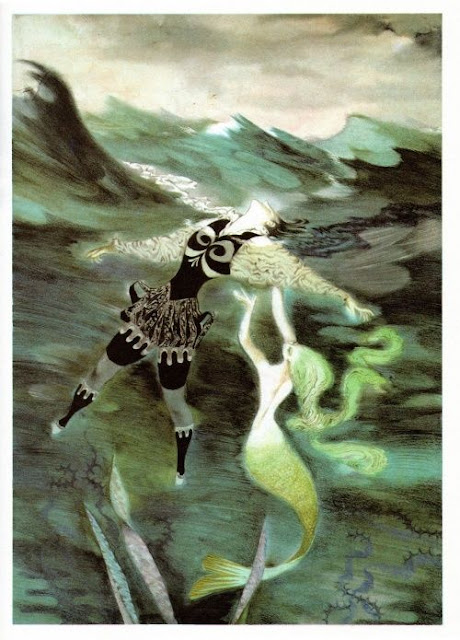
The Little Mermaid - Arthur Rackham

 
There are a number of possible answers to that question. One thing I believe with all my heart is that there is nothing trivial about childhood emotion. Children may be small, but their emotions are big, as big if not bigger than the emotions of adults. You will never be more passionate than you are at five. Things will never matter to you more, and you will never be capable of more suffering. It is also perfectly possible that you have already had your heart broken. I am the eldest of two sisters; my younger sister was born when I was eighteen months old. It is a family anecdote that, when my beloved grandfather came to see my baby sister for the first time, he walked past me and went first to her in her bassinet, the new baby. I’ve been told that I ignored him  completely for the duration of the visit which followed that betrayal and indeed that our relationship never recovered. I hope you are not shocked — in fact I think this is a fairly ordinary family story; one adult or another   must have made that kind of crucial false step every time a new baby has been born into this world. But I think, in common with many children, that must have been my first experience of losing a beloved to another, and that that was one of the things I was recognising in “The Little Mermaid”. You learn all the basics of romantic love before you hit kindergarten; I’m quite certain of that.

But romantic love is not the only subject of “The Little Mermaid”. It is also, crucially, about the longing for another state of existence; and about dignity and even triumph in humiliation in suffering. In a way, the Little Mermaid’s falling in love is just the trigger for a drama about personal identity; she doesn’t just love the prince, she wants to be him, that is, human, with an immortal soul, which in Andersen’s tale is the exclusive preserve of human beings. And — according to the Sea Witch — she can only truly become a human being, with a human being’s immortal privileges, if she wins the love of the prince. The Sea Witch can give her legs — at a dreadful price. Only the prince can give her a soul.

The Little Mermaid, Jiru Trnka


Many people seem to think that this story of Andersen’s is deeply anti-feminist. I think that is a profound misreading. I’m not arguing that he was a feminist in our terms or that he was anything other than a man of his time. But it astonishes me that such people haven’t noticed that he has identified himself completely with his female hero — she’s not the Other (as women continue to be for so many male authors), she is himself.  Furthermore, she is doing something completely atypical of traditional fairy tale heroines (or at least those belonging to the canon of the best known) — she is the lover, not the beloved, the active, not the passive one. Indeed, it is she who saves the prince from drowning in a feat that would take almost impossible strength and stamina, even for a mermaid. She’s only a fifteen-year-old girl with a fishtail, after all, and yet she holds the insensible prince above the waves during the entirety of a terrible storm at sea, which has wrecked his ship, and which rages all night. Then, as the story develops, she pursues him — but, lacking the voice she has given in payment to the Sea Witch for the magic that will split her fishtail into legs (and less obviously but just as importantly, being a foundling with no family or earthly breeding) — she is unable to win his love. (And incidentally, what an unforgettable character the Sea Witch is — laughing in scorn at romantic love, and cutting, with the Little Mermaid, one of the most chilling devil’s bargains in literature. And the Little Mermaid’s grandmother — what a marvelous creation! — with all her wise counsel against reaching too high, and being discontent with what she believes to be the pretty good wicket of mermaid-hood.) It is also crucial to note, not only that the Little Mermaid makes her own independent choices, creates her own destiny, throughout the story, but also that in the overwhelmingly powerful denouement, which is to some extent a twist, the Little Mermaid beats the Sea Witch and even the strictures of the story itself, at their own game. Two possible endings have been laid out for her by others; instead — by staying utterly true to her self, her principles and her conception of genuine love — she invents her own.

The Little Mermaid - Edmund Dulac

When I was twelve, because of the Robert Redford film, which I adored, I read "The Great Gatsby" for the first time. It had the same effect on me as “The Little Mermaid”, and when I was in my twenties and more capable of analysis it dawned on me that it is exactly the same story. Gatsby is the Little Mermaid. He, a poor boy, falls in love with a rich girl, Daisy. He cannot win her in the state of existence into which he was born — that is, poverty — and so he devotes his life, spectacularly, to transforming himself into a rich boy. He gets the mansion and the money, just like the Little Mermaid gets the legs. But he cannot win Daisy from the husband she has chosen from her own kind, just as the Little Mermaid cannot win the prince from his intended. For both of them, tragedy, and a strange kind of transcendence, results.

Unrequited love makes you question your entire existence. It is as if your whole self is worthless, because that self is worthless, or not worth enough, to the beloved. If you experience unrequited love profoundly, it will have a profound effect on your personality. You will be inclined to define yourself by it, as if it is the single most important aspect of your personality. And it will force you to find a means of transcendence — a sense of worth, even of personal destiny, that makes the indifference of the beloved bearable and even creatively and spiritually lucrative.

Here is something I will never know, but will wonder about all my life. When I first heard “The Little Mermaid”, was I already, at five or six, that kind of personality who would spend much of her life loving unrequitedly? Or could it be true — though, as a children’s author, I hope with all my heart that it is not — that the story affected me so deeply that it turned me into such a person?

I’m sure you already know why I hope that’s not true. It’s because I don’t want to have that much power. I don’t want any story to have that much power.
 
Cassandra Golds, Friday 19th November, 2010


Update Friday 22 June 2012: Cassandra writes:

P.P.S. Now here, gentle reader, is a post script which I feel bound in honour to add, for life is nothing if not surprising, and we would all do well to remember this -- especially those of us who are authors! The very week that I wrote this piece in late 2010 -- the very week -- I met the man who has become the love of my life. It took until well into my forties, but I have finally experienced a love that is not unrequited. And so you see, “The Little Mermaid” notwithstanding, my life has turned out quite unexpectedly. I seem almost to have gone from being a Hans Andersen heroine to a Jane Austen one. And as Emma discovered, we are not entirely the authors of our own biographies. For that matter, as Catherine Morland discovered, we are not characters in our favourite books, either! In the infinitely complex, utterly unpredictable stories that are our lives, we never know what plot twists we will encounter -- perhaps on the very next page.

Cassandra Golds is an Australian writer of children's and YA fantasy: she and I seem to have much in common, not least that we are both big fans of the wonderful, currently-neglected-and-out-of-print Scots author Nicholas Stuart Gray, whose wildly imaginative yet down-to-earth fantasies we both grew up on and both love.

Cassandra says, “I was born in Sydney and grew up reading Hans Christian Andersen, C.S. Lewis and Nicholas Stuart Gray over and over again.” She always knew she wanted to write for young people and had her first book accepted for publication when she was nineteen. Her beautifully-written novels, Clair-de-Lune, The Museum of Mary Child, The Three Loves of Persimmon and Pureheart (2013) are deeply influenced by the worlds of fairytale and 19th century literature. 


Tuesday, 19 June 2012

Folklore Snippets: The Ghost and His Wives

Here's a story from Ireland which insists on the traditional message of the Lyke Wake Dirge: whatever charity or good deeds you do in life will be rewarded you in equal and accurate measure after death. 

I love the flat, unastonished tone of this story, which of course was originally told out loud by Michael Flaherty, and is much better read aloud than silently.  The confusion of hero and narrator at the end is a characteristic feature of oral storytelling; and so is the fairy dance after which the narrator awakes to find the vision has fled.  ("And I awoke and found me here/On the cold hill's side.")


"The Ghost and His Wives" from: West Irish Folk Tales, ed: William Larminie 1893
Narrator Michael Faherty, Renvyle, County Galway.

There was a man coming from a funeral, and it chanced as he was coming along by the churchyard he fell in with the head of a man. “It is good and right,” said he to himself, “to take that with me and put it in a safe place.” He took up the head and laid it in the churchyard. He went on along the road home, and he met a man with the appearance of a gentleman.

“Where were you?” said the gentleman.
“I was at a funeral, and I found the head of a man in the road.”
“What did you do with it?” said the gentleman.
“I took it with me and left it in the churchyard.”
“It was well for you,” said the gentleman.
“Why so?” said the man.
“That is my head,” said he, “and if you did anything out of the way to it, assuredly I would be even with you.”

“And how did you lose your head?” said the man.
“I did not lose it at all, but I left it in the place where you found it to see what you would do with it.”
“I believe you are a good person [ie: a fairy]” said the man; “and if so, it would be better for me to be in any other place than in your company.”
“Don’t be afraid, I won’t touch you. I would rather do you a good turn than a bad one.”
“I would like that,” said the man. “Come home with me till we get our dinner.”

…They were playing cards that evening, and the gentleman slept that night in the house, and on the morning of the morrow, “Come with me,” said the gentleman.


They got up and walked together till they came to the churchyard. “Lift the tombstone,” said the gentleman. He raised the tombstone and they went in. “Go down the stairs,” said the gentleman. They went down together till they came to the door; and it was opened, and they went into the kitchen. There were two old women sitting by the fire. “Rise,” said the gentleman to one of them, “and get dinner ready for us.” She rose and took some small potatoes.

“Have you nothing for us for dinner but that sort?” said the gentleman.
“I have not,” said the woman.
“As you have not, keep them.”
“Rise you,” he said to the second woman, “and get ready dinner for us.” She rose and took some meal and husks. “Have you nothing for us but that sort?” “I have not,” said she.
“As you have not, keep them.”

He went up the stairs and knocked at a door.
There came out a beautiful woman in a silk dress, and it ornamented with gold from the sole of her foot to the crown of her head. She asked him what he wanted. He asked her if she could get dinner for himself and the stranger. She said she could. She laid a dinner before him fit for a king. And when they had eaten and drunk it, the gentleman asked if he knew the reason why she was able to give them such a dinner.

“I don’t know,” said the man, “but tell me if it is your pleasure.”

“When I was alive I was married three times, and the first wife I had never gave anything to a poor man except little potatoes; and she must live on them herself till the day of judgement. The second wife, whenever anyone asked alms of her, never gave anything but meal and husks, and she will be no better off herself, nor anyone else who asks her, till the day of judgement. The third wife, who got the dinner for us – she could give us everything from the first – because she never spared on anything she had; and she will have of that kind till the day of judgement.”

"Come with me till you see my dwelling," said the gentleman.  There were outhouses and stables and woods around the house, and to speak the truth, he was in the prettiest place ever I saw with my eyes. "Come inside with me," said he to the man, and I was not long within, when there came a piper, and he told him to play, and he was not long playing when the house was filled with men and women. They began dancing. When part of the night was spent, I thought I would go and sleep; and when I awoke in the morning I could see nothing of the house or anything in the place.


Picture credit:  Helen West Heller,Ghost on the Stairs c.1925
linoleum-cut or woodcut
© private collection
 
See website http://helenwestheller.wordpress.com/2012/01/15/helen-west-heller/

Thursday, 14 June 2012

"Stormswept" by Helen Dunmore


Mermaid season continues here on Steel Thistles with my review of “Stormswept”, a standalone title in Helen Dunmore’s distinguished series of children’s books about Ingo, the undersea land of the Mer. 

Morveren and her twin sister Jenna live on an island off the Cornish coast, cut off from the land except for a single causeway exposed at low tide.  Like Holy Island (Lindisfarne) off the Northumberland coast, or St Michael’s Mount in Cornwall, or Mont St Michel off the coast of Brittany, such islands are special, numinous places – neither part of the mainland nor entirely parted from it; a kind of halfway gatehouse to the otherworld. 

In keeping with this, perhaps the people of such islands are also halfway people, belonging to the sea as well as to the land?  At any rate, the legend of Morveren’s island is that once, long ago, out in the bay there was a town with a great hall and houses, which was overwhelmed by a gigantic wave.  Few of the townspeople escaped, but those who did became the islanders – while some of those who drowned may have become sea people.  And one of the things saved was a violin, now one of the great treasures of the island.

When a Polish ship is wrecked in a storm, Morveren joins her father and the islanders as they search for survivors and for bodies swept up on the strand. And in the morning after the storm, Morveren discovers a boy half-buried in the sand… but he’s not a human boy.  He’s Malin, a Mer with a seal’s tail, who’s been flung up on the beach and badly injured. Malin is distrustful of humans, and Morveren can’t help him on her own.  She has to enlist her twin sister Jenna to help her carry Malin over the rocks to a deep rock pool in which he can slowly recover.

Morveren finds herself drawn more and more to the cold waters of the Cornish sea and her Mer blood.  She sees and speaks and swims with the Mer; and her little brother Digory can hear their wild music out beyond the surf.  When local bad boy Bran discovers the secret, Malin’s life and freedom are at stake. And then Digory disappears with the treasured violin – and it’s up to Morveren to find him in the kingdom of the Mer.

Here Morveren dives deep into the sea with the help of the Mer:

We swim down and down, where moonlight can barely reach.  The water shimmers with faint phosphorescence.  We swerve sharply to avoid a Portuguese Man o’ War that swims towards us with outstretched tentacles, and as we turn a thick dark shadow looms ahead of us.  The weight of the water presses down.  I glance up and see how far I am from the air. If I needed to breathe, I don’t think I’d get back there in time.  We’re so deep, much further underwater than I’ve ever been in my life.  My heart pumps hard and the noise of my rushing blood almost drowns the music.

Stop it.  Don’t panic.  If you panic way down here, you’ll die.

My mouth fills with water.  I gulp and choke and I know I’m not in Ingo any more.  I tear my wrists loose from the Mer grasp.  I’ve got to get out.  I’ve got to swim up.  

“Stormswept” plays with all sorts of ideas about identity and belonging.  Jenna and Morveren are identical twins with very different personalities.  Jenna is kind, sweet-natured, a good scholar, the dutiful one – yet she’s attracted to the rough Bran whose father beats him.  Morveren is the passionate, wilful one.  Jenna is oblivious to the call of the sea, while Morveren’s very name means ‘sea girl’. But the twins are inextricably bound together – unless the world of Ingo can lure Morveren away.

One of Helen Dunmore's strengths is her ability to conjure up a very concrete sense of place and community.  I found myself believing in the reality of Morveren's island and the conflicting ambitions of those who live there.  'Stormswept' is a lovely, lyrical book, which anyone will enjoy who is enchanted by the beauty and danger of the sea.

Stormwept is published in paperback by HarperCollins


Friday, 8 June 2012

The Perilous Seas of Faeryland

 'The Little Mermaid', Arthur Rackham


Are 'mermaid books' a genre? There’ve been plenty of mermaid stories published in the last six to eight years – Helen Dunmore’s ‘Ingo’ series and Liz Kessler’s lovely ‘Emily Windsnap’ titles spring instantly to mind: but they've been too different to be connected or viewed as a genre – certainly not in the same way that vampire or werewolf stories have. This is no bad thing.  For even though what seems to be a sudden fashion is often no more than a different way of joining up the dots, I’ve got a feeling that mermaids (and their underwater kin the selkies and kelpies) offer more various kinds of opportunity to the writer than the biting of throats and sucking of blood.  Subtler, more lyrical.  A different world.

Mermaids and selkies represent the Other – they look like humans but they aren’t, or perhaps they are only half human.  In all the folklore I’ve read about mermaids, they have no souls, and sometimes they mourn this and sometimes they don’t care…  Hans Andersen’s little mermaid will disappear like foam on the sea if she doesn’t win a soul: but when she does gain a soul, she stops being a mermaid.  She becomes a spirit of the air, a sort of angelic Christian spirit – and so in either case she ceases to be, or at least loses her identity... Plus, mermaids and selkies physically inhabit a place we can’t survive in, the world of the sea: so to write a book about mermaids is to take the reader on an imaginative journey into a different world. 

Most mermaid stories are sad.  Some mermaids are actively dangerous. (One legend tells of a giant mermaid who rises out of the sea to demand of passing ships, ‘What news of King Alexander?’  Unless she receives the response, ‘He lives, reigns, and conquers the world!’ she wrecks the ship in her fury.)  So mermaids are also a metaphor for the beauty and danger of the sea, which has the power to wreck ships and take lives. There’s a lot going on in mermaid stories.

For me this sombre illustration by Arthur Rackham suggests the danger of desiring the Other

All fiction is affected by contemporary concerns.  Hans Christian Andersen’s ‘Little Mermaid’ was concerned with salvation because he wrote in a highly Christian century.  Nowadays, in our multi-cultural, multi-faith, multi-everything society, I think writing about mermaids offers an opportunity to explore issues of trust and communication between individuals who may look different from one another, who may appear to come from different worlds. What is it to be ‘human’? How do we define it?  How do we recognise similarities and reconcile differences?  In very different ways, Liz Kessler’s 'Emily Windsnap' books and Helen Dunmore’s ‘Ingo’ and its sequels explore these questions, as well as issues of pollution and climate change. In 'Ingo', merfolk and humans were once one people, who have diverged and now live in separate worlds - except that each race still impacts the other. Liz Kessler's 'Emily Windsnap' is a little girl who herself bridges the gap: her father is mer, her mother human. To which world does she belong?  Is it always necessary to choose?

And what about the original legends, such as the Cornish Mermaid of Zennor or the Scottish selkie and kelpie stories?  The legends are tremendously inspiring - but you have to think about them, find out what they are saying to you.  I wrote about the selkies, the shape-shifting seal people, in ‘Troll Mill’, the second part of my trilogy ‘West of the Moon’.  The legend is of a fisherman who sees the selkies dancing on the moonlit beach in the form of lovely women, and he snatches up one of their discarded sealskins so that the selkie girl can’t escape into the sea.  She has to marry him and bear his children, but one day she finds where he’s hidden the sealskin.  At once she throws it on, returns to the sea and abandons him and her human (half-human?) children forever. 

For me, this legend seemed to be about the difficulty of understanding one another, even in a bond as close as marriage – in a sense, one’s partner is always the Other.  It speaks of the power struggle between couples – and the grief of a failed partnership – and, very strongly I thought, about the new mother’s plunge into post-natal depression.  And that was how I used it in my book, though keeping the magic and lyricism. In my short mermaid book ‘Forsaken’, the human-mer partnership is the other way around, based on an old Scandinavian ballad about a Mer-king who marries a mortal woman, and one day she hears the church bells ringing above the sea, and goes back to the land and leaves him forever.  Rarely in folklore do these stories end happily.  But I read the legend, and my spine tingled, and I wanted to see what would happen if one of the half-mer children went looking for her mother…  Would the ending be different?

Margo Lanagan, in ‘The Brides of Rollrock Island’, has found something quite different in the selkie legends (see her post and my review).  In her book, the seals are used, manipulated, transformed, in a way which denies their nature and damages the wrongdoers. It’s a marvellous book which will keep me thinking for – I suspect – years. The beautiful women who step out of the seal carcasses appear, to the rough island men who have obtained them like mail-order brides, to be the culmination of delight: but they and their sons live with the guilt of the seal women’s ever-present mild but steadfast grief.

Franny Billingsley’s ‘The Folk Keeper’ is another story which is concerned with questions of identity and belonging, a wonderfully creepy take on the selkie legend.  And Gillian Philip’s ‘Firebrand’ and ‘Bloodstone’ include not only selkies, as sinister death-omens, but her heroes of the Sithe, the Scottish faeries, ride kelpies too (water horses from the lochs): sleek and dangerous and man-eating.  Kelpies appear again in Maggie Stiefvater’s wonderful ‘The Scorpio Races’, an evocative and thrilling story of racing the savage water horses on a wild Scottish island.  Should men take and attempt to tame these otherworldly creatures?  Is it courage or cruelty?  Should they, perhaps, be left to their own world and their own nature?

These are all strong, and wonderfully written books.  If you feel like taking a plunge into the perilous seas of fairyland, do try them!