Friday, 16 May 2014

Alice, Creator and Destroyer

 I once read – I think it was an essay by C.S. Lewis – that to have weird or unusual protagonists in a fantasy world was gilding the lily: too much icing on a very fancy cake.  And then he cited Lewis Carroll's Alice as a good example of an ordinary child to whom strange things happen.  I’m not sure Lewis was right on either count.

Of course it’s true that many heroes and heroines in classic 20th century fantasy are ‘ordinary’ – hobbits, for example, and Lewis’s own Pevensie children, and Alan Garner’s Colin and Susan in the ‘Weirdstone of Brisingamen’ and ‘The Moon of Gomrath’.  There’s pleasure in seeing an ordinary person rise to the occasion, as when Bilbo Baggins turns out to be a very good burglar indeed, or when Frodo self-sacrificingly takes on the burden of the Ring.   Tolkien must have seen many instances of ‘ordinary’ heroism in the trenches of World War I. 

And I’d agree that it's helpful to be able to identify with characters in fantasy.  For me, one of the difficulties of Mervyn Peake’s Gormenghast trilogy is that apart from Titus and Fuschia there are too few characters for whom one can feel any empathy.  Although I love the setting and the descriptions of the immense castle and its strange ritual life, I become emotionally exhausted by Peake’s cast of grotesques.  Peake had, it’s fair to say, a line on the darker side of life.  And not coincidentally for this post, he illustrated the two Alice books.  Just look at his picture of Alice emerging out of the mirror into Looking-Glass Land, and compare it with Tenniel’s.


Tenniel’s Alice is barely halfway through the mirror.  She looks not at us, but around and down at the room with an expression of calm interest.   She is a little excited, perhaps, but not alarmed.  We don’t feel there in the room waiting for her: instead, we are looking through the window of the picture.  We can glimpse part of the room.  The grinning clock is strange but not threatening.  The room itself appears to be well lit.  In Tenniel’s drawing, Alice is firmly planted on the mantelshelf.  She has a chance to look around, and will jump down when she chooses. 

Peake’s Alice appears through the misty glass like an apparition.  She looks straight into our eyes, as if we are the first thing she sees. Her face is very white, and so are her hands, outspread as if pressing through the glass, but also gesturing an ambiguous mixture of alarm and conjuration.  She is coming out of darkness, and there are no reflections to suggest what the looking glass room may contain – except us, for we are already there, waiting for her.  (We may not be friendly).  With one leg waving over the drop, she is about to fall off the mantelshelf into the room – for her position is precarious.


Even the 1951 Disney cartoon recognised the tough element in Alice’s character, and the latent terror in Wonderland.  They made her into a prim little cutie, but she still managed to stand up to the frightening Queen of Hearts and the Mad Hatter. I still haven't seen the Tim Burton movie, and I'd be interested to hear from anyone who has.

So how ordinary is Alice, after all – is she really just an innocent and rather pedestrian Every-little-girl in a mad, mad world?  Or does she have her own brand of illogical weirdness with which to combat the weirdness she finds?  I think she does, and I think modern readers often miss it.  We look at the blonde hair, the hairband, the blue dress and the white pinafore, and forget her speculative, inventive mind, her impatience - and passages like this:

And once she had really frightened her old nurse by shouting suddenly in her ear, “Nurse!  Do let’s pretend that I’m a hungry hyaena, and you’re a bone!” 

Compare that with George MacDonald’s heroine in ‘The Princess and The Goblin’.  Can you imagine Princess Irene doing anything so bizarre?   Irene is truthful and brave, but always a little lady: the Victorian gentleman’s ideal child.   The adventures that happen to Irene are not of her own creation.  But it’s Alice’s weird imaginings – about what might be happening on the other side of the glass – that take her into Looking Glass Land at all.  Alice is both a credibly strong-minded little girl – capable of losing her temper, of defending herself in the White Rabbit’s house by kicking Bill the lizard up the chimney – and a surreal philosopher, as some children are.  She is the maker of her own imaginary worlds, and when they get too chaotic, she ends them – amid considerable violence.  In the illustration, Tenniel gives her face an angry, narrow-eyed intensity.  The cards may seem to be attacking her, but in fact her challenge has reduced them to a harmless and lifeless shower.


“Who cares for you?” said Alice, (she had grown to her full size by this time) “You’re nothing but a pack of cards!”    
            At this the whole pack rose up into the air and came flying down upon her: she gave a little scream, half of fright and half of anger, and tried to beat them off…

Alice's Adventures in Wonderland

While as for 'Through the Looking Glass'...


“I can’t stand this any longer!” she cried as she jumped up and seized the tablecloth with both hands: one good pull, and plates, dishes, guests and candles came crashing down together in a heap on the floor.
            “And as for you,” she went on, turning fiercely upon the Red Queen… “I’ll shake you into a kitten, that I will!”  

Through the Looking-Glass, and What Alice Found There


Tenniel’s illustrations catch the vivid threat and drama of the situation.  Alice is active, destructive, tugging the cloth off the table.  (By contrast, in Peake's illustration of the same moment, Alice and the two Queens are being sucked helplessly into a black whirlpool lit by three sinister candles.) 


Some books with dream endings can feel like a cheat.  ‘And she woke up, and it was only a dream’ seems to negate all that has happened.  John Masefield's otherwise marvellous  'The Box of Delights' is a case in point.  But for Alice, the dream settings are absolutely necessary.  She has not strayed into a pre-existing Narnia like Lucy Pevensie.  You can't imagine anyone else going there.  Alice is the Alpha and Omega of her own fantasylands, the creator and destroyer of worlds.  She sleeps, and they come into existence. When she awakes, it is utterly logical that Wonderland and Looking Glass Land shall cease to be.    


Saturday, 3 May 2014

Fearsome Persephone

Persephone as throned goddess of the underworld


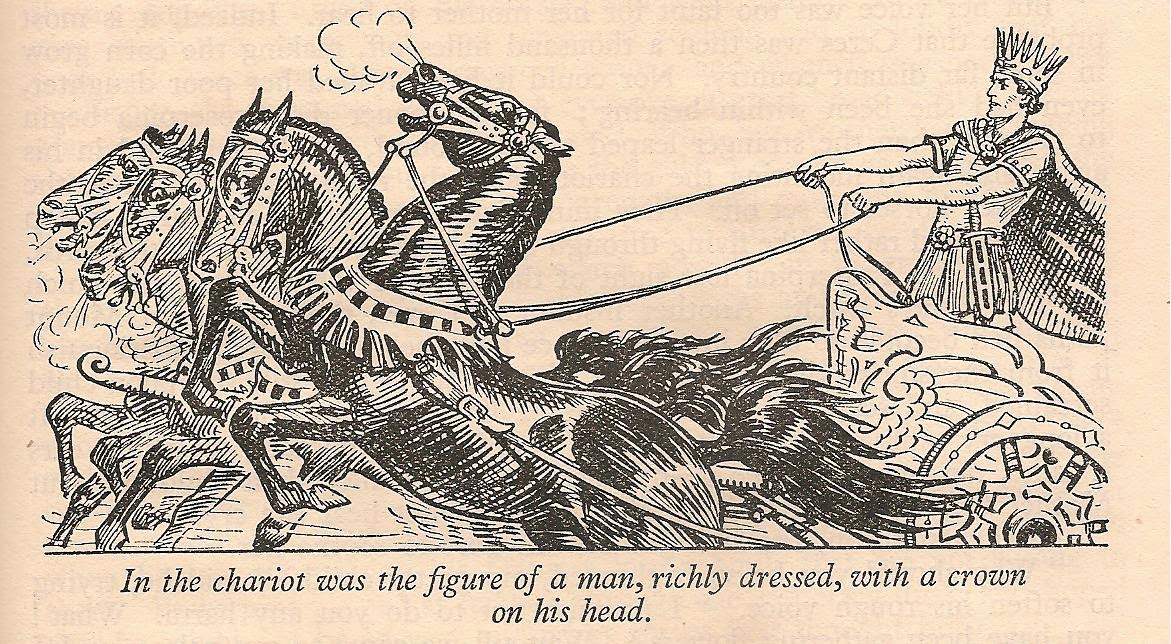
The Greek myth of Persephone has often been retold as a sweet and charming little story, a just-so fable about the cycle of winter and spring. Here’s an extract from a 19th century version for children, ‘The Pomegranate Seeds’ by Nathaniel Hawthorne. Persephone (under her Roman name, Proserpina) has begged Mother Ceres for permission to pick flowers, when, attracted by an unusually beautiful blossoming bush, she pulls it up by the roots. The hole she has created immediately spreads, growing deeper and wider, till out comes a golden chariot drawn by splendid horses.


In the chariot sat the figure of a man, richly dressed, with a crown on his head, all flaming with diamonds.  He was of a noble aspect, but looked sullen and discontented; and he kept rubbing his eyes and shading them with his hand, as if he did not live enough in the sunshine to be very fond of its light.

“Do not be afraid,” said he, with as cheerful a smile as he knew how to put on. “Come!  Will you not like to ride a little way with me in my beautiful chariot?”

Reducing the myth to a 19th century version of ‘don’t get into cars with strange men’, Hawthorne tells how King Pluto (something of a spoiled Byronic rich boy) makes off with the ‘child’ Proserpina and takes her into his underground kingdom, where she refuses to eat. Archly, Hawthorne explains that if only King Pluto’s cook had provided her with ‘the simple fare to which the child had been accustomed’, she would probably have eaten it, but because ‘like all other cooks, he considered nothing fit to eat unless it were rich pastry, or highly-seasoned meat’ – she is not tempted. In the end, of course, Mother Ceres finds her daughter, and Jove sends ‘Quicksilver’ to rescue her but not before (‘Dear me!  What an everlasting pity!’) Proserpina has bitten into the fateful pomegranate – and her natural sympathy for the gloomy King Pluto leads her to declare to her mother, ‘He has some very good qualities, and I really think I can bear to spend six months in his palace, if he will only let me spend the other six with you.’


And lo, the happy ending. Prettified as this is, no one would guess that Persephone – whose name means 'she who brings doom’ – was one of the most significant of Greek goddesses. In Homer, it is to her kingdom which Odysseus sails:  

Sit still and let the blast of the North Wind carry you.
But when you have crossed with your ship the stream of the Ocean
you will find there a thickly wooded shore, and the groves of Persephone,
and tall black poplars growing, and fruit-perishing willows;
then beach your ship on the shore of the deep-eddying Ocean
and yourself go forward into the mouldering home of Hades.

The Odyssey of Homer, Book X, tr. Richmond Lattimore, Harper & Row, 1965

As Demeter’s daughter, she is originally named simply ‘Kore’ or ‘maiden’. When Kore is stolen away, Demeter searches for her throughout the earth, finally stopping to rest at Eleusis, outside Athens. There, disguised as an old woman, she cares for the queen's son, bathing him each night in fire so that he will become immortal. When the queen finds out, she interrupts the procedure and the child dies. The angered goddess throws off her disguise, but in recompense teaches the queen's other son, Triptolemos, the art of agriculture. Meanwhile, since the crops are dying and the earth will remain barren until Demeter's daughter is restored, Zeus persuades Hades to return Kore to her mother - so long as no food has passed her lips. But Hades has tricked Kore into eating some pomegranate seeds, and she must therefore spend part of every year in Hades. Kore emerges from the underworld as Persephone, Queen of the dead. And a temple is built to Demeter and Persephone at Eleusis, which every year will host the Great and the Lesser Mysteries.  The participants would:

[walk] the Sacred Way from Athens to Eleusis calling for the Kore and re-enacting Demeter's search for her lost daughter. At Eleusis they would rest by the well Demeter had rested by, would fast, and would then drink a barley and mint beverage called Kykeon. It has been suggested that this drink was infused by the psychotropic fungus ergot and this, then, heightened the experience and helped transform the initiate. After drinking the Kykeon the participants entered the Telesterion, an underground `theatre', where the secret ritual took place. Most likely it was a symbolic re-enactment of the `death' and rebirth of Persephone which the initates watched and, perhaps, took some part in. Whatever happened in the Telesterion, those who entered in would come out the next morning radically changed. Virtually every important writer in antiquity, anyone who was `anyone', was an initiate of the Mysteries.

 (Professor Joshua J. Mark on the Eleusinian Mysteries, at this link: http://www.ancient.eu.com/article/32/)

The story really does contain all those mythic, seasonal references. While Persephone is in the underworld, the plants wither and die; there are the scattered flowers dropped by the stolen girl, there are the significant pomegranate seeds: but this is much more than a pretty fable.  It’s a sacred story which conveyed to the initiate the promise and comfort of life after death.


A couple of years ago, I went to see an exhibition of treasures from the royal capital of Macedon, Pella, at the Ashmolean Museum in Oxford. The treasures were dazzling, and the exhibition also included photographs of the lavish interiors and furnishings of the royal tombs of Philip II (father of Alexander the Great) and his family, at Aegae. In the tomb of Philip’s mother, Euridike, was a fabulous chair or throne.  On its seat had rested the chest containing the Queen’s burned bones, wrapped in purple...


...while on the back of the throne is a painting depicting Hades and Persephone riding together in triumph on their four-horse chariot. In another tomb at Aegae, Demeter is shown lamenting the loss of Persephone, while on another wall, Hades carries her off.  For me, it seems these images are being used in much the same way that we would place a cross on a Christian tomb. They are not merely referencing, but calling upon a significant myth, a myth with immediate, emotional potential, a myth that speaks of life beyond the doorway of death.

Although these tombs belong to the Classical era, in many ways the Macedonian royals had more in common with the heroic Mycenean age of a thousand years earlier.  Many Macedonian consorts acted as priestesses as well as queens. At the funeral pyre of Philip II, in 336 BC, it’s startling to learn that his youngest wife, Queen Meda, went to the flames with him, along with the dogs and horses which were also sacrificed.  But she was quite likely a willing victim.  Dr Angeliki Kottaridi explains; ‘According to tradition in her country, [this] Thracian princess followed her master, bed-fellow and companion forever to Hades. To the eyes of the Greeks, her act made her the new Alcestes [in Greek mythology, a wife who died in her husband’s place] and this is why Alexander honoured her so much, by giving her, in this journey of no return, invaluable gifts’ – for example, a wreath of gold myrtle leaves and flowers: 


Dr Angeliki Kottaridi again:

In the Great Eleusinian Mysteries, Demeter gave to mankind her cherished gift, the wisdom which beats death. With the burnt offering of the breathless body, the deceased, like sacrificial victims, is offered to the deity. Through their golden bands [pictured below] the initiated ones greet by name the Lady of Hades, the ‘fearsome Persephone’.  …Purified by the sacred fire, the heroes – the deceased – can now start a ‘new life’ in the land of the Blessed; in the asphodel mead of the Elysian Fields.

Dr Angeliki Kottaridi: “Burial customs and beliefs in the royal necropolis of Aegae”, from ‘Heracles to Alexander the Great, Treasures from the Royal Capital of Macedon’, Ashmolean Museum, 2011


For me, one of the most moving items in the exhibition was this small leaf-shaped band of gold foil, 3.6 cm by 1 cm.  Upon it is impressed the simple message:

ΦΙΛΙΣΤΗ ΦΕΡΣΕΦΟΝΗΙ ΧΑΙΡΕΙΝ

Philiste to Persephone, Rejoice!

And I wonder, I wonder about that leaf-shape. The goldsmiths of Macedon were unrivalled at creating wreaths – of oak leaves and acorns, or of flowering myrtle that look as though Midas has touched the living plant and turned it to gold. Would such artists really have used any old ‘leaf shape’ – or is this slim slip a gold imitation of the narrow leaf of the willow – the black, ‘fruit-perishing willows’ which Homer tells us fringe the shores of Persephone’s kingdom? 


Picture credits:

Statue of Persephone: ca 480–460, found at Tarentum, Magna Graecia (Pergamon Museum, Berlin)
Illustrations of Hawthorne's 'The Pomegranate Seeds' from 'The Mammoth Wonder Book': 1935
Photos of Macedonian tomb and goods from Heracles to Alexander the Great, Treasures from the Royal Capital of Macedon’, Ashmolean Museum, 2011

Sunday, 20 April 2014

"It's not just an [insert genre] book..."


I went into ‘The Last Bookshop’ in Oxford the other day, which sells what I assume (?) are remaindered books, since everything in the shop, regardless of size or original price, is sold for two pounds. I buy books regularly enough that I don’t feel guilty about getting them cheap from time to time: and anyway the selections here are sometimes more interesting than what is to be found in the chains. Which proved to be the case as I pounced with delight upon this: 


It’s the third in a series of horse books for children, 'The Horses of Oak Valley Ranch', by Jane Smiley, the Pulitzer Prize-winning author of ‘A Thousand Acres’.  I have the first two in the US hardcover editions: ‘A Good Horse’ and ‘The Georges and the Jewels’. Faber and Faber in the UK have changed these titles - in a way that links them more clearly as a series - to the more generic ‘Secret Horse' and ‘Nobody's Horse’. ‘Mystery Horse’ is called ‘True Blue’ in the States, and there are two more, which I look forward to reading.

 
US title/cover
UK title/cover
Take a look at the UK cover of 'Mystery Horse' - the gorgeous galloping grey horse against the blue sky, with a blue foil title, and little blue and pink foil flowers scattered around. Any pony-mad child would want it.  And then – well, then they might find this is more than your average pony story. 

Set in 1960’s California, the books follow the story of a young girl, Abby, growing up in a fundamentalist Christian family. Her father is a horse trainer and dealer, and Abby spends much of her free time outside school helping him work with the horses. Her mother and father are loving parents but her father in particular is unbending in his outlook, and her elder brother Danny has left home after a bitter row. 

Smiley’s treatment of the family and its predicament is sympathetic and nuanced.  As Abby is the narrator, we see her father through her eyes: stubborn, hardworking, fair according to his lights, rigid in his beliefs but – over the course of the first three volumes – able finally to compromise and come to terms with his son’s independence.  In the meantime Abby begins to navigate her own way through life. Observing her father’s strengths and weaknesses, she learns how to trust herself, to question her parents’ views without loss of love or respect, and to come to her own conclusions.

US title/cover
UK title/cover
 And YES, there is a lot about horses. Horses, Smiley suggests, are much like people. When her father, a church elder, wants to discipline the disruptive young sons of a church family, Abby points out that whipping a child can be as counterproductive as whipping a horse:

“I think they [the boys] are like Jack, not like Jefferson. If we whipped Jack, it wouldn’t make him stop running.  It would make him run faster.  If we whipped Jefferson, he might not run at all.  He might just stop and buck.”

Mom reached over and smoothed my hair.  Dad didn't say anything, and we drove the rest of the way home.

As if all this wasn’t enough, ‘Mystery Horse’/’True Blue’ is also a remarkably good ghost story: unsettling, spooky, beautiful and ultimately all about Abby – so that the ghostly bits are integral to the narrative and not some tacked-on extra thrill.

As an adult, I love these books.  I  love the detailed and thoughtful accounts of grooming, training and riding these horses which – because they are all for sale – often don’t even have individual names, in case anyone gets too attached to them. I love the fact that there can be whole chapters set in church – the ‘church’ which is all this small faith group can afford, a featureless rented space in a shopping mall.  I love the thoughtfulness with which Jane Smiley navigates Abby’s world.  The ways in which school and home life clash: textbooks which mention evolution and therefore cannot be shown to Daddy, or Mom’s horror on discovering that in a history lesson, Abby has been constructing cardboard models of  Spanish missions.

‘“You built a Catholic mission?”   
“We all did.”’ 

It’s done with a light, almost comedic touch, but can become serious. ‘“So,” said Daddy'  [to Daniel, at the beginning of their quarrel]. “Some boys who taught you to take the holy name of the Lord in vain are going to pick you up and take you to see a fantasy movie about evil and hate.  Am I right?”’ Other kids are allowed to go to movies and listen to the Beatles. Abby doesn’t exactly miss these activities, but she knows that not having them makes her different. 

I love all of this. But would a child?

Well, it depends on the child.  And this is where the title for this post comes in.  Genre fiction has an undeserved bad name.  Horse and pony books. School stories. Crime. Romance. Historical novels. Science fiction.  Fantasy. Children’s books.  If you can put it in a category, it must somehow be less than a ‘real’ novel.  ‘It’s just a pony book.’  ‘It’s just a school story.  ‘It’s just a romance.’


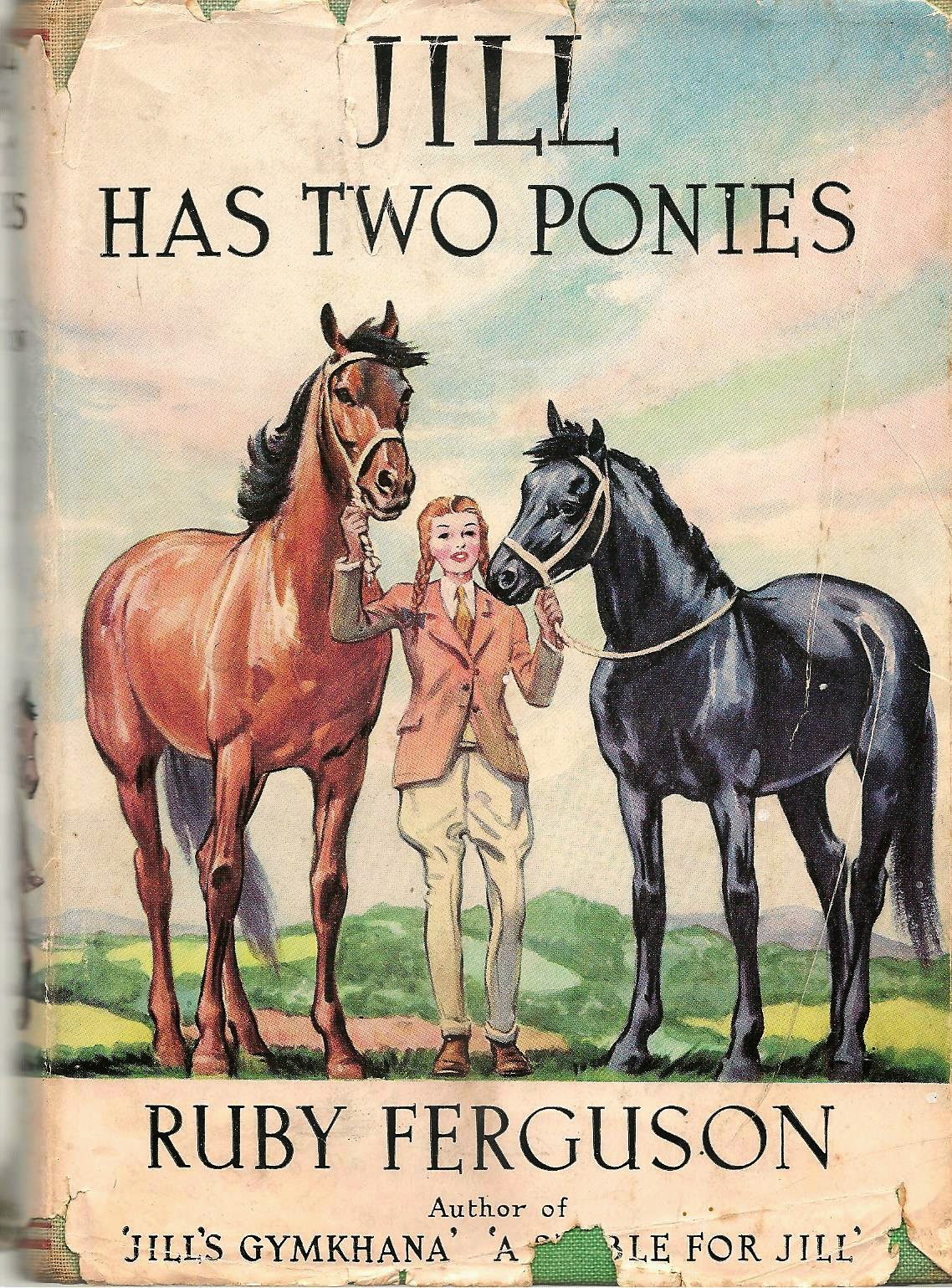
It’s true that there are many pony books, school stories or adventure stories which are hardly great literature, however that may be defined. But not every plain old novel is great literature either.  I’m not denigrating the many, many pony books I read as a child just because, as an adult, I no longer find them so interesting. The ‘Jill’ books by Ruby Ferguson, for example, kept me enthralled when I was ten or eleven. They are fun, they are lively. They do one single thing: tell an entertaining story and tell it well.  That is good in itself.

But there are books which do more, which are multi-dimensional. Mary O’Hara’s ‘My Friend Flicka’ and ‘Thunderhead’ and ‘Green Grass of Wyoming’ are multi-dimensional. They offer a richness – of characterisation, of description, of emotional intelligence – which the ‘Jill’ books don’t have and never aspired to.  KM Peyton’s  ‘Flambards’ and ‘Fly By Night’ and ‘The Team’ are multi-dimensional. In the genre of ‘school story’, Enid Blyton’s ‘Malory Towers’ and ‘St Claire’s’ stories offer the child reader excellent ripping yarns, unashamed fantasies of the fun and frolics of boarding-school life. But Antonia Forest’s school stories  ('Autumn Term' and its sequels) are multi-dimensional. They offer more: depth of character, growth, change, consideration of topics such as religion, censorship, responsibility, and the unwitting cruelty of schoolchildren to persons they dislike. 

And yes, I loved all of them indiscriminately, but the ones I read and reread and have kept reading into adult life are the multi-dimensional books.  I knew even back at the age of eleven or twelve or thirteen that I was getting far, far more out of ‘My Friend Flicka’ than I was getting out of ‘Jill’s First Pony’.  Mary O’Hara was talking about stuff that was important to me.  My father and my brother, much as they loved each other, used to argue. There were misunderstandings, jealousies, quarrels which sometimes burst around us with the violence of a thunderstorm. In ‘My Friend Flicka’ and its sequels, the dreamy boy Ken and his impatient, practical father are also negotiating a difficult relationship punctuated by storms.  That story intertwines with the story of Ken’s love for his little horse, and is equally important.

Maybe some children don’t like these multi-dimensional books, maybe some children – perhaps even many children? – become bored, impatient, wanting simply to get on with the story. But there will be other children who want more, who are already thinking, already asking questions about life, who will appreciate finding these questions taken seriously in the middle of a book ‘about’ horses or school. A multi-dimensional book always gives the reader more than they expected.

Am I simply saying that genre books can be good novels?  Of course I am. But it’s more than that.  It’s a plea.  The next time you read an excellent horse story or school story or fantasy, try not to say in its praise,  ‘It isn’t just a pony book/school story, of course…’ as if somehow it needs to be extracted from its lowly niche before it can be appreciated.  Worse still, don’t say, ‘It’s not really a pony book/school story/children’s book at all!’

Because if you do, if everyone who ever reads and loves a ‘genre’ book feels they have to rescue it from its category before praising it, then what is left?  Every category of books – novels, children’s fiction, popular science, you name it – contains a multiplicity of less or more able writers, and we should remember it's better do something simple and do it well, than to aim high and fail. If somebody says, as someone recently said to me, ‘But Ursula le Guin’s books aren’t really fantasies’, how is that a compliment to le Guin, who chose to employ her wonderful talents in the field of sci-fi and fantasy?  All it really proclaims is the reader’s embarrassment at having enjoyed a book belonging to a genre which they believe - in spite of the evidence before their eyes - to be second-rate.

Either we need to do away with categories and genres altogether – which isn’t going to happen – or we need to stop being embarrassed and apologetic, and be ready to recognise and celebrate good work in whatever field it happens to grow.   Loud and clear: there are excellent pony books, there are excellent school stories, there are excellent fantasies, and there are excellent children’s books.  Their excellence is no different in kind from that of any other writing. So, yes!  Unsurprisingly, Jane Smiley's series of horse stories is truly excellent. Any child or adult who picks them up will learn much – about horses, and about life. 


Saturday, 5 April 2014

The Colours in Fairytales


The Sleeping Beauty: Rene Cloke

It’s usual for collections of fairytales to include pictures.  When I was very small, the simple retellings I was able to read were full of lavish colour illustrations like the one above, by Rene Cloke. It's very pink.

The Andrew Lang collections, the Red, the Green, the Violet, theYellow Fairybooks had their intricate Victorian engravings (which I longed, but was never allowed, to colour in). I read the tales of Hans Christian Andersen with wonderful watercolour illustrations by Edmund Dulac, all twilight blues.
 

The Little Mermaid: Edmumd Dulac


And I borrowed from the library Grimm’s fairytales with pictures by Arthur Rackham, rich and dark. 
 

The Singing, Soaring Lark: Arthur Rackham


But fairystories don’t actually need illustrations. They contain their own colours, brilliant as any medieval painting. As red as blood, as black as ebony, as white as snow. 

In his book ‘An Experiment in Criticism’ CS Lewis talks about good and bad writing, and the possible differences between them. (I know this sounds as if I'm heading off at a tangent, but bear with me.)  He suggests that some readers prefer bad writing because they do not want or are not interested in the things which good writing can provide: richness of experience, for example, or depth of thought. Some readers simply want the action, the page-turning, the next thing. And this explains the popularity of the airport thriller, and of Dan Brown.

For such a reader, Lewis says, good writing will be either too rich or too bare for his purposes:

A woodland scene by DH Lawrence or a mountain valley by Ruskin gives him far more than he knows what to do with; on the other hand, he would be disappointed with Malory’s ‘he arrived afore a postern opened towards the sea, and was open without any keeping, save two lions kept the entry, and the moon shone clear.’ Nor would he be content with ‘I was terribly afraid’ instead of ‘my blood ran cold’. To the good reader’s imagination such statements of the bare facts are often the most evocative of all.  But the moon shining clear is not enough for the unliterary.  They would rather be told that the castle was ‘bathed in a flood of silver moonlight’.

I’m not concerned here with Lewis’s thesis about different types of reading; I think he’s right, but I also think all of us can be ‘good’ and ‘bad’ readers: I have days when I can be that attentive, sensitive reader Lewis applauds and other days when I simply feel too lazy. But I do want to point out that fairytales – traditional fairytales – tend like Thomas Malory's Morte D'Arthur to be economical with description.

In olden times, when wishing still helped one, there lived a king whose daughters were all beautiful, but the youngest was so beautiful that the sun itself, which has seen so much, was astonished whenever it shone on her face. Close by the King’s castle lay a great dark forest, and under an old lime-tree in the forest was a well, and when the day was very warm, the King’s child went out into the forest and sat down by the side of the cool fountain; and when she was bored she took a golden ball, and threw it up on high and caught it.

            The Frog-King

 
Lovely as it is, the phrase ‘so beautiful that the sun was astonished’ does not tell us what the king’s daughter looks like. Hardly any modern writer who might wish to turn The Frog-King into a novel could resist providing more. The princess would have to be given a name. We would learn what colour her hair and eyes are, whether her nose turns up at the end, what she wears. In the inevitable process of extending and elaborating the tale, the writer would have to try very hard to avoid literary clichés.

A fairytale does not have to try hard.  In keeping everything simple, it also keeps everything fresh. ‘Close by the King’s castle lay a great, dark forest’ leaves almost everything to your imagination, and then comes the ‘old lime tree’ and the cool well, and that’s as much as anyone needs to know.  A novelist might add a description of the well, providing it with a carved marble parapet or a rustic stone wall.  It might be beautifully written and very fine – but in a fairytale, it would merely get in the way.

Yet how is a simile like ‘as green as grass’ or ‘as black as coal’ less of a cliché than ‘bathed in a flood of silver moonlight’?  In my opinion, because they are so brief.  They leave the imagination free. ‘Red as blood’. The colour flashes on the inward eye in all its familiar, potent brilliance, and is gone: what else can ‘red’ be as red as? Strain after another comparison as much as you like, you’ll do no better.

Colours in fairytales are strong, simple, basic, and meaningful.
 
 
 Blanche-Neige: Benjamin Lacombe


Once upon a time in the middle of winter, when the flakes of snow were falling like feathers from the sky, a Queen sat at a window sewing, and the frame of the window was made of black ebony. And whilst she was sewing and looking out of the window at the snow, she pricked her finger with the needle, and three drops of blood fell upon the snow. And the red looked pretty on the white snow, and she thought to herself, ‘Would that I had a child as white as snow, as red as blood, and as black as the wood of the window-frame.’

Little Snow-White

In spite of the 'Sleeping Beauty' picture at the top of this post, you don’t get pink in fairytales. You don’t get purple. Yellow is rare. But there is white snow, white linen, white snakes, white doves, white swans, white feathers. Red blood, and roses as red as blood. There are green branches in dark forests.  Black ravens, black ebony, black coal.  Golden hair, golden straw, golden crowns, golden spinning wheels.

The dove said to her, ‘For seven years must I fly about the world, but at every seventh step that you take I will let fall a drop of red blood and a white feather, and these will show you the way.’

            The Singing, Springing Lark

White, black and red are meaningful colours because they are rare in nature and therefore noticeable. White is the colour of innocence, the colour of an untrodden fall of snow under which the whole landscape is transformed. A white dove is an emblem of peace, a black raven a signifier of wisdom. In some variants of Snow-White, it is a raven which the queen sees against the snow, a more likely and a sharper contrast than an ebony window-frame. Black is unusual. Most birds are brownish: even today with our dulled attention to nature, we notice black crows and white swans.  Before chemical dyes, black was an expensive colour for clothes: it stood out: most people could not afford to wear it. And red of course is the most meaningful of all colours, the most emotionally charged.  Red is the colour that accompanies childbirth, wounds, war, accidents. Red is the stuff of life and death.

Blanche-Neige: Benjamin Lacombe

Gold is the colour of the sun, or perhaps it should be the other way around: the sun is more glorious than gold. The princess in The Singing, Springing Lark wears a dress ‘as brilliant as the sun itself’, while the heroine of The Black Bull of Norroway cracks open nuts to reveal dresses the colours of the sun, moon and stars. Gold stands for luck, goodness, happiness and fortune.

Blue, the colour of the sky, is strangely rare in fairytales. Apart from the eerie, supernatural blue light – the witch-light – in the story of that name, the only instance I can find is a sad little tale about a toad in which the blue object is artificial, a handkerchief:

An orphan child was sitting by the town wall spinning, when she saw a paddock coming out of a hole low down in the wall.  Swiftly she spread out beside it one of the blue silk handkerchiefs for which paddocks have such a liking, and which are the only things on which they will creep. As soon as the paddock saw it, it went back, then returned, bringing with it a small golden crown…

Tales of the Paddock, II

Colours in fairytales aren’t decoration, they aren’t even ‘just’ descriptive. They carry information.  They are a form of emphasis. And they can be relied upon. A golden head which rises to the surface of a well may be strange, but it won't be evil. Magical and just, it gives the same advice to both the good and the selfish girls: it's their own natures which will bring them good or bad luck. A girl who can ask a hazel tree to shake gold and silver down upon her is sure to prove fortunate, and a white dove will aid the innocent even as it pecks out the eyes of the guilty.


The Water of Life: Arthur Rackham

Here’s a poem into which I tried to work the colours of fairytales.


FAIRYTALE

Out from the pine forest stepped
the bowing yellow dwarf, and stopped the prince,
who - half despairing - told him everything.

If the bent woman, walking backwards, sets you
to sweep the green pins with an old owl's feather,
and call up storm clouds in the fine June weather,
and ride the yellow colt of your last nightmare -
what can you do but sigh and tell your story
to the first kindly stranger who has met you?

'Tell me,' the dwarf said, 'what of your princess?'
'Oh, turned into a brown thrush long ago
she sits and sings in a fine gilded cage,
and every spring she lays a pure blue egg,
which, hatched, displays a tiny golden crown.
That's why you see me wandering alone:
for hills of glass and plains of knives spring up
behind, and hinder me from turning back.'

'Where's your white horse? Your squire, young Constant Jack?'

'Jack used to fret me - always making speed.
He rode my white horse red towards the wars
a long time back. Today, I have no doubt,
sheep graze the fine new grass between their bones.'

'Ah?' said the dwarf. 'And so you're quite alone?'
'Alone. And burdened with confusing tasks.'

Then, pointing where the green ride ducked and dipped
to twist behind the dense pine barrier:
'Now,' said the dwarf, smiling, 'keep on till dark...'