Thursday, 1 June 2017

Willie Millar and the Sleeper in the Cave


In the widespread legend known as 'The King in the Mountain' (Aarne-Thompson 776), an unsuspecting shepherd or lost traveller stumbles upon a cavern in which he (so far as I know it's always a he) discovers a sleeping or incarcerated king, often surrounded with his retinue. The king may be Holger Dansker (Ogier the Dane) as in the illustration above; he may be Arthur, Charlemagne,  Barbarossa or many another; sometimes the sleeper is not a king but another important figure such as Merlin, St John, or Sir Francis Drake. There's often a horn to be blown or a drum to be struck, which will call the sleeper to wake and ride out to battle - but it's not very wise to disturb him before his time.

Here is a wonderfully Gothic version from Scotland set down by Hugh Miller (1802-1856). Miller was a native of Cromarty on the east coast of the Highlands. Born to a humble family he took up his trade as a stonemason, but became in later years a well-known and highly respected geologist, lecturer, writer and folklorist. Cromarty’s Dropping (or Dripping) Cave in which the tale is set, is a sea-cave, said also to be the haunt of a mermaid. I like the touch of scepticism with which Miller incorporates the sly suggestion that the hero’s visions may have been assisted by, well, gin.

I've slightly abridged the tale. And in a later version which Miller published in Chambers’ Edinburgh Journal, February 17th 1838, the hero is named Archie, not Willie.


Willie Millar and the Sleeper in the Cave
(from ‘Scenes and Legends of the North of Scotland’ by Hugh Miller, 1834)

There was a Cromarty mechanic of the last age, named Willie Millar, who used to relate a wonderful adventure which befell him in the Dropping Cave of Cromarty. Willie was a man of fertile invention, fond of a good story and zealous in the improvement of bad ones … Hearing of a tradition that the cave extended over three miles from the entrance,  Willie resolved on testing the story for himself.

He sewed sprigs of rowan and wych-elm in the hem of his waistcoat, thrust a Bible into one pocket and a bottle of gin into the other, and providing himself with a torch, and a staff of buckthorn which had been cut at the full of the moon, he set out for the cave on a morning of midsummer. It was evening ere he returned – his torch burnt out, and his clothes stained with mould and slime, and soaked with water.

After lighting the torch, he said, and taking a firm grip of the staff, he plunged fearlessly into the gloom. The cavern lowered and narrowed as he proceeded; the floor of white marble-like stone was hollowed into cisterns filled with water so pure it sparkled in the light like spirits in crystal; from the roof depended clusters of richly embossed icicles of white stone. The springs from above trickled down their channeled sides and then tinkled into the cisterns, like rain from the eaves of a cottage after a thunder-shower. Perhaps he was too busy looking around at all this, for at the ninth and final cistern he missed his footing, and falling forwards shattered his bottle of gin. The liquor ran into a little hollow in the marble, and unwilling to lose it, he stooped down and drank till his breath failed him, and pausing to recover himself, stooped and drank again. 

There were strange appearances when he arose. A circular rainbow had formed around his torch; there was a blue mist gathering in the hollows of the cave, the roof and sides began to heave and reel, and a low humming  sound came from the interior, like that of bees in a hawthorn thicket on a midsummer evening. Willie, however, had become much less timorous than at first… And so on he went. 

The cavern widened and the roof rose. The sound of his footsteps was echoed on either hnd by a multitude of openings, in which the momentary gleam of his torch was reflected, as he passed, on sheets of water and ribs of rock, and which led – like so many arched corridors – into the bowels of the hill. Not that all of the sounds were echoes. Besides the continuous humming noise, he could hear sounds like the wind moaning in the trees above, the scream of the hawk as if pouncing on its prey; the deafening blast of a smith’s bellows and the clang of hammers. A breeze came moaning along the cave and shook the marble drapery of the sides, as if it were formed of gauze or linen; the entire cave seemed turning around till the floor stood upright and the adventurer fell heavily against it; as his torch hissed and sputtered in the water he could see by its expiring gleam that a full score of dark figures, as undefined as shadows by moonlight, were flitting around him in the blue mist which now came rolling in dense clouds from the interior. In a moment more, all was darkness and he lay insensible amid the chill damps of the cave.

On returning to consciousness  he found the gloom around him had given place to a dim red twilight which flickered along the sides and roof like the reflection of a distant fire. ‘It is sunlight,’ thought he, ‘I shall find an opening among the rocks of Esthie and return home over the hill.’ Instead, however, he found the passage terminate in a wonderful space so vast that though an immense fire of pine-trees, whole and unbroken from root to branch, threw up a red wavering sheet of flame many yards in height, he could see in some places neither the walls nor the roof. A cataract descended in thunder from one of the sides, presenting its broad undulating front of foam to the red gleam of the fire, and again escaped into darkness though a wide broken-edged gulf at the bottom. The floor of the cave appeared to be thickly strewn with human bones, half-burned, blood-stained, and gnawed as if by cannibals; and directly in front of the fire there was a low tomb-like structure of dark stone, full twenty yards in length, roughened with grotesque hieroglyphs like those of a Runic obelisk. An enormous mace of iron, crusted with rust and blood, lay against the upper end; while a bugle of gold hung by a chain of the same metal from a column at the bottom. 

Willie seized the bugle and winded a blast till the wide apartment shook with the din; the waters of the cataract disappeared, as if arrested at their source, and the ponderous cover of the tomb began to heave and crackle and pass slowly over the edge, as if assailed by the strength of some newly-awakened giant below. Willie again winded the bugle; the cover heaved upwards, disclosing a corner of the chasm beneath; and a hand covered with blood and of such fearful magnitude as to resemble only the conceptions of Egyptian sculpture, was slowly stretched from the darkness towards the handle of the mace. Willie’s resolution gave way, and flinging down the horn he rushed toward the passage. A yell of blended grief and anger burst from the tomb, as the immense cover again settled over it; the cataract came dashing from its precipice with a heavier volume than before; and a furious hurricane of wind and spray rushed howling from the interior, well-nigh dashing the adventurer against the sides of the rock. He succeeded however in gaining the passage; a state of imperfect consciousness followed, like that of a feverish dream; on fully gaining his recollection he found himself lying across the ninth cistern, with the fragments of the broken bottle on the one side, and his buckthorn staff on the other.


Picture credits:

Holger Danske, also known as Ogier the Dane, was a legendary Danish warrior and knight in Charlemagnes army. The statue is made by Hans Peder Pedersen-Dan (1859-1939) 1907, and is found in the cellar (kasematterne) of Kronborg Castle, Denmark. Here he sleeps until Denmark is in danger and needs his help. My thanks to Malene Thyssen who has kindly permitted me to use this image. http://commons.wikimedia.org/wiki/User:Malene


The Sleeping King, by Eric Fraser, illustration from English Legends by Henry Bett, 1950

Thursday, 27 April 2017

The Magical SATOR Square


In Lady Wilde’s ‘Ancient Legends of Ireland’ there’s a story about a young man, a poet, who attempts to seduce a farmer’s daughter. He’s used to having his wicked way with girls, for we're told that Irish poets were known for possessing ‘the power of fascination by the glance … so that they could make themselves loved and followed by any girl they liked.’

With this particular girl, however, the power doesn’t seem to work very well at first. The poet arrives at her farm and begs for a drink of milk, but the young woman happens to be on her own in the house – the maids are busy churning in the dairy – so she refuses to let him in. Annoyed by this, the poet takes action. Lady Wilde continues:

The young poet fixed his eyes earnestly on her face for some time in silence, then slowly turning round left the house and walked towards a small grove of trees just opposite. There he stood for a few moments resting against a tree, and facing the house as if to take one more vengeful or admiring glance, then went his way without once turning round. 

The young girl had been watching him from the window, and the moment he moved she passed out of the door like one in a dream, and followed him slowly, step by step, down the avenue.

As the girl passes through the farmyard, the dairymaids notice her entranced state. They raise the alarm and her father comes running from his work, shouting for her to stop, but his daughter doesn’t seem able to hear. The poet does, though,


…and seeing the whole family in pursuit, quickened his pace, first glancing fixedly at the girl for a moment. Immediately she sprang towards him, and they were both almost out of sight, when one of the maids espied a piece of paper tied to a branch of the tree where the poet had rested.  From curiosity she took it down, and the moment the knot was untied, the farmer’s daughter suddenly stopped, became quite still, and when her father came up she allowed him to lead her back to the house.

Recovering, the girl tells her family how she’d felt impelled to follow the young man ‘wherever he might lead’, only coming to her senses when the spell was broken. But what was the spell?

The paper, on being opened, was found to contain five mysterious words written in blood, and in this order:
Sator
Arepo
Tenet
Opera
Rotas

These letters are so arranged that read in any way, right to left, left to right, up or down, the same words are produced; and when written in blood with a pen made of an eagle’s feather, they form a charm which no woman (it is said) can resist…

(In a sceptical aside, Lady Gregory adds, ‘but the incredulous reader can easily test the truth of this assertion for himself.’)


The Sator, Rotas, or Rotas Sator Square as this acrostic is called, is both very old and tantalisingly obscure; at any rate, no one has yet succeeded in explaining to everyone else’s satisfaction exactly what it means. Carved in stone or painted on walls, it crops up all over the place, at sites in Italy, Britain, Sweden and even Syria, ranging in date from Roman to medieval to near-modern. The words are obscure in themselves and have given rise to various tortuous interpretations (explored in this interesting article by Duncan Fishwick MA, "An Early Christian Cryptogram?"), which range from the reassuringly rural though still opaque, ‘The sower Arepo works the wheels with care’ – to Satanic invocations. AREPO is a nonsense word, and it seems that the rest, though they may resemble Latin words, are so ungrammatical as to be pretty much nonsense too. 


However, back in the 1920s two German scholars discovered (or re-discovered) that the Square hides an anagram: it can be arranged as the word PATERNOSTER written twice in a cruciform order which uses the N only once, and leaves four letters over: two As and two Os – Alpha and Omega.  


There’s really no chance that this is not deliberate, but to assume a Christian solution is problematic. The earliest known examples of the SATOR square are two graffiti from Pompeii which predate the Vesuvian eruption of AD 79.  Duncan Fishwick summarises the difficulties thus: there's no convincing evidence of any Christians in Pompeii before it was destroyed; the Cross is not found as a Christian symbol before about AD 130; Christians of the First Century used Greek not Latin for teaching and liturgy; the Christian use of Alpha and Omega as symbols for God was inspired by verses of the Apocalypse, which by AD 79 had not yet been written; finally, ‘cryptic’ Christian symbols first appear only ‘during the persecutions of the third century’ when overt Christianity had become politically unsafe. 

There was however a Jewish population in and around Pompeii, as various graffiti testify, and Fishwick suggests that rather than Christian, the Sator Square may have been Jewish in origin. The Alpha and Omega may derive their significance from Old Testament passages such as Isaiah 44, 6 in which God declares, ‘I am the first and the last’, while as for the Paternoster anagram, Fishwick explains that, ‘Far from being a Christian innovation this form of address [eg: 'Our Father'] has its roots in Judaism’, citing various Judaic prayers. He concludes that the Square may likely have been a charm constructed by Latin-speaking Jews, the magic of which resides in its satisfying symmetry and the concealed invocation which, revolving around the single letter N, hints at the unspoken nomen or name of God. Another scholar, Rebecca Benefiel, points out in a fascinating article, "Magic Squares, Alphabet Jumbles, Riddles and more: The culture of word-games among the graffiti of Pompeii," that the Sator Square is only one of many different word-squares found at Pompeii.

Even if not Christian in origin, the Square was soon adopted as a Christian charm and invested with more specifically Christian symbolism: a belief arose that the five 'words' of the palindrome were the names of the five nails which fastened Christ to the cross.  And it went on from there to enjoy a long subsequent history as a potent magical spell. It was used in the 12th century, according to medieval scholar Monica Green (quoted by Sarah E. Bond in a post, 'Power of the Palindrome', in her blog History from Below), as a charm which could be written on butter and eaten, to help women who had miscarried. At some time in the 18th century the Sator Square was brought from Germany to America: in the Pennsylvanian Dutch example shown below, dated circa 1790, you can see that mistakes have been made in the lettering, so that it becomes simply a piece of magical gibberish. One wonders how early any awareness of the Paternoster anagram had vanished.


In 1820 printer and chapbook seller, Pennsylvanian John or Johann Hohman published German and English versions of a book of spells, charms and remedies called 'The Long Lost Friend' or 'The Long Hidden Friend'. On the page reproduced below, we find in charm number 121 the Sator Square, used 'To Quench Fire Without Water':


It's clear that people tried it. The photo above, from the Oberhausmuseum in Passau, Bavaria, shows 'a plate with magic inscription, used as a fire fighting device to expel the evil spirits of fire.'  Perhaps people prepared them in advance? I suppose it might even have worked to damp out a very small fire, but one hopes those who tried this charm were busy stamping out the flames at the same time. (At least it's fairly brief, unlike the elaborate spell Hohman provides for 'Preventing Conflagration' which involved throwing into the fire a bundled-up sheet stained either with the menstrual blood of a chaste virgin, or the blood from child-birth.)


A charm written on wood, intended to put out fires

In fact 'The Long-Hidden Friend' itself had a long history as a popular folk-magic text: as late as 1904, Carlton F. Brown wrote in The Journal of American Folk-lore (Vol. 17, No. 65, Apr. - Jun., 1904, pp 89-152) that 'in eastern Pennsylvania whole communities, even whole counties, firmly believe in the realities of "hexing", and protect themselves from its influence by the charms and incantations of witch doctors.' Subsequent investigation by the Berks County Medical Society into the practices of the witch doctors showed that 'the principal source of the charms which they were using was this very book of Hohman's.'  And they charged high prices for their services.

Who would have thought that a word puzzle dating from at least as early as first century Pompeii would still be in use as a popular charm in 19th century America, and appear in a 19th century Irish folk tale? Whether Judaic or Christian, Roman or medieval, European or American – whether religious symbol, magical aid for women in childbirth, a charm to put out fires or a spell to lure young Irishwomen away – the Sator Square will surely continue to puzzle and intrigue.


Picture credits

Fair Rosamund, by Arthur Hughes, 1854. (So no real connection with Lady Wilde's story, but a sweet young woman in a summer garden with something doomful looming.)
Rotas square from St Peter ad Orotarium, Capestrano, photo by Poecus, at Wikimedia Commons
Rotas square from Cirencester,  photo by ThrowawayHack, at Wikimedia Commons
Pennsylvania Dutch talisman c. 1790, Wikimedia Commons
Plate from Passau, Bavaria, with Sator charm against fire, photo by Wolfgang Sauber at Wikimedia Commons
Sator square from Freistadt, Austria: Mühlviertler Schlossmuseum: Magic formula against fire, photo by Wolfgang Sauber, Wikimedia Commons

Thursday, 6 April 2017

'The Museum of Shadows and Reflections' by Claire Dean: Review


Claire Dean’s fairy stories are for adults, not because anything in them is inappropriate for children, simply because most children would find them difficult to understand. Much is left hanging in the air, hinted yet unsaid. I was already familiar with a few of the stories which have previously appeared in various new fairy tale journals, and the words I’d have used to describe them would have been ‘beautiful', 'airy', 'delicate’. Now, ‘delicate’ is a word that isn’t always welcome: it can signal ‘slight’; surely ‘delicate’ rules out ‘powerful’? Well, Hans Christian Andersen could write beautiful, airy, delicate fairy tales which have the emotional kick of a mule. At her best so can Dean, and this collection showcases a very talented writer whose work is getting better and better. The illustrations by Laura Rae perfectly complement the text.  

‘You have to catch their coats while they’re young’ is the mantra of a faded and nameless north-country village where most of the locals are married to or descended from swan maidens.  In ‘Feather Girls’ a man makes an habitual visit to the local pub to share a couple of pints and a packet of crisps with the swan-maid whom, unlike the other village men, he has refused to trap. In Dean’s elegant, sharp writing the ‘feather girl’  comes to life, ‘tall and slight in her downy white under dress, and she compulsively twiddled her fingers, as though when she had them she couldn’t bear not to be using them’. And ‘she plucked at the crisps … as though her fingers became her beak and her long thin arm took the place of her graceful neck’. It’s a story about love, loneliness and the price of freedom: it’s also perhaps a story about the way custom turns the strangest things into the quotidian. But I was left asking myself why the feather girl would join the man at all?  How far should gratitude for not being enslaved take you?  Is she sorry for him? Are there no feather men in the lake? 

People in Dean’s stories tend to be nameless: often only the subsidiary characters have names. In traditional fairy tales it’s usual for the main character to be ‘the boy’, ‘the maiden’, ‘the king's daughter’, and so universal rather than particular. Dean takes this further towards anonymity by referring to her characters with simple pronouns: ‘he’, ‘she’. It usually works I think, but occasionally the anonymity can get a little characterless. The opening story, ‘Raven’, is based on another animal transformation tale, ‘The Raven’ from the Brothers Grimm. An exhausted mother wishes her restless child would change into a raven and fly away.  In the traditional fairy tale this is the beginning of magical adventures out in the forest. Dean shows the interaction of raven-child and mother within doors, within the domestic setting. The bird-baby is active, full of energy, curiosity, boldness; the mother is passive: she copes better with the raven than she did with the child, but is emotionally numb:

I watched her watch the flock of ravens as they flew out of sight over the terraced roofs, chasing wind-torn scrags of cloud. I was still holding my arms as though to cradle her and support her head.

It’s very dreamlike. ‘I watched her’; ‘I was still holding my arms as though to cradle her’ – such physical stiffness and inability to react seem at odds with the vigorous, lively descriptions of the first-person narration. The mother seems to feel neither surprise nor responsibility for her daughter’s transformation, though maybe that too is the point: the baby has always felt alien to her.  


In ‘Growing Cities,’ a little girl visits the greenhouse where her Granddad grows cities from seed. A woman who works in the seaside ‘Museum of Shadows and Reflections’ takes an unexpected revenge when she is overlooked for a position. In the lovely ‘Chorlton-under-Water’ a resident clings on to life in her own home even after it’s been submerged in the new reservoir, and ‘A Book Tale’ is a charming, topsy-turvy, inside-out story reminiscent of traditional fairy tales in which girls travel east of the sun, west of the moon to rescue their lovers, or fall down wells into fairy kingdoms. These are all delightful, and there are many more.  

I did occasionally wish Dean had drawn with bolder strokes: when she does, the effect is electrifying.  The best stories in the collection are also the most recent. ‘The Sand Ship’ is a splendidly weird tale about the power of imagination, narrated by a bossy, rather unpleasant little boy as he plays with his sister on a toy ship in a playground. It’s tough and funny and I loved the sudden, surreal ending. In ‘The Stone Sea’, the growing, miniature stone seafront (complete with stone funfair) in Rivalyn’s living room seems to parallel the gradual petrification and loss of her memory. Finally, ‘Glass, Bricks, Dust’ is outstanding: a softly sinister tale of a boy playing alone on a mound of rubble by a demolition site: ‘At the top of the mound he was king.’  On summer evenings he stays out late, making play cities from bits of broken glass, ‘balancing roofs on them, building towers’. As dusk is falling, 

He heard nine chimes of the town hall clock. For a moment, the lamppost looked like a tall thin man wearing a large black hat. When the man turned towards him, he looked like a lamppost…  face to face with the boy with his feet still planted in the pavement.

Dark and utterly assured, this story has the strength and coherence of Neil Gaiman’s ‘Coraline’ and is a terrific achievement. ‘The Museum of Shadows and Reflections’ is a collection of beautiful, disturbing stories which will bear reading and rereading. I unreservedly recommend it and look forward to whatever this author does next.

THE MUSEUM OF SHADOWS AND REFLECTIONS by Claire Dean, illustrated by Laura Rae, is published by Unsettling Wonder and available from Amazon (click here)

Read more about it, and other publications, at Unsettling Wonder's website (click here)


Thursday, 30 March 2017

Here Be Griffins!


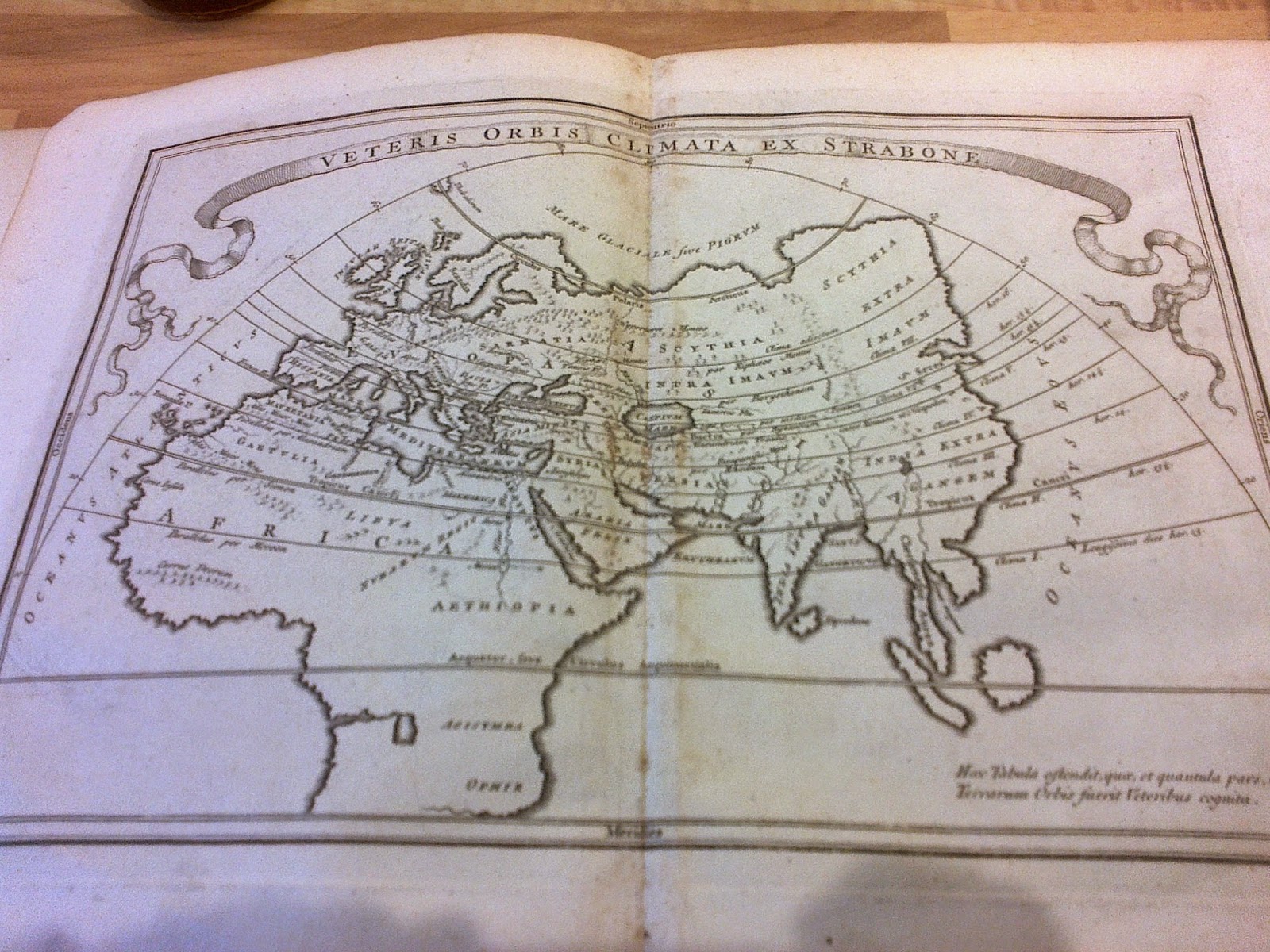
Some years ago my mother handed over to me this book, which had been my grandfather's. I suppose it must have been given to him by someone else - in fact, it must have been handed down for generations. 


It's an atlas of the classical world dated 1785, 'Designed for the Ufe of Schools, and of Gentlemen who make the Antient Writers their Delight or Study.' The maps cover all areas which such Gentlemen might wish to consult while following the journeys of Herodotus, or perhaps the campaigns of Alexander, or the Gallic Wars.


Of course the maps are deliberately limited to those parts of the world known to ancient geographers, but they aren't themselves 'Antient'. They're drawn to an eighteenth century knowledge of the shapes of coasts and continents.


Like any historical atlas of today, they fit the old stories into what was then a modern frame. Here for example is Mesopotamia, with squiggly rivers, the Tigris and the Euphrates. A graceful line of mountains (the Taurus range, somewhat attenuated) drapes itself across the top of the map like a paper-chain.


I wanted to look for griffins, though (or gryphons, griffons, spell as you please), and in a way I found them. In Book Two of Paradise Lost, Milton describes how Satan launches himself out on his 'Sail-broad Vannes'  into the abyss of Chaos:

As when a Gryfon through the Wilderness
With winged course ore Hill or moarie Dale,
Pursues the Arimaspian, who by stelth
Had from his wakeful custody purloin’d
The guarded Gold...

All right: who were the Arimaspians? It turns out they come into the first century 'History of Alexander the Great' by Quintus Curtius Rufus: they were also known as the Euergetae, the Benefactors, whose kindness once saved the army of Cyrus the Great of Persia. Alexander, a fan of Cyrus, respected these people for assisting his hero, and he was also impressed by their laws and customs which the 2nd century historian Arrian reports 'had as good a claim to fairness as the best in Greece.' Nothing, sadly, about stealing gold from griffons. That's left to Herodotus, in Book 4 of his History: 'Aristeas ... son of Caystrobius, a native of Proconnesus, says in the course of his poem that wrapt in Bacchic fury he went as far as the Issedones. Above them dwelt the Arimaspi, men with one eye; still further, the gold-guarding griffins; and beyond these, the Hyperboreans, who extended to the sea.'

Wow. They have only one eye and still succeed in stealing gold from griffins? But here they are, if you can make out the name: the ARIASPAE [sic] and Euergetae, halfway down the map on the left-hand side. By that way, that graceful curve of mountains just below the legend at the top is named as the Parapamisus Mons and Imaus Mons. That's the Hindu Kush.


I went hunting for more. Here, at the top of the map of Scythia and Serica (peppered with cities called Alexandria) on the very verge of 'Terra Incognita' - thrilling to see - are the Anthropophagi, Eaters of Men, while below them, fittingly a little less distant, a little less uncivilised, we encounter the Hippophagi, eaters of horseflesh.


Lots of almost ruler-straight lines of mountains are scattered across the map. We really do seem to be somewhere in Middle-earth!


Pliny the Elder describes how the Anthropophagi, 'whom we have previously mentioned as dwelling ten days' journey beyond the Borysthenes, according to the account of Isigonus of Nicæa were in the habit of drinking out of human skulls, and placing the scalps, with the hair attached, upon their breasts, like so many napkins."

It doesn't sound utterly impossible, but I feel that Pliny's next source, Ammianus Marcellinus, may have been embroidering at little when he adds: "And these men are so avoided on account of their horrid food, that all the tribes which were their neighbours have removed to a distance from them. And in this way the whole of that region to the north-east, till you come to the Chinese, is uninhabited."  Although that's the China Sea, there, at the eastern edge of the map...

I've always had a soft spot for the Anthropophagi since first meeting them in T.H. White's The Sword in the Stone:  Robin Hood explains:

‘Now, men... Tonight the Anthropophagi are holding one of their feasts of sacrifice and it behoves us to slay them at it. You know how many varieties they have.  The Scythians, who wrap themselves in their ears, can hear a twig break half a mile away. The Pitanese, who live by smell, can detect a man upwind for three miles. The Nisites, with three or four eyes, can distinguish the faintest movement anywhere. All these men, or beast if you prefer to call them so, are ... armed with poison arrows.  Our chances are small.’

Sir John Mandeville knew of creatures like these, living in the Island of Dodyn - not to be found anywhere in my maps, alas - and he had more to say on griffins, this time from Bactria, north of the Arimaspians:

'In that land are trees that bear wool, as it were sheep, of which they make cloth. In this land are ypotains that dwell sometimes on land, sometimes on water, and are half a man and half a horse, and they eat naught but men, when they may get them. In this land are many gryffons, more than in other places, and some say they have the body before as of an Egle,  and behind as a Lyon, and it is trouth, for they be made so, but the Griffen hath a body greater than viii Lyons and ... worthier than a hundred Egles. For certainly he will bear to his nest flying, a horse and a man upon his back... for he hath long nayles on his fete, as great as it were hornes of Oxen,  and of those they make cups there to drink of, and of his rybes they make bowes to shoot with.'

Ypotains are hippos, I suppose? And the wool growing on trees, might that be cotton, or even silkworm cocoons?  Since things so strange turn out really to exist, then why on earth not griffins?
 
https://commons.wikimedia.org/wiki/File:Marco_Polo,_Livre_des_merveilles,_Fr._2810,_Tav._88_(Dettaglio_Detail).PNG

Marco Polo too had something to say about griffins, which he located - possibly - on the island of Madagascar. In this wonderful early 15th century illustration, we see a number of gentlemen looking on with calm disapproval as a griffin gobbles up a sheep or goat in the background. I love the little white pygmy elephants - which appear to live in burrows? Marco Polo writes:

''Tis said that in those other Islands to the south, which the ships are unable to visit because this strong current prevents their return, is found the bird Gryphon, which appears there at certain seasons. The description given of it is however entirely different from what our stories and pictures make it. For persons who had been there and had seen it told Messer Marco Polo that it was for all the world like an eagle, but one indeed of enormous size; so big in fact that its wings covered an extent of 30 paces, and its quills were 12 paces long, and thick in proportion. And it is so strong that it will seize an elephant in its talons and carry him high into the air, and drop him so that he is smashed to pieces; having so killed him the bird gryphon swoops down on him and eats him at leisure. The people of those isles call the bird Ruc, and it has no other name. So I wot not if this be the real gryphon, or if there be another manner of bird as great. But this I can tell you for certain, that they are not half lion and half bird as our stories do relate; but enormous as they be they are fashioned just like an eagle.'

Such fun for the eighteenth century Gentleman to muse on all this as he sat in his library, drinking his port.